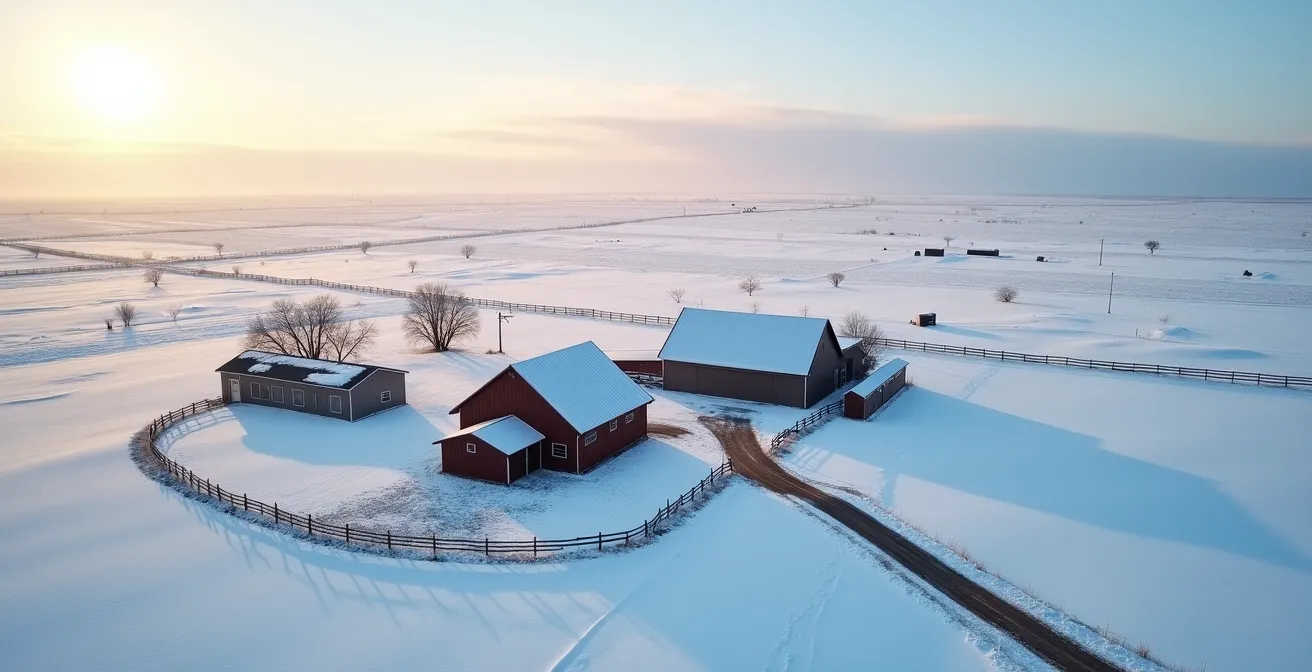
The biggest winter costs on a Prairie acreage are not your heating bills; they are the catastrophic failures of the private infrastructure you now own and must manage.
- Your well and septic systems are your sole responsibility, and their failure due to cold or neglect can be immediate, disruptive, and extremely costly.
- Being snowed-in or without a stable internet connection is not a mere inconvenience; it’s a logistical blackout that can halt your income and isolate you for days.
Recommendation: To thrive, you must shift from a city homeowner’s mindset to a proactive property manager’s mindset, actively mitigating risks before they become emergencies.
The dream of an acreage in the Prairies is powerful: endless skies, quiet nights, and space for your family to grow. For many fleeing the city, it represents a return to a simpler, more connected way of life. You’ve likely budgeted for the obvious changes—higher heating bills for a larger home, maybe a more powerful snowblower for the long driveway. These are the expected costs of admission to the rural club.
But what if the most expensive ‘costs’ of winter on your Alberta or Saskatchewan acreage don’t appear on a utility bill? The true financial and lifestyle shocks come not from predictable expenses, but from the failure of critical infrastructure you’ve never had to think about before. In the city, water, sewer, and internet are invisible, reliable services. In the country, they are systems you own, operate, and maintain. When they fail at -30°C, the cost isn’t just financial; it’s a direct hit to your safety, sanity, and ability to work.
This isn’t about scaring you away from your dream. It’s about equipping you with the experienced perspective of a rural property manager. We will shift the focus from paying bills to owning infrastructure. This guide breaks down the eight critical areas where a city mindset leads to the most common and costly rural reality checks, turning your dream property into a manageable, resilient home, no matter what a Prairie winter throws at you.
This article will guide you through the essential systems and logistical challenges you’ll face. By understanding these potential points of failure, you can proactively manage them and truly enjoy your new rural life.
Summary: The Acreage Owner’s Guide to Winter Infrastructure and Logistics
- Why well water testing is non-negotiable before buying rural land in Alberta
- How to extend your septic field’s life by 10 years with simple daily habits?
- Starlink or Fixed Wireless: which supports two people working from home in rural zones?
- The snow removal clause that could leave you stranded for 3 days in January
- How to lower insurance premiums by 20% when living 15km from a fire station?
- The step-by-step guide to draining pipes so they don’t burst at -30°C
- Why 2 feet of wet spring snow is more dangerous than 4 feet of dry powder
- How to protect your property title against ID theft and fraudulent mortgages?
Why well water testing is non-negotiable before buying rural land in Alberta
When you move to an acreage, you often become your own water utility company. It’s a fundamental shift that city dwellers are unprepared for. Data from Canadian government sources indicates that over 90% of rural Alberta residents rely on private well water for their daily needs. This isn’t city-treated water; it’s groundwater that can be affected by geology, agriculture, and its own infrastructure. Ignoring this makes your water supply a critical point of failure.
The assumption that “country water” is pure is a dangerous one. Environment Canada has found that a significant portion of wells across the country face issues. In Alberta and Saskatchewan, where groundwater is often highly mineralized, the numbers are even more stark. An estimated 30% or more of privately-owned wells may have water quality problems that could directly impact human health. The only way to know what’s in your water is to test it rigorously before you even consider purchasing a property.
A basic test is not enough. You must conduct comprehensive testing that looks for specific contaminants common to the Prairies. This isn’t just about taste or odour; it’s about safeguarding your family’s health from unseen risks lurking in your primary water source.
Your Essential Well Water Testing Plan
- Test for Health Indicators: Check for coliform bacteria (a sign of harmful microorganisms) and nitrate, which is especially hazardous for infants under six months old.
- Analyze Aesthetic & Functional Parameters: Test for sodium, chloride, sulphate, iron, and manganese. These can cause unpleasant taste and odour, stain laundry and fixtures, and even have laxative effects.
- Investigate Geological Contaminants: Given Prairie geology, consider specific tests for arsenic, selenium, and uranium, along with potential pesticide contamination from nearby agricultural activity.
- Establish a Testing Cadence: As recommended by Alberta’s official water guidelines, conduct basic testing at least annually. For shallow wells or surface water sources, seasonal testing is crucial to monitor for changes.
- Verify Your System: Test water from both the source (the well itself) and a tap inside the house. A discrepancy can indicate a problem with your pipes or a failing water treatment system.
How to extend your septic field’s life by 10 years with simple daily habits?
After becoming your own water utility, your next role is manager of your own private waste treatment facility. Your septic system isn’t a “set it and forget it” feature; it’s a living, biological system that can cost upwards of $20,000 to $40,000 to replace if it fails. The single biggest threat to its longevity in the Prairies is often misunderstood: winter soil compaction and frost. When vehicles, even a simple quad or lawn tractor, drive over the septic field in winter, they compact the snow and soil, driving frost deeper and potentially crushing critical drainage pipes.
Protecting the septic field is an active, not passive, task. Before the first significant snowfall, you must clearly mark the perimeter of the field with tall stakes. This visual reminder is crucial for you, your family, and any service providers who might visit your property. If early snow cover is thin, the risk of deep frost penetration increases. An effective, low-cost solution is to apply a thick layer of straw (12-18 inches) over the entire field area. This acts as a natural insulation blanket, trapping geothermal heat and preventing the ground from freezing as deeply.
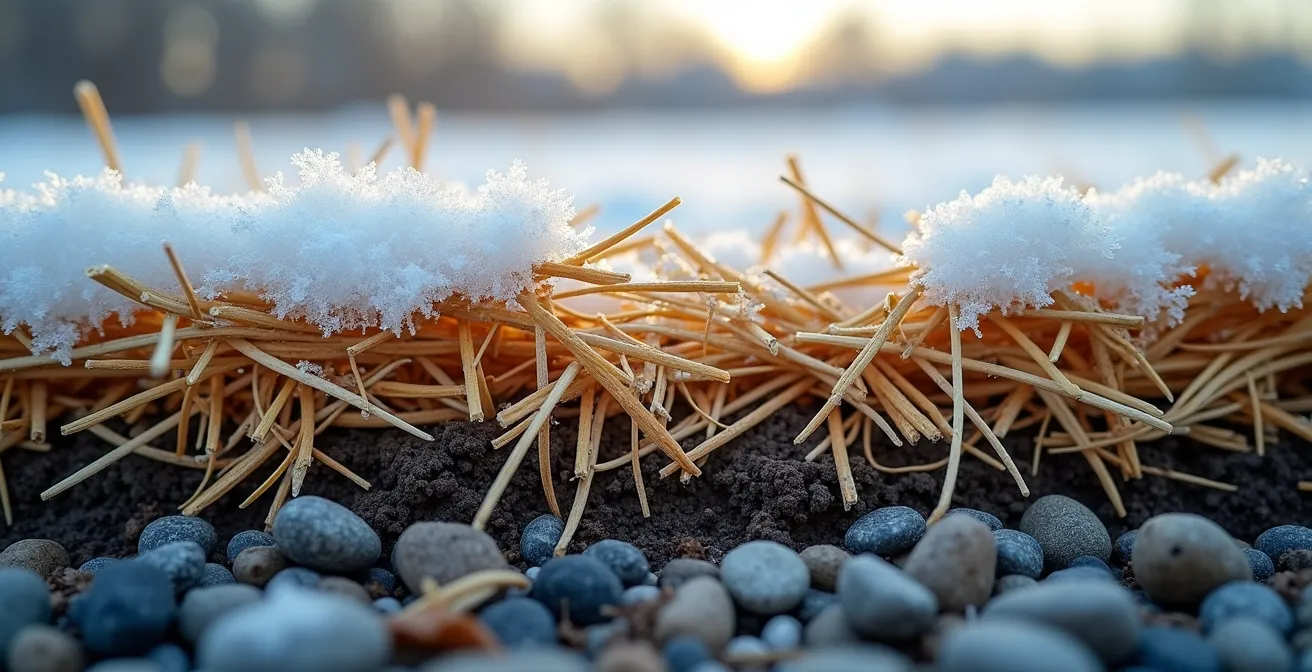
As the illustration shows, this protective layer is the barrier between the harsh winter elements and the delicate underground ecosystem of your septic system. Finally, a pre-winter pumping schedule is a wise investment. Having the tank pumped before the ground freezes solid ensures easy access for the service truck and prevents potential backups during the coldest months when a service call would be most difficult and expensive.
Starlink or Fixed Wireless: which supports two people working from home in rural zones?
For the modern acreage owner, a reliable internet connection is not a luxury; it is your lifeline to income, education, and communication. A common misconception for city movers is that you can simply “order internet.” The reality is a complex decision with significant trade-offs, especially when two people need to run VPNs, video calls, and cloud-based applications simultaneously. Your main contenders in rural Alberta and Saskatchewan are typically satellite services like Starlink and Fixed Wireless providers like Xplornet.
The choice involves more than just advertised speeds. Each technology has a distinct “point of failure” during a Prairie winter. Starlink’s performance can degrade significantly when its dish is covered in heavy, wet snow, and its snow-melt feature comes at the cost of increased electricity consumption. Fixed Wireless is less affected by snow on the ground but can be impacted by heavy whiteout conditions or ice buildup on the provider’s tower. Furthermore, Starlink’s satellite-based system can have moments of higher latency or brief outages that, while short, are just long enough to drop a critical VPN connection or freeze a video call.
Because neither solution is foolproof, the professional’s approach is to budget for redundancy. A true work-from-home setup on an acreage requires a primary connection and a robust secondary backup, usually a cellular data plan from a provider like Bell or Telus with a dedicated hotspot device. This isn’t an extravagance; it’s a necessary business expense to prevent a “logistical blackout” that could cost you a day’s work or a client’s trust.
This comparative table, based on insights from Calgary-based property managers, breaks down the key operational differences for a Prairie winter.
| Feature | Starlink | Fixed Wireless (Xplornet) |
|---|---|---|
| Weather Impact | Performance degrades with heavy wet snow on dish | Affected by whiteout conditions and tower icing |
| Snow Melt Feature | Available (increases electricity costs) | Not applicable |
| Latency | Higher, brief outages disrupt VPN | Generally lower, better for real-time applications |
| Installation | DIY possible, mounting hardware required | Professional installation, potential tower rental |
| Contract | No contract | Often requires contract with buyout penalties |
The snow removal clause that could leave you stranded for 3 days in January
On a city lot, a blizzard is an inconvenience. On a sprawling acreage with a long driveway, it’s a logistical barrier that can cut you off completely. New acreage owners often underestimate the sheer volume of snow and the commitment required to manage it. The first decision is between a significant capital investment—an upfront cost of $1,000 to $5,000 for a quality snowblower or a plow for your truck—or hiring a snow removal service. While a service seems like a simple solution, the “hidden cost” lies in the fine print of your contract.
Many rural snow removal contracts contain vague language that prioritizes commercial clients. A clause stating service will be provided “after the snow event has ended” could mean you’re waiting 24, 48, or even 72 hours after a major storm before your driveway is cleared. During a heavy January snowfall, this can leave you stranded, unable to get to work, school, or a grocery store. Furthermore, local municipalities are excellent at clearing main routes, especially school bus routes, but properties at the end of quiet range roads or township roads are officially the last priority. A three-day wait for the municipal plow is a realistic scenario you must be prepared for.
When negotiating a contract, you are not just buying snow removal; you are buying a guaranteed response time. Insist on specific language. Clarify where you are on the priority list and negotiate a guaranteed timeframe for service, especially in emergencies. For many, a hybrid approach works best: owning smaller equipment for immediate light clearing while relying on a contractor for the major, back-breaking work after a storm. Some neighbours even form co-ops to negotiate better rates and priority service, turning a shared problem into a community solution.
How to lower insurance premiums by 20% when living 15km from a fire station?
One of the jarring financial realities of rural living is the sticker shock on your home insurance premium. Being located far from a municipal fire hydrant and fire station automatically places your property in a higher risk category. An insurer might see your dream home as being 15 kilometers of winter roads away from help. However, you are not powerless. By shifting your mindset from a passive policyholder to an active risk manager, you can take concrete steps to significantly lower your premiums—often by 20% or more.
The key is to demonstrate to your insurer that you have mitigated the inherent risks of your location. The most impactful action you can take is installing a water source for firefighters. This could be a dry hydrant installed into a dugout or a large cistern (water tank) on your property. This single piece of infrastructure dramatically improves your Fire Underwriters Survey rating, which is a key factor in determining your premium. Secondly, adopting Alberta’s FireSmart program guidelines to create a defensible space around your home is crucial.
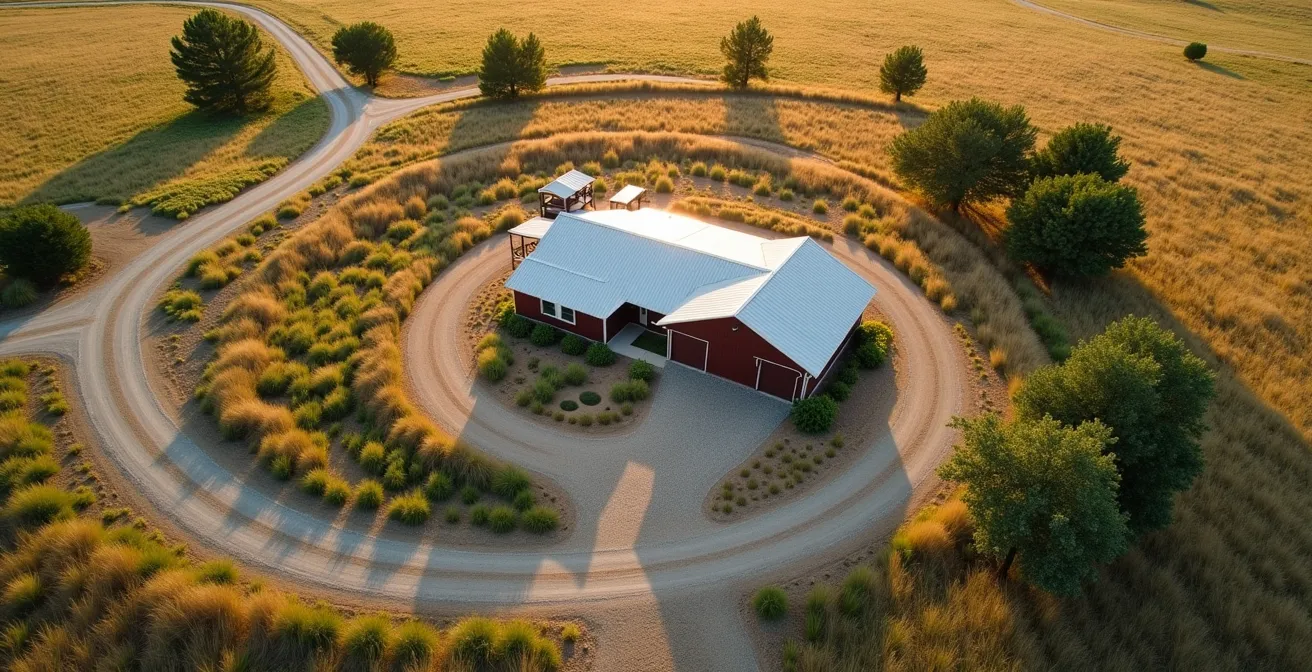
This involves managing vegetation in concentric zones around your house and outbuildings, as shown in the aerial view above. Using fire-resistant building materials, like a metal roof, also provides a significant credit. As you implement these measures, be proactive. Contact your insurance provider, provide documentation of the upgrades (photos, receipts), and ask for a policy reassessment. According to financial experts at leading Canadian comparison site Ratehub.ca, bundling home and auto insurance or asking about claims-free discounts can provide further savings.
The step-by-step guide to draining pipes so they don’t burst at -30°C
A burst pipe in a city home is a costly mess. A burst pipe in a rural barn, guest cabin, or even within the main house during a -30°C cold snap is a full-blown catastrophe. The “hidden cost” here is not just the price of a plumber, but the extensive and devastating water damage that can occur in a remote location where help might be hours away. Proper winterization is not an optional chore; it’s a critical preventative protocol to protect your property’s most vulnerable systems.
The process goes far beyond simply shutting off a valve. For any outbuildings like barns, shops, or guest cabins, you must use an air compressor to physically blow out every drop of water from the lines after draining them. Even “frost-free” outdoor hydrants can retain water and fail in deep freezes; they must be drained completely. The same applies to your property’s irrigation system, which requires a professional “blow out” to prevent water from freezing and cracking the underground pipes and components.
Inside the house, your defense continues. For any drains in sinks, showers, toilets, and even your dishwasher that will not be used for an extended period, you must pour a small amount of non-toxic plumbing antifreeze into them. This sits in the P-trap and prevents the water seal from freezing, expanding, and cracking the pipe. But the most critical advice for occupied homes during extreme cold spells is often the simplest. Property management experts advise that during extremely cold spells of -30°C or colder, you should let faucets connected to exterior walls drip slightly. This constant movement makes it much harder for water to freeze solid. Opening the cabinet doors under these sinks also allows warmer air from the house to circulate around the pipes, providing another layer of crucial protection.
Key Takeaways
- Embrace Infrastructure Ownership: Your well, septic, and driveway are not services—they are critical systems you are responsible for maintaining and protecting.
- Proactive Management Trumps Reactive Repair: The most significant “costs” are emergencies. A small investment in prevention (e.g., straw for a septic field, a backup internet plan) saves thousands in disaster recovery.
- Self-Reliance is a Learned Skill: The convenience of city life does not exist on an acreage. You must plan for logistical delays, from snow removal to emergency services, and build redundancy into your life.
Why 2 feet of wet spring snow is more dangerous than 4 feet of dry powder
After surviving the deep freeze of January, many new acreage owners breathe a sigh of relief when the milder, wetter snows of March and April arrive. This is a critical mistake. The “hidden cost” of late winter is the immense, concentrated weight of wet spring snow. While four feet of light, fluffy “dry” powder might look intimidating, it’s far less of a structural threat than two feet of saturated, “wet” snow. This heavy, water-laden snow can weigh up to 30 lbs per square foot, placing extreme stress on the roofs of your home, garage, and especially older barns or outbuildings.
This heavy snow cover also creates the perfect environment for another problem: snow mould. As noted by lawn care specialists in Calgary, this mould thrives in the cool, damp conditions under melting snow piles, particularly affecting common Prairie grasses like Kentucky bluegrass. It can leave your lawn with unsightly dead patches that require significant remediation in the spring. Raking your lawn and mowing it to half-height before winter is the best prevention, but actively removing long-standing snow piles in the spring can also help.
A proactive spring melt plan is essential. Before the rapid melt begins, you must clear accumulated leaves and debris from your gutters to prevent ice damming and water damage. Shovel snow away from your foundation to prevent seepage into your basement. Most importantly, walk your property and ensure all culverts and drainage ditches are clear of debris and ice. A blocked culvert can quickly turn a gentle melt into a localized flood, washing out driveways and damaging landscaping. Finally, test your sump pump before you need it to ensure it’s ready for the deluge.
How to protect your property title against ID theft and fraudulent mortgages?
Perhaps the most insidious “hidden cost” is one that has nothing to do with weather or maintenance, but with security and identity. Title fraud is a growing crime where a scammer uses stolen identity documents to pose as a homeowner, either selling the property to an unsuspecting buyer or, more commonly, securing a large mortgage against the property and disappearing with the funds. The homeowner is left with a massive lien against their title and a legal nightmare to unravel.
Rural acreage properties are uniquely vulnerable, especially those owned by “snowbirds” who are absent for the entire winter. The isolation and lack of daily oversight create a perfect environment for fraudsters.
Case Study: The Snowbird’s Vulnerability
According to insights from Calgary real estate professionals, rural properties are prime targets. The isolation means a fraudster can put a “For Sale” sign on your lawn, and it might be weeks before a neighbour even notices or questions it. They can show the property, pose as the owner or a realtor, and initiate fraudulent transactions with minimal risk of being caught in the act. The legitimate owner may not discover the fraud until they receive a foreclosure notice months later.
Protecting yourself requires a proactive, modern approach to security. The most robust defense is purchasing title insurance when you buy your property. Unlike other insurance, this is a one-time fee that protects you against title defects and fraud for as long as you own the home. Additionally, several provinces, including Alberta and Saskatchewan, offer land titles alert systems that can notify you via email or text if any documents are registered against your property title. This gives you an early warning to act before a fraudulent transaction is completed. In an age of digital identity, securing your property’s legal ownership is the final, and most critical, act of a vigilant acreage manager.
Start by auditing your property not as a home, but as a system of critical infrastructure. This proactive manager’s mindset is your best defence against the hidden costs and your greatest asset in truly enjoying the freedom of Prairie acreage life.