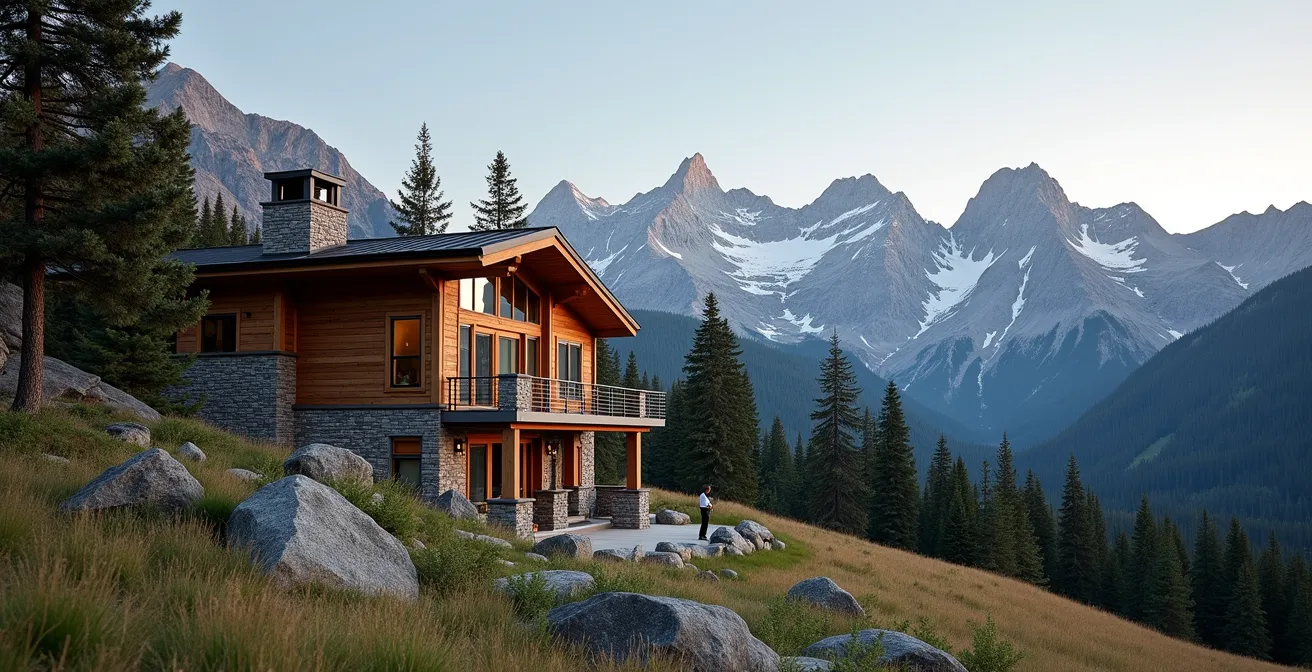
In summary:
- Banff’s “Need to Reside” clause is non-negotiable and exists to preserve the community; vacation homes are not permitted.
- Canmore offers more flexibility, but property use is strictly dictated by zoning (Tourist Home vs. Residential).
- Short-term rentals (STRs) in Canmore are only legal in designated Tourist Home zones and require a business license.
- Beyond legal rules, owning in the Rockies involves a responsibility to manage wildlife, fire risk, and extreme weather.
- Proving primary residency to the CRA involves more than just an address; it requires deep community and financial integration.
The dream of a mountain home in the Canadian Rockies—crisp air, jaw-dropping vistas, and world-class adventure at your doorstep—is a powerful one. For many, the Bow Valley, encompassing Canmore and Banff, represents the pinnacle of this lifestyle. Yet, prospective buyers quickly encounter a web of regulations that seem designed to confuse: “Need to Reside” clauses, complex zoning bylaws, and strict short-term rental rules. It’s easy to get lost in the legalese and wonder if your dream is even possible.
Most advice simply states the rules: Banff is for locals, and Canmore has specific zones. While true, this misses the fundamental point. These regulations aren’t arbitrary barriers; they are the bedrock of a deliberate strategy to protect the region’s delicate balance. Owning property here isn’t just a real estate transaction; it’s an implicit stewardship contract with a UNESCO World Heritage site and the communities within it. Unlike other resort towns, the policies in Banff and Canmore are designed to maintain a vibrant community fabric and preserve ecosystem integrity above all else.
But what if the key to unlocking your mountain dream wasn’t just learning the rules, but understanding the philosophy behind them? This guide moves beyond the surface-level restrictions. We will explore the practical realities of mountain homeownership, from the logic behind residency requirements to the tangible steps you must take to protect your home from wildlife and wildfires. By embracing the mindset of a steward, you can navigate the process not as a frustrated outsider, but as an informed and responsible future resident.
This article breaks down the essential considerations for any prospective buyer in the Bow Valley. The following sections provide a clear roadmap to understanding the unique responsibilities and opportunities of owning property in this iconic Canadian landscape.
Summary: A Guide to Canmore & Banff’s Unique Property Ownership Rules
- How to landscape your yard to avoid attracting bears and cougars?
- Can you actually Airbnb your Canmore condo legally to cover costs?
- AWD vs 4WD: what do you really need to access your driveway in the foothills?
- FireSmart principles: cutting trees to save your house vs keeping the forest look
- When to block off your calendar to capture the highest peak rates in the Rockies?
- What is the minimum roof pitch required for snow to slide off naturally?
- How to prove residency to avoid the 25% Non-Resident Speculation Tax?
- How to manage a remote cottage property without spending every weekend fixing things?
How to landscape your yard to avoid attracting bears and cougars?
Owning a home in the Rockies means accepting that you are a guest in a vast, wild ecosystem. Your property is not a suburban bubble; it is part of a wildlife corridor. As a homeowner, your landscaping choices directly impact the safety of both your family and the local animal population. The goal is not to create an impenetrable fortress, but to make your yard uninteresting and unattractive to wildlife, particularly bears and cougars. This is a core part of your stewardship contract with the environment.
The most significant attractant is food. This includes obvious sources like garbage and barbecues, but also natural ones. Fruit-bearing trees and shrubs (like berry bushes or crab apple trees) are essentially bear buffets and should be avoided entirely. Instead, opt for native, non-fruit-bearing species that are adapted to the local climate. Bird feeders are also a major problem; they attract birds, which attract squirrels, which attract predators. In many mountain communities, they are strongly discouraged or outright banned during bear season.
Beyond food, wildlife seeks shelter. Thick brush, dense shrubs, and low-hanging tree branches near your foundation create perfect hiding spots for cougars. By clearing these areas and maintaining a clear line of sight around your home, you eliminate the element of surprise. Gravel pathways or borders can also act as a deterrent, as the noise of walking on them can alert both you and the animal to each other’s presence. In a place like Banff National Park, which is home to 53 species of mammals including grizzly bears, wolves, and cougars, these small landscaping decisions have a massive collective impact on human-wildlife coexistence.
Ultimately, a wildlife-aware yard is a clean, open, and boring yard from an animal’s perspective. It’s a fundamental shift in thinking from cultivating a lush garden to maintaining a defensible and safe space that respects the natural inhabitants.
Can you actually Airbnb your Canmore condo legally to cover costs?
The short answer is yes, but only if you buy the right type of property in the right location. This is arguably the most misunderstood aspect of the Canmore real estate market and a primary example of how the town works to protect its community fabric. Unlike many tourist destinations, Canmore has drawn a very hard line in the sand: you cannot run a short-term rental (like Airbnb or Vrbo) out of a property zoned for residential use. Doing so is illegal and subject to heavy enforcement.

To legally operate an STR, you must purchase a property within a “Tourist Home” zone. These properties are specifically designated for visitor accommodation and are often found in purpose-built condo-hotel developments. While this may seem restrictive, the zoning philosophy is clear: it concentrates the impacts of tourism and prevents residential neighbourhoods from being hollowed out by vacation rentals, ensuring long-term housing remains available for the local workforce. Furthermore, even with the correct zoning, you must maintain a valid business license and pay commercial property taxes. As a case study shows, a Canmore tourist home’s tax rate is significantly higher, and fines for illegal listings start at $2,500 for a first offense, quickly escalating from there.
The town’s commitment to enforcement is serious. As the industry has grown, so has the oversight. The recent injection of federal funding, with the Town of Canmore set to receive a portion of a $45.9 million fund over three years for STR enforcement, signals a continued crackdown on illegal operations. For a potential buyer, this means there are no grey areas or loopholes. Your ability to generate rental income is entirely dependent on buying a property with the correct legal designation from the outset.
Therefore, if offsetting costs with rental income is part of your plan, your property search must be exclusively focused on units within the Tourist Home zone. Attempting to circumvent these rules is not only a poor financial bet but also disrespects the community framework that makes Canmore a desirable place to live.
AWD vs 4WD: what do you really need to access your driveway in the foothills?
The question of All-Wheel Drive (AWD) versus four-wheel drive (4WD) is a classic debate in any snowy region, but in the Rockies, it’s about more than just getting to the ski hill. It’s about pragmatic preparedness for steep, icy driveways, unplowed side streets after a surprise dump, and variable highway conditions. While both systems provide power to all four wheels, they function differently, and the right choice depends on your specific property and lifestyle.
Most modern SUVs and crossovers come with AWD. This system is typically “on” all the time, automatically detecting wheel slip and sending power to the wheels with the most traction. It’s seamless and efficient, making it perfect for driving on plowed or lightly snow-covered roads. For the majority of homeowners in Canmore or Banff whose properties are on maintained town roads, a good AWD vehicle is more than sufficient for daily life. However, its biggest weakness can be deep, heavy snow or slick ice where the system’s reactive nature might not provide the proactive grunt needed.
This is where 4WD, common in trucks and more rugged SUVs, shines. A true 4WD system can be manually engaged, locking the front and rear driveshafts together to provide continuous power to all four wheels. More importantly, it often includes a “low-range” gear (4-Lo) that multiplies torque for crawling up or down extremely steep, slippery surfaces. If your dream property is up a long, private, and steeply graded driveway in the foothills, 4WD provides an extra layer of security and capability that AWD can’t match. The trade-off is that 4WD is less fuel-efficient and must be disengaged on dry pavement to avoid damaging the drivetrain.
The following table, based on expert analysis, breaks down the key differences for mountain conditions:
| Feature | AWD | 4WD |
|---|---|---|
| Best For | Plowed roads, light snow | Deep snow, unplowed roads |
| Engagement | Automatic | Manual selection |
| Fuel Efficiency | Better | Lower |
| Traction Benefit | 2x acceleration grip | 2x acceleration grip + low range |
| Daily Driving | Excellent | Must disengage on dry pavement |
However, the most crucial factor in winter traction isn’t the drive system—it’s the tires. A proper set of winter tires provides far more grip for stopping and turning on ice and snow than all-season tires on any vehicle. Shockingly, Consumer Reports found that less than 15% of AWD or 4WD vehicle owners actually use winter tires, effectively neutralizing much of their vehicle’s winter capability. An AWD car with winter tires will almost always outperform a 4WD truck on all-seasons in typical winter driving situations.
The final verdict for a Rockies homeowner? A quality set of winter tires is non-negotiable. Beyond that, choose AWD for convenience and efficiency on most roads, but opt for 4WD if your property access involves challenging, unplowed, or exceptionally steep terrain.
FireSmart principles: cutting trees to save your house vs keeping the forest look
The lush, forested landscape is a huge part of the allure of a mountain home. However, that same beauty represents a significant risk: wildfire. Living in the Wildland Urban Interface (WUI) comes with a responsibility to actively manage your property to be fire-resistant. This is where FireSmart Canada’s principles come in, offering a proven framework that balances aesthetics with safety. It’s a critical part of upholding your stewardship contract, as protecting your own home also helps protect your neighbours and the entire community.
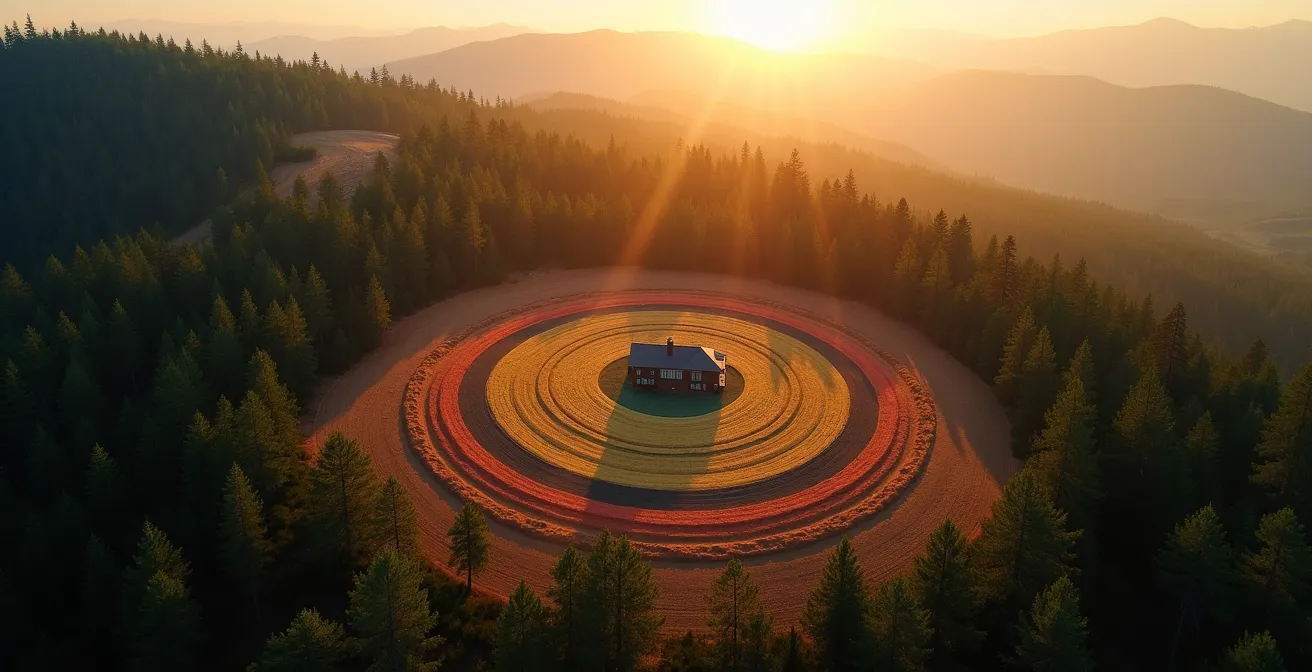
Many homeowners resist the idea of cutting trees, fearing it will destroy the “forest look” they bought the property for. This is a misconception based on the idea that the fire itself is the primary threat. As FireSmart Canada experts emphasize, the real danger often comes from the sky. This is powerfully summarized in their official guidance:
More than 90% of homes damaged or destroyed by wildfires are ignited by embers. Maintaining a 1.5 metre non-combustible surface around your entire home will reduce the chance of wind-blown embers igniting materials near your home.
– FireSmart Canada, The Seven FireSmart Disciplines
This single fact reframes the entire approach. The main goal of FireSmart landscaping isn’t to create a barren clear-cut, but to manage the immediate vicinity of your home to deny embers a place to land and ignite. This starts with creating a 1.5-metre non-combustible zone directly around your foundation, using materials like gravel, rock, or pavers. Within this zone, there should be no flammable materials: no bark mulch, no shrubs, no firewood, and no wooden decks attached directly to the house without proper protection.
The next zone, extending from 1.5 to 10 metres, is about “fuel reduction.” It doesn’t mean removing all trees. It means choosing fire-resistant species (like aspen over pine), trimming lower branches to prevent a “ladder” effect, and spacing trees so their crowns don’t touch. You can maintain a beautiful, treed lot while still being FireSmart. It’s about being strategic—creating a landscape that slows a fire’s spread and gives firefighters a defensible space to work.
Ultimately, being FireSmart is not a choice between safety and aesthetics; it’s about intelligently integrating safety into the landscape. A well-managed property can be both beautiful and resilient, fulfilling your responsibility to the broader ecosystem.
When to block off your calendar to capture the highest peak rates in the Rockies?
For owners of legal Tourist Home properties in Canmore, maximizing revenue requires more than just listing on Airbnb; it demands a strategic approach to calendar management. The Rockies have distinct high, low, and shoulder seasons, each attracting a different type of guest. Understanding these patterns is key to setting dynamic pricing that captures the highest possible rates during peak demand while maintaining occupancy during quieter periods.
The two primary peak seasons are winter and summer. The winter peak, as outlined by local property management experts, generally runs from December through March. Within this period, the weeks surrounding Christmas, New Year’s, and the Alberta Family Day long weekend in February are premium. These are times when you can, and should, command your highest nightly rates and often implement minimum stay requirements (e.g., 3-5 nights) to maximize booking value.
The summer peak is just as crucial, spanning from late June through August. Driven by hiking, sightseeing, and family vacations, demand is extremely high, and properties often book out months in advance. This is another period for premium pricing, especially around long weekends like Canada Day and the August Heritage Day. Savvy owners will also align their pricing with local events like the Canmore Folk Music Festival, which creates a concentrated surge in demand.
The “shoulder seasons”—April-May and September-October—present a different opportunity. While overall occupancy and nightly rates are lower, these periods are popular with digital nomads, couples without children, and long-stay guests looking for value. Attracting this demographic requires a different strategy: offering reduced weekly or monthly rates can secure a stable income stream when transient weekend traffic is low. This also includes being flexible with last-minute pricing to capture weekend travelers from nearby Calgary who make spontaneous trip decisions based on the weather.
Your Action Plan: Strategic Pricing for a Canmore STR
- Identify Premium Dates: Block and price winter holidays (Christmas, New Year’s) and Alberta long weekends (e.g., Family Day) at your highest rates.
- Optimize for Summer: Analyze peak hiking season (July/August) and local festival dates to implement premium summer pricing and minimum night stays.
- Target Shoulder Seasons: Create attractive weekly or monthly discounted rates for April-May and September-October to appeal to digital nomads and long-stay guests.
- Capture the Local Market: Implement a flexible pricing strategy for weekends to attract last-minute travelers from Calgary and Edmonton.
- Bundle for Maximum Revenue: During the busiest periods, encourage longer stays by offering a slight discount for booking 5-7 nights, ensuring full occupancy and reducing turnover costs.
By treating your calendar as a strategic tool rather than a static grid, you can significantly boost your property’s financial performance while catering to the diverse rhythms of Rocky Mountain tourism.
What is the minimum roof pitch required for snow to slide off naturally?
In the context of mountain architecture, a roof isn’t just a cover; it’s an active tool for managing one of the biggest challenges of the environment: snow load. The weight of accumulated snow can be immense, posing a structural risk to buildings. While all homes in the Rockies are engineered to handle a specific snow load, a key element of pragmatic preparedness is designing a roof that sheds snow naturally, reducing both the structural strain and the need for manual roof raking.
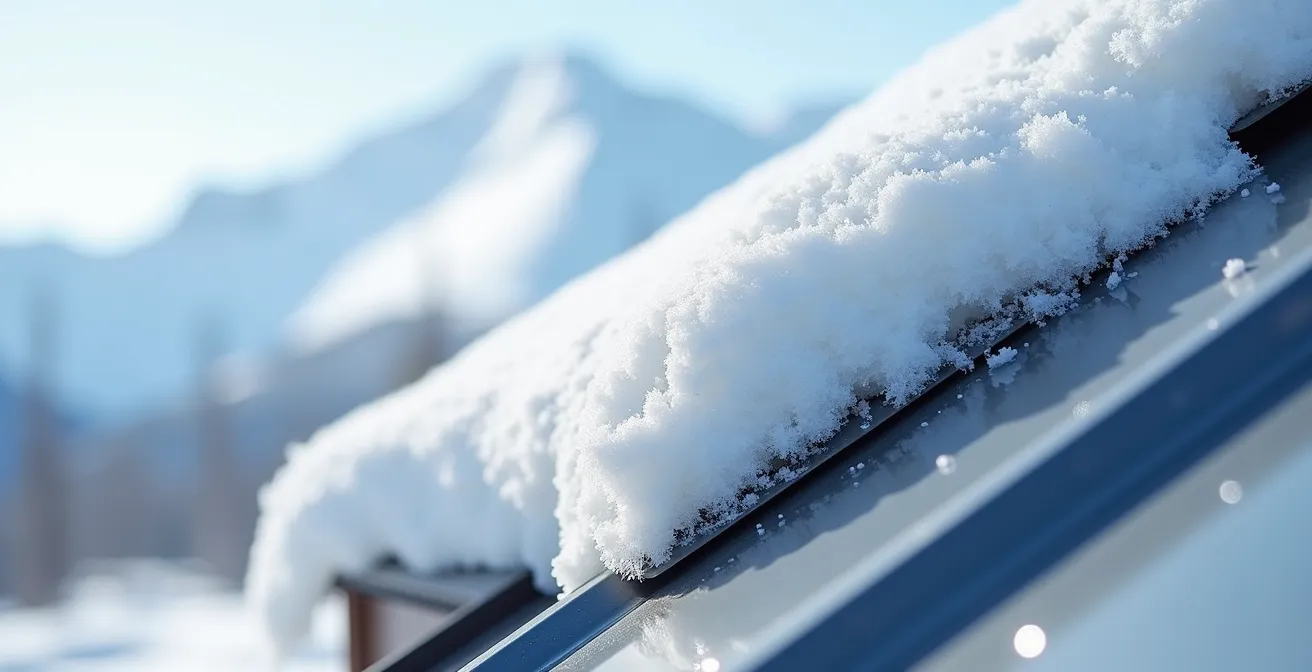
There isn’t a single magic number for roof pitch, as the ideal angle depends heavily on the roofing material. Pitch is expressed as a ratio of “rise” over “run,” where a 6:12 pitch means the roof rises 6 inches for every 12 inches of horizontal distance. For a very slick surface like a standing-seam metal roof, snow can begin to slide off at a pitch as low as 4:12. This material is highly favoured in modern mountain homes for its durability and excellent shedding properties. The smooth, vertical seams provide minimal friction, allowing gravity and a little sunshine to do the work.
However, for more traditional and textured materials like asphalt shingles, a much steeper pitch is required. Snow will tend to stick to the granular surface of shingles. To encourage natural shedding, architects will often specify a pitch of 10:12 or even 12:12 (a 45-degree angle) for shingled roofs in heavy snow areas. At this angle, the force of gravity is strong enough to overcome the friction of the shingle surface, causing snow to avalanche off in sheets after a storm.
Beyond the pitch and material, other design elements are critical. Any feature that impedes the snow’s path—such as skylights, chimneys, or complex roof valleys—can create areas of accumulation and increase the risk of ice dams. This is why simple, steep gable roofs are a hallmark of mountain design. They provide a clean, unobstructed path for snow to slide off, effectively using the building’s form to manage a powerful force of nature.
For a prospective buyer, looking at the roof pitch and material is a quick way to gauge how well a home has been designed for its environment. A steep, simple, metal roof is a clear sign of a home built with a deep understanding of mountain realities.
How to prove residency to avoid the 25% Non-Resident Speculation Tax?
This question cuts to the core of property ownership in the Bow Valley, but it actually combines two separate—though related—concepts: Banff’s “Need to Reside” clause and the broader tax implications of primary versus secondary homes. Understanding both is essential. First and foremost, the “Need to Reside” clause in Banff National Park is not about taxes; it’s about eligibility to live there at all.
As Parks Canada explicitly states, the eligible residency provisions are in place to ensure that housing in the national park is used for community purposes, not as recreational or second homes. Their goal is to maintain a sustainable community fabric by prioritizing housing for those who work and have strong ties to the park. To be an eligible resident in Banff, you generally need to meet criteria such as working in the park or owning a business there. You cannot simply buy a property to use as a vacation home. If you don’t meet these strict requirements, you cannot legally occupy a residence in Banff, full stop.
For properties outside the national park, such as in Canmore, the question shifts to one of taxation, particularly for foreign buyers or those with multiple properties. The Canada Revenue Agency (CRA) has specific rules to determine a property’s status as a “primary residence.” This designation carries significant tax benefits, most notably the exemption from capital gains tax upon selling. Proving a home is your primary residence is about more than just owning it; it’s about demonstrating that it is the central hub of your life. This is not a simple box to tick; it requires a pattern of behaviour and documentation.
The CRA looks for a collection of evidence to support your claim. A single piece of mail isn’t enough. They want to see a comprehensive integration into the community at that address. This means transferring official documents, engaging in local life, and making the property the clear centre of your domestic world.
Checklist: Proving Your Primary Residence to the CRA
- Update Government ID: Ensure your driver’s license and provincial health card (e.g., Alberta Health Care) are registered to your new Canmore or Banff address.
- File Your Taxes: Your annual income tax return is a primary document; it must list the property as your primary residence address.
- Maintain Utility Bills: Keep records of electricity, gas, internet, and cable bills in your name for the property.
- Register to Vote: Enrolling on the voters’ list for municipal, provincial, and federal elections at that address is strong proof.
- Demonstrate Community Ties: Document your life there through memberships in local clubs, libraries, or volunteer organizations as supporting evidence.
In short, you must first be legally eligible to live in Banff. Then, for any property you wish to declare as your primary residence, you must build a comprehensive case for the CRA that proves it is truly the place you call home.
Key Takeaways
- Residency is a Privilege: In Banff, the right to reside is earned through work or business, not bought. This preserves the town’s character and is non-negotiable.
- Zoning is Law in Canmore: The ability to use a property for short-term rentals is strictly determined by its “Tourist Home” zoning, with heavy fines for violations.
- Ownership is Stewardship: A Rockies home comes with active duties, including managing wildlife attractants (FireSmart landscaping) and designing for extreme weather (snow loads, proper vehicles).
How to manage a remote cottage property without spending every weekend fixing things?
The dream of a mountain getaway can quickly turn into a part-time job if not managed correctly. For owners who don’t live in their property full-time, the key to enjoying it—rather than constantly working on it—is pragmatic preparedness through a combination of smart systems and a reliable local team. Remote management is not about being absent; it’s about having the right eyes, hands, and technology on the ground when you can’t be.
The first step is building your local support network. This is non-negotiable. At a minimum, you need three key people:
- A trusted property manager or watch service: This person is your primary point of contact. They can perform regular checks for leaks, pests, or storm damage, especially after extreme weather events. For STRs, they are essential for guest management.
- A reliable cleaner: A good cleaning service that understands the standards of a vacation property is worth its weight in gold, ensuring a positive experience for you and any guests.
- A go-to handyman: From a leaky faucet to a furnace that won’t start, having a skilled and responsive tradesperson on call can prevent a small issue from becoming a weekend-ruining disaster.
These relationships are built on trust and fair compensation; they are your insurance policy against stress.
The second pillar of remote management is technology. Modern smart home devices are game-changers for second-home owners. A smart thermostat (like Nest or Ecobee) allows you to monitor and control your home’s temperature remotely, preventing frozen pipes in winter while saving on energy costs. Smart locks with keypads eliminate the need for physical keys, allowing you to grant temporary access to your cleaner, handyman, or guests from anywhere. Finally, water leak sensors placed near washing machines, hot water tanks, and sinks can send an alert to your phone at the first sign of moisture, potentially saving you from catastrophic water damage.
By investing in a local team and smart technology upfront, you transform your role from a constant troubleshooter to a relaxed owner. This proactive approach ensures that when you arrive for your mountain escape, you can spend your time on the trails, not on the phone with a plumber.