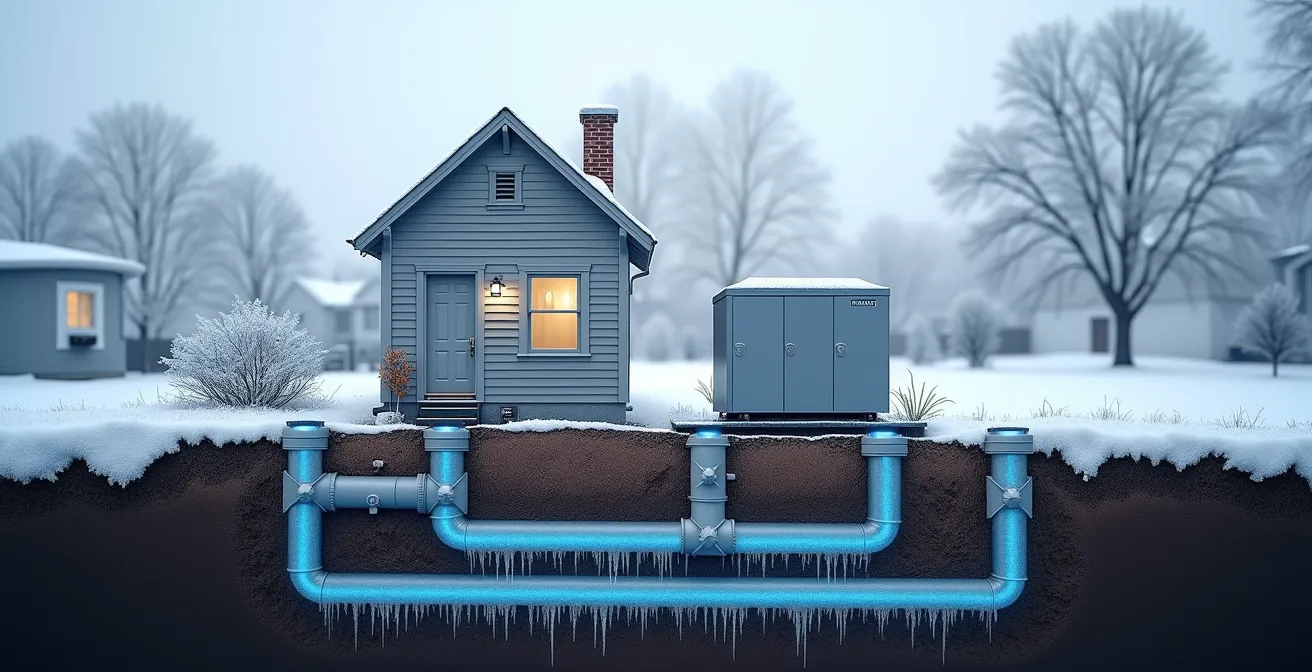
In Ontario, geothermal’s true return on investment transcends simple energy savings; it’s a strategic financial decision that builds long-term property value and resilience against inevitable carbon-cost increases.
- Geothermal leverages stable ground temperatures for unmatched efficiency, cutting summer cooling energy use by up to 70% compared to conventional air conditioning.
- A single geothermal installation is designed to last over 50 years, while a comparable air source heat pump (ASHP) system may require 2-3 full replacements in that same timeframe, dramatically altering the lifecycle ROI.
Recommendation: For homeowners with the capital, prioritizing a geothermal system is the most effective way to secure long-term asset protection and insulate your finances from future energy and regulatory volatility.
As an Ontario homeowner considering a move away from fossil fuels, the debate between a geothermal system and an air source heat pump (ASHP) often boils down to a single question: is the massive upfront cost of geothermal really worth it? The common wisdom suggests a simple trade-off: ASHPs are cheaper to install, while geothermal offers better long-term operational savings. This is true, but for the discerning, eco-conscious homeowner with a significant budget, this perspective is dangerously incomplete.
Focusing only on the initial quote and the monthly bill ignores the more critical financial variables that will define your home’s value and costs over the next few decades. The conversation must evolve beyond a simple payback period. We need to analyze these systems as long-term assets within the specific economic and regulatory landscape of Ontario. This means accounting for the total lifecycle cost, the impact of embodied energy, and, most importantly, the financial risk posed by upcoming Net Zero building codes.
The real key to this decision isn’t about which system saves you more money next year; it’s about which system best functions as a financial hedge against future uncertainty. This analysis re-frames the choice not as a simple appliance purchase, but as a strategic investment in your property’s resilience and future marketability. We will dissect the physical, financial, and regulatory factors to reveal the true, comprehensive ROI for each technology in an Ontario climate.
For those who prefer a visual primer on the core technology, the following video offers a foundational refresher on how heat pumps work before we delve into the advanced strategic comparison.
To provide a clear, structured analysis for your investment decision, this guide is organized to address the most critical questions you’ll face. We will move from the practical installation considerations to the long-term financial and regulatory implications, giving you a complete picture for a confident choice.
Summary: Geothermal vs. ASHP Investment Analysis for Ontario
- Vertical boreholes or Horizontal loops: which fits your lot and budget?
- How to connect a geothermal system to existing ductwork without losing pressure?
- How to stack the Canada Greener Homes Loan with geothermal incentives?
- The myth of leaking loops: why modern HDPE pipes last 50+ years underground
- How to use your geothermal loop for virtually free air conditioning in summer?
- At what electricity price does a hybrid heat pump switch back to gas?
- How to spot “eco-friendly” marketing that ignores embodied energy?
- How will the upcoming 2030 Net Zero building codes impact the resale value of homes built today?
Vertical boreholes or Horizontal loops: which fits your lot and budget?
The first major decision for any geothermal project is the ground loop configuration, which is dictated almost entirely by two factors: your property’s available space and your budget. This is the foundational component of your system, responsible for exchanging heat with the earth. In Ontario, the choice between vertical boreholes and horizontal loops often defines the project’s feasibility from the outset. Vertical boreholes involve drilling deep into the ground, making them ideal for urban and suburban lots in places like Toronto or Ottawa where space is at a premium. While they have a minimal surface footprint, the specialized drilling equipment required makes them the more expensive option.
Conversely, horizontal loops consist of pipes laid in trenches a few metres underground. This method requires significant land area—often half an acre or more—making it a viable choice primarily for rural properties, such as those in Muskoka or the countryside. The installation involves excavation rather than deep drilling, which generally results in lower upfront costs. However, the land is disturbed significantly during installation and must remain unobstructed long-term.
The following table provides a clear comparison of installation costs and requirements specific to the Ontario market, helping you identify which system aligns with your property and financial planning. While geothermal installation carries a significant premium over traditional systems, this initial cost is the entry point to decades of energy savings and asset enhancement.
| System Type | Typical Lot Size Required | Installation Cost (Ontario) | Best For |
|---|---|---|---|
| Vertical Boreholes | Small (urban lots) | $19,500-$40,000 | Toronto, Ottawa urban areas |
| Horizontal Loops | Large (0.5+ acres) | $15,000-$25,000 | Muskoka, rural properties |
How to connect a geothermal system to existing ductwork without losing pressure?
For many homeowners in Ontario, the prospect of retrofitting a geothermal system into a house with existing forced-air ductwork is a major consideration. A common concern is whether the current ducts can handle the specific airflow requirements of a geothermal unit without significant efficiency loss. Geothermal systems operate differently from traditional furnaces; they deliver a larger volume of air at a more moderate temperature. A successful retrofit hinges on ensuring your ductwork can accommodate this higher CFM (cubic feet per minute) without creating backpressure or noisy, inefficient delivery.
The primary issue is often undersized or leaky ductwork. If the ducts are too small, the system’s blower must work harder, negating energy savings. Leaks in plenum joints or poorly sealed connections can lead to a significant loss of conditioned air into unconditioned spaces like basements or attics. Therefore, a thorough ductwork audit is not just recommended; it’s essential for achieving the advertised efficiency of your geothermal investment. This involves calculating the required airflow, verifying duct dimensions, and sealing the entire system meticulously.

As seen in a professional installation, the process often involves replacing sections of flexible ducting with rigid metal, which offers less resistance to airflow. All joints and seams must be sealed with mastic or high-quality foil tape to ensure the system is airtight. Finally, ensuring there are adequate return air pathways is critical to creating a balanced pressure system where air is supplied and returned at the correct rate. Without these steps, you risk turning a high-efficiency machine into a mediocre performer.
Your Action Plan: Ductwork Audit for Geothermal Retrofit
- Calculate Airflow Needs: Work with your HVAC technician to determine the target airflow, typically calculated at 400 CFM per ton of the system’s refrigeration capacity.
- Inventory and Assess Ducts: Measure the size of your existing main trunk lines and branches to verify they can handle the required CFM without excessive velocity or pressure drop.
- Seal All Connections: Methodically seal all joints in the plenums, take-offs, and duct connections using mastic sealant to eliminate pressure loss.
- Upgrade Problematic Ducting: Identify and replace crushed, undersized, or excessive lengths of flexible ducting with smooth, rigid metal ducts to improve airflow.
- Verify Return Air Paths: Ensure there are enough large, unobstructed return air vents throughout the home to allow for balanced air pressure and prevent starving the system.
How to stack the Canada Greener Homes Loan with geothermal incentives?
The high upfront cost of a geothermal system is its single greatest barrier, but strategic use of government programs can dramatically alter the financial equation for Ontario homeowners. The key is not just to use one incentive, but to “stack” federal loans with provincial rebates to minimize out-of-pocket expenses and accelerate your return on investment. The cornerstone of this strategy is the federal government’s program, which is a significant financing tool. An official overview confirms the Canada Greener Homes Loan offers up to $40,000 interest-free over 10 years for eligible retrofits, including geothermal installations.
This loan can then be combined with provincial incentives. For instance, in Ontario, homeowners can benefit from additional rebates that directly reduce the principal cost of the project before financing is even considered. According to recent reports, Ontario’s IESO offers up to $10,000 for ground source heat pumps, which you can apply for to lower the total project cost that you’ll need to finance. By applying the IESO rebate first, you reduce the overall loan amount required from the Greener Homes program, making the entire project more manageable.
This stacking creates a powerful financial synergy. You lower the capital cost with the rebate, then finance the remaining balance with an interest-free loan. In many cases, the monthly energy savings from the geothermal system can exceed the monthly loan payment, creating a positive cash flow from day one.
Case Study: Ontario Homeowner Financing Example
Consider a homeowner with a $30,000 geothermal installation. After receiving a $10,000 IESO rebate, the remaining cost is $20,000. They finance this amount using the Canada Greener Homes Loan. This results in 120 interest-free monthly payments of approximately $167. If the new geothermal system saves them $250 per month on heating and cooling costs, they experience an immediate positive cash flow of $83 per month. After the 10-year loan is fully paid off, their monthly savings jump to the full $250, demonstrating a clear and profitable investment path.
The myth of leaking loops: why modern HDPE pipes last 50+ years underground
A persistent fear among prospective geothermal owners is the nightmare scenario of an underground leak. The thought of having to excavate a landscaped yard to repair a buried pipe is enough to deter many from the technology. However, this concern is largely a relic of the past, based on outdated materials and installation techniques. Modern geothermal ground loops are constructed from a material that has virtually eliminated this risk: High-Density Polyethylene (HDPE). This is not ordinary plastic; it’s an incredibly durable, flexible, and inert material engineered for extreme conditions.
The key to HDPE’s longevity is its method of connection. Sections of pipe are not clamped or glued together; they are joined via thermal fusion, where the pipe ends are heated and melted together to form a single, continuous piece of plastic. This creates a joint that is as strong, or even stronger, than the pipe itself, making it leak-proof for its entire lifespan. The material’s inherent flexibility allows it to withstand ground shifting and the intense freeze-thaw cycles common in Ontario without cracking or becoming brittle. As experts in the field note, this resilience is a core feature of the material.
HDPE conduit withstands freeze-thaw cycles and continuous subzero temperatures without cracking.
– Chapman Electric, Geothermal HDPE Pipe Technical Specifications
Manufacturers are so confident in this technology that they back it with remarkable guarantees. For example, leading pipe manufacturers confirm that CenFuse HDPE 4710 pipes come with a 50-year non-prorated warranty. This level of security means the underground portion of your geothermal system—the most difficult and expensive part to access—is effectively a maintenance-free asset designed to outlast nearly every other component of your home. The “leaking loop” is a myth that modern engineering has decisively busted.
How to use your geothermal loop for virtually free air conditioning in summer?
While geothermal systems are famous for their heating efficiency in cold Ontario winters, one of their most significant yet undersold benefits is their ability to provide remarkably inexpensive cooling in the summer. This isn’t just standard air conditioning; it’s a fundamentally more efficient process that leverages the free, stable temperature of the earth. While summer air temperatures in Ontario can soar above 30°C, the ground just a few metres below the surface remains at a constant, cool 6-11°C. A geothermal system uses this massive temperature difference to its advantage.
Instead of a conventional air conditioner’s struggle to dump heat into already hot outdoor air, a geothermal system simply circulates fluid through its underground loop, efficiently transferring your home’s indoor heat into the cool earth. The earth acts as a massive, natural heat sink. Because the temperature difference between your home and the cool ground is so large, the system’s compressor—the primary energy consumer in any AC unit—has to do very little work. This results in a massive reduction in electricity consumption. In fact, performance data shows that geothermal cooling systems consume 50-70% less electricity than conventional high-efficiency air conditioners.

This process is not only energy-efficient but also places far less strain on the equipment, contributing to the system’s long lifespan. The outdoor condenser unit, a common failure point for ASHPs due to its exposure to weather and debris, is completely eliminated. For an Ontario homeowner, this translates to a quiet, reliable, and incredibly cheap source of summer cooling, turning a major seasonal expense into a negligible one. Your geothermal loop is not just a winter heating source; it’s a year-round energy-saving asset.
At what electricity price does a hybrid heat pump switch back to gas?
For homeowners not ready to commit fully to geothermal, a hybrid system—pairing an air source heat pump with a natural gas furnace—is often presented as a “best of both worlds” solution. The system intelligently switches between electricity (for the heat pump) and natural gas (for the furnace) depending on which is more economical. The critical question, however, is determining the precise “economic crossover point.” This isn’t a fixed outdoor temperature; it’s a dynamic calculation based on the fluctuating costs of electricity from providers like Hydro One and natural gas from providers like Enbridge, including the ever-increasing federal carbon tax.
A common misconception is to set the switchover at a static outdoor temperature, like -5°C. This is a flawed approach. The true crossover point depends on the system’s Coefficient of Performance (COP) at a given temperature versus the relative cost of the two fuels. For example, during on-peak hours, when Ontario electricity rates can be high, gas may be cheaper even at milder temperatures. Conversely, during overnight off-peak hours, the heat pump may remain the more economical choice well into colder temperatures.
As a consultant, I advise programming your smart thermostat not based on temperature alone, but on a regularly updated cost-per-BTU calculation for each fuel source. This requires active monitoring of your utility bills. Here are the steps to optimize your hybrid system for actual cost savings:
- Monitor your current Enbridge gas rate, ensuring you include all delivery charges and the current carbon tax.
- Track your specific Hydro One Time-of-Use electricity rates (off-peak, mid-peak, and on-peak).
- Work with your HVAC technician to understand your heat pump’s COP at different outdoor temperatures.
- Program your smart thermostat’s dual-fuel settings to switch based on the real-time economic crossover point, not a fixed temperature.
- Re-evaluate these settings quarterly, as carbon tax increases and fluctuating energy prices will shift the crossover point.
How to spot “eco-friendly” marketing that ignores embodied energy?
In the pursuit of a greener home, it’s easy to be swayed by marketing that focuses exclusively on operational efficiency—the energy a system uses while it’s running. However, for the truly eco-conscious investor, this is only half the story. A far more telling metric is embodied energy: the total energy consumed during a product’s entire lifecycle, from manufacturing and transportation to installation and eventual disposal. Many “eco-friendly” claims for systems like ASHPs conveniently ignore this crucial factor.
An air source heat pump, particularly its outdoor condenser unit, is a complex piece of machinery exposed to Ontario’s harsh weather, including salt and freeze-thaw cycles. Its lifespan is inherently limited. In contrast, the largest component of a geothermal system—the underground HDPE loop—is protected from the elements and designed to last for generations. The indoor unit is also sheltered. This difference in durability has massive implications for embodied energy. A decision based on lifecycle impact must account for the energy and resources required for future replacements.
From an asset management perspective, the numbers are stark. Over a 50-year period, analysis suggests that homeowners typically need 2-3 ASHP replacements to match the lifespan of a single geothermal installation. Each of those replacements carries a significant embodied energy cost from manufacturing new units, transporting them (often from overseas), and disposing of the old ones. A geothermal system, with its exceptionally long-lasting core components primarily sourced and installed locally, represents a far lower total energy investment over its lifetime. When a salesperson highlights only operational efficiency, you must ask the harder questions about lifespan and replacement frequency to get the full picture.
Key Takeaways
- The true ROI of geothermal is not just energy savings, but its function as a financial hedge against future carbon taxes and regulations.
- Stacking federal interest-free loans with provincial rebates can make the upfront cost of geothermal cash-flow positive from the start.
- The 50+ year lifespan of modern HDPE ground loops makes geothermal a low-lifecycle-cost asset compared to ASHPs, which require multiple replacements.
How will the upcoming 2030 Net Zero building codes impact the resale value of homes built today?
The most compelling argument for geothermal in Ontario is not about the present, but about the future. Canada’s commitment to Net Zero by 2050 includes increasingly stringent building codes, with a major milestone around 2030 that will effectively phase out fossil fuel heating in new constructions and major renovations. A home built or retrofitted today with a natural gas furnace, even a high-efficiency one, is being saddled with a system that will soon be considered obsolete. This creates a significant, quantifiable financial risk that directly impacts future resale value.
Imagine selling your home after 2030. A prospective buyer, aware of the new regulations, will view a gas furnace not as an asset, but as a liability—a mandatory, expensive upgrade they will have to undertake. The cost of this future retrofit (potentially $30,000-$50,000) will almost certainly be deducted from their offer price. Investing in a geothermal system today is a direct hedge against this “retrofit penalty.” It makes your home compliant with the energy standards of the future, today. This is why studies consistently find that homes with geothermal systems command higher resale values; they are fundamentally more resilient assets.
This forward-looking perspective is what separates a simple purchase from a strategic investment. By choosing geothermal, you are not just buying an appliance; you are investing in your property’s long-term marketability and insulating it from regulatory obsolescence. As leading analysts in the energy sector conclude, this durability is a key feature of the technology.
Geothermal remains one of the most durable, inflation-resistant efficiency upgrades available through 2030 and beyond.
– Energy Solutions, Geothermal Heat Pumps 2026 Report
By assessing geothermal not just on its upfront cost but on its lifecycle ROI, its ability to stack incentives, and its role as a hedge against future regulations, you are making a sophisticated financial decision. The next logical step is to get a detailed site assessment to determine the specific costs and benefits for your unique property.
Frequently Asked Questions on Geothermal vs. ASHP
What is the Global Warming Potential (GWP) of the refrigerant used?
Look for systems using R290 or other low-GWP refrigerants rather than traditional high-GWP options. This is a critical question to ensure the “eco-friendly” label is accurate from a chemical standpoint.
What is the expected lifespan of the outdoor condenser in Ontario’s salt-belt conditions?
For an ASHP, this is a crucial question. Quality units should last 15-20 years minimum, but some may only last 10-12 years in the harsh salt-spray and freeze-thaw conditions common in many parts of Ontario. Geothermal systems do not have an outdoor unit, eliminating this risk entirely.
What percentage of the system is manufactured in Canada vs overseas?
This speaks directly to embodied energy. Canadian-made geothermal units generally have lower embodied energy from transportation than imported ASHP units manufactured in Asia. Asking this question helps clarify the true carbon footprint of your investment.