
True energy savings in a Canadian home come from treating windows as a dynamic thermal system, not just holes in a wall.
- South-facing windows must be paired with a high Solar Heat Gain Coefficient (SHGC) to capture free winter heat.
- This gain must be balanced by high-performance glazing (like triple-pane) to prevent heat loss and strategic overhangs to block summer sun.
- The entire system only works when integrated with proper insulation and ventilation to manage air leakage and moisture.
Recommendation: Shift from thinking about individual components to a “House as a System” approach, where windows, insulation, and ventilation work together to create a comfortable, efficient home.
For any eco-conscious Canadian homeowner or builder, the promise of passive solar heating is alluring. The idea that you can simply use your windows to capture the sun’s energy and reduce your heating bill is a core principle of sustainable design. Many articles will offer the standard advice: “install south-facing windows.” While not incorrect, this tip is dangerously incomplete. It’s like telling a chef to “use heat” without explaining the difference between a simmer and a sear.
The common approach often overlooks the critical trade-offs. A window designed to maximize winter sun can easily become a massive radiator in the summer, turning your living room into a sauna. In a modern, airtight home, the wrong window specification can lead to a host of secondary problems, from condensation and mould to faded hardwood floors. The real key to unlocking energy savings isn’t just window placement; it’s a sophisticated balancing act.
This guide moves beyond the platitudes. We will explore windows through the lens of a building science consultant, treating them as a dynamic thermal system. Instead of offering simple tips, we will delve into the physics of solar gain, heat loss, and moisture control. You will learn not just *what* to do, but *how* and *why* it works in the unique context of a Canadian climate, transforming your windows from a potential liability into a powerful asset for your home’s performance.
This in-depth guide will walk you through the essential considerations for designing and selecting windows that truly work. We’ll cover everything from the technical specifications of glass to the architectural details that make a passive solar strategy successful year-round.
Summary: A Guide to High-Performance Windows in Canada
- Why a High SHGC Is Good for South Windows but Terrible for West Windows
- How to Calculate the Perfect Roof Overhang to Block July Sun but Welcome January Sun?
- Triple Pane Windows: Are They Worth the 30% Extra Cost for Noise and Heat Control?
- The Humidity Mistake That Rots Window Frames in Super-Tight Homes
- How to Enjoy Natural Light Without Fading Your Hardwood Floors in 3 Years?
- How to Balance Large Windows with Energy Codes Without Failing Inspection?
- External Blinds vs. Internal Curtains: Stopping the Heat Before It Enters
- Why Simply Adding Insulation Isn’t Enough to Fix a Cold Canadian House?
Why a High SHGC Is Good for South Windows but Terrible for West Windows
The single most important metric for passive heating is the Solar Heat Gain Coefficient (SHGC). This number, between 0 and 1, tells you how much of the sun’s heat radiation is transmitted through a window. A higher SHGC means more free heat. For Canada’s cold winters, this is exactly what we want on our south-facing walls. During the day, the low-angled winter sun streams in, warming the interior mass of your home, which then slowly releases that heat overnight.
To maximize this effect, Natural Resources Canada recommends an SHGC greater than 0.30 for south-facing windows in most Canadian climates. This turns your southern facade into a passive solar collector. However, this same high SHGC becomes a major liability on west-facing windows. The intense, low-angled afternoon sun in the summer can cause massive overheating, putting a huge strain on your air conditioning. This is especially true in places like Calgary, where a warm Chinook wind can coincide with intense solar radiation, making west-facing rooms unlivably hot.
The solution is orientation-specific glazing. You want a high SHGC on the south, but a low SHGC (typically under 0.25) on the west and east to reject unwanted summer heat. North-facing windows receive almost no direct sun, so their SHGC is less important than their insulating value (U-factor). This strategy is the first step in designing a home’s window package as a dynamic thermal system, tailored to each facade’s unique solar exposure.
How to Calculate the Perfect Roof Overhang to Block July Sun but Welcome January Sun?
Once you’ve optimized your southern windows for solar gain, you must control that gain. A fixed roof overhang is the most elegant and effective passive solution. Its purpose is simple: to be precisely long enough to block the high-angled sun of summer while being short enough to allow the low-angled sun of winter to pass underneath and warm your home. Getting this geometry right is a matter of simple trigonometry tied to your home’s latitude.
To design the perfect overhang, you need to know the sun’s angle at two key times: the summer solstice (around June 21st) and the winter solstice (around December 21st). As a detailed guide from Canadian building experts at BuildGreen explains, you can use specific formulas based on your latitude. For a house at 44°N latitude (covering a large portion of Southern Ontario and Quebec) with a standard 78-inch high window, the ideal overhang depth falls between 29.2 inches (to block summer sun) and 43.5 inches (to allow full winter sun). An overhang of around 36 inches would be an excellent compromise.
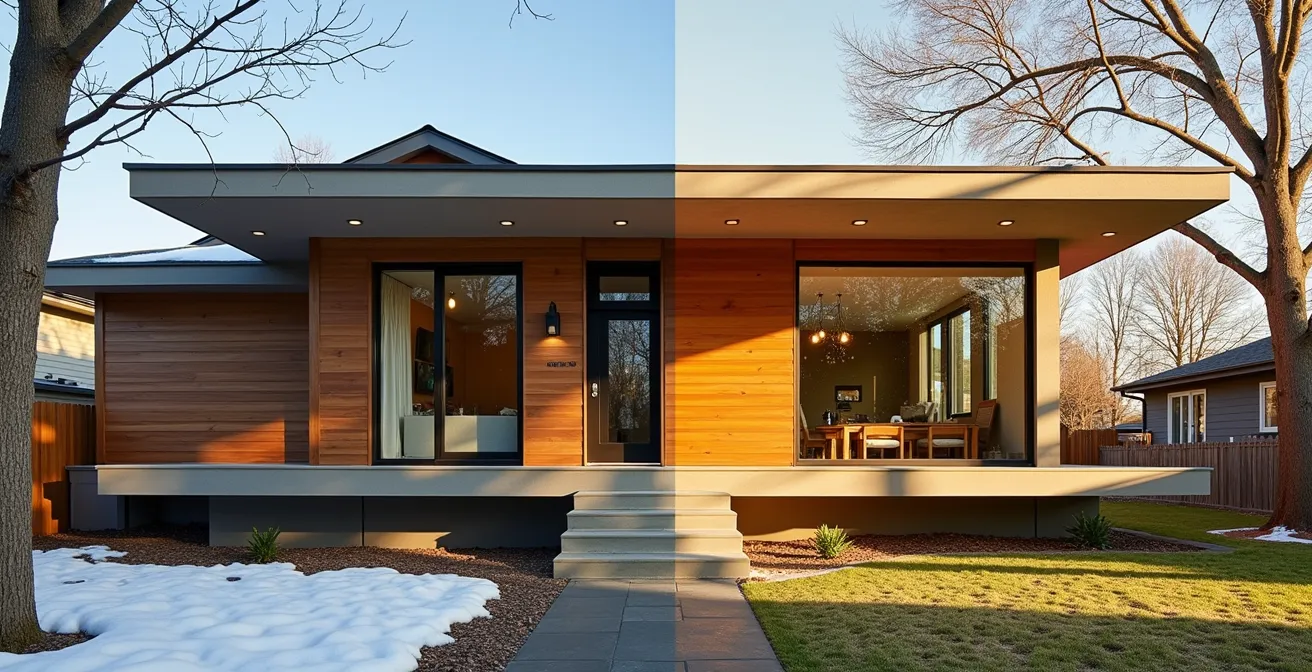
This architectural feature works tirelessly without any moving parts or energy consumption. It’s a prime example of climate-specific design, where the building’s form is intelligently shaped to respond to the predictable path of the sun throughout the year. It solves the overheating problem of high-SHGC southern windows, allowing you to get the best of both worlds: free heat in January and cool shade in July.
Triple Pane Windows: Are They Worth the 30% Extra Cost for Noise and Heat Control?
While SHGC governs how much heat gets *in*, the U-factor (or its inverse, the R-value) dictates how much heat gets *out*. In a cold Canadian winter, even a sun-drenched room will feel chilly if the window itself is a thermal weak point. This is where the debate between double and triple-pane windows becomes critical. Triple-pane windows introduce a third layer of glass and a second gas-filled chamber (typically argon or krypton), significantly improving insulation.
As Cherry Jian, a Senior Sales Consultant at Total Home Windows, notes, “A window might have excellent solar control but poor insulation, or vice versa. The best replacement windows balance both characteristics.” Triple-pane windows are superior at this balancing act. Data from Canadian window installers shows they can be up to 20% more energy efficient than double-pane units, with heat loss dropping from around 10% to as low as 3%. This directly translates to lower heating bills and improved comfort, eliminating the cold drafts often felt near lesser windows.
Of course, this performance comes at a cost—typically a 20-40% premium. The payback period depends heavily on your climate and energy costs. In the harsh winters of the Prairies or Northern Ontario, the savings accumulate quickly. The additional benefits, such as a remarkable reduction in outside noise, often tip the scales. The following table breaks down the key considerations.
This comparative data, adapted from analysis by Windows Canada, helps clarify the decision-making process for homeowners.
| Feature | Double Pane | Triple Pane |
|---|---|---|
| Initial Cost Premium | Baseline | +20-40% higher |
| R-Value Range | R-3 to R-4 | R-6 to R-9 |
| Energy Savings | Baseline | 10-20% reduction in heating/cooling |
| Noise Reduction | Moderate | 30-50% better than single pane |
| Best For | Mild climates, budget-conscious | Harsh winters, near airports/highways |
| Payback Period | N/A | 7-15 years depending on climate |
The Humidity Mistake That Rots Window Frames in Super-Tight Homes
As we build more airtight and insulated homes, we solve the problem of drafts but create a new one: trapped moisture. Every time we cook, shower, or even breathe, we release water vapour into the air. In an old, leaky house, this moisture would simply find its way out. In a modern, high-performance home, it can accumulate, leading to a critical problem in winter: interior window condensation.
When this warm, moist indoor air comes into contact with the coldest surface in the room—the window pane—it condenses into water droplets. This moisture can then pool on the sill and seep into the frame, leading to rot, mould, and premature window failure. Simply having a high-performance window isn’t enough; you must manage the home’s interior humidity as part of an integrated system. In Canada, the target for indoor relative humidity in winter should be between 30-40%. Any higher, and you risk condensation.
The solution is not to open a window, which would defeat the purpose of our energy-efficient envelope. The correct approach is balanced mechanical ventilation. A Heat Recovery Ventilator (HRV) or an Energy Recovery Ventilator (ERV) is essential. These systems continuously exhaust stale, moist air and supply fresh, filtered air from outside. In the process, they transfer heat (and in the case of an ERV, some moisture) from the outgoing air to the incoming air, saving energy. An HRV is ideal for damp climates like Halifax to expel excess moisture, while an ERV helps retain some humidity in dry climates like Saskatoon.
Your Action Plan for Managing Winter Humidity
- Monitor Levels: Use a simple hygrometer to ensure your indoor humidity stays between 30-40% during Canadian winters.
- Control at the Source: Use bathroom and kitchen exhaust fans diligently during and after activities that produce moisture.
- Inspect for Condensation: Regularly check windows, especially after cold snaps or snowstorms, for signs of fogging or water droplets on the interior pane.
- Check Seals Annually: In the spring, inspect exterior caulking around window frames for cracks or gaps where cold air could infiltrate and create cold spots.
- Ensure Proper Ventilation: If you have a modern, tight home, installing and maintaining an HRV or ERV system is not a luxury—it’s a necessity for managing moisture and preserving the integrity of your window frames.
How to Enjoy Natural Light Without Fading Your Hardwood Floors in 3 Years?
Large windows bring in beautiful natural light, but they also bring in ultraviolet (UV) radiation, the primary culprit behind the fading of hardwood floors, furniture, and artwork. A stunning south-facing window wall can, in just a few years, leave a permanent, discoloured “shadow” on your floor where an area rug once sat. Fortunately, modern window technology offers a solution that doesn’t require you to live in the dark: Low-E coatings.
Low-E, or low-emissivity, coatings are microscopically thin, transparent metallic layers applied to one or more surfaces of the glass. Their primary job is to reflect heat (infrared radiation), but they are also incredibly effective at blocking UV radiation. Standard Low-E coated windows offer a significant benefit, blocking up to 84% of damaging UV rays for a price premium of only about 10-15%. This investment protects the much larger investment you’ve made in your interior finishes.
There are different levels of Low-E coatings, each offering a different balance of UV protection, solar heat control, and visible light transmittance. More advanced coatings, like those with three layers of silver (Low-E 366), can block up to 95% of UV rays, offering maximum protection for valuable interiors, though they may have a slightly more noticeable tint. The choice depends on your budget and priorities, as outlined in the comparison below.
| Solution | UV Blocking % | Cost | Impact on View |
|---|---|---|---|
| Standard Low-E 272 | 84% | Moderate | Minimal |
| Low-E 366 | 95% | Higher | Slight tint |
| Window Film Retrofit | Up to 99% | Lower upfront | May affect clarity |
| Spectrally Selective | 75-85% | Highest | None |
How to Balance Large Windows with Energy Codes Without Failing Inspection?
A common fear for homeowners and builders planning a wall of glass is failing to meet the increasingly stringent energy codes across Canada, such as the BC Energy Step Code or the National Building Code’s tiered requirements. Prescriptive paths in these codes often set a maximum window-to-wall ratio, which a modern, light-filled design can easily exceed. This can lead to a frustrating impasse where your design vision clashes with regulatory requirements.
However, most modern energy codes include a crucial alternative: the performance path. This approach allows for much greater design flexibility. Instead of checking boxes for insulation levels or window ratios, you use energy modelling software to prove that your home’s *overall annual energy performance* meets or exceeds the target. This is where a strategic window design becomes your greatest asset.
This is a point emphasized by building science experts. As one consultant from the Canadian Building Code Performance Path Guidelines states:
A certified energy advisor can prove that the high solar gains from a huge south-facing window offset its nighttime heat loss, thus meeting the code.
– Building Science Expert, Canadian Building Code Performance Path Guidelines
By using a performance path, you can demonstrate that the massive free solar heat gained from your high-SHGC, triple-pane south-facing windows more than compensates for their heat loss compared to a standard wall. The energy model shows that your smart design achieves the code’s goal—energy efficiency—even if it does so through a different method. This allows you to build the home you want, balancing aesthetics with certifiable high performance, and ultimately increasing your property’s value and market appeal.
External Blinds vs. Internal Curtains: Stopping the Heat Before It Enters
Even with perfect overhangs, there will be times when you need more dynamic control over heat and light, especially on east and west-facing windows or during the “shoulder seasons” of spring and fall. This is where window treatments play a vital role. The critical distinction to understand is between external and internal shading. From a pure performance standpoint, it is always more effective to stop solar radiation before it passes through the glass.
Exterior options like roller shutters, awnings, or external venetian blinds are the gold standard for preventing summer heat gain. Once sunlight passes through the window, it’s already inside, and its energy is trapped—the greenhouse effect. Internal curtains and blinds can only manage the heat that’s already entered the room. However, external solutions can be costly and architecturally complex, so a well-designed internal strategy is essential for most Canadian homes. Research shows that proper window shading can achieve a reduction in cooling costs of up to 23%.
For internal treatments, the best choice for insulation are cellular or honeycomb blinds. Their trapped air pockets can add an extra R-2 to R-4 of insulation to your window assembly, a significant boost on a cold winter night. For a complete strategy, consider layering treatments: a sheer curtain for daytime privacy and light diffusion, paired with a heavy thermal or blackout curtain to be drawn at sunset. In a passive solar design, the daily routine is key: open south-facing blinds on sunny winter days to welcome free heat, and close all blinds and curtains at night to trap it inside.
Key Takeaways
- Windows are a system: Success depends on balancing solar gain (SHGC), heat loss (U-factor/R-value), and UV protection (Low-E coatings).
- Design must be climate-specific: Overhangs must be calculated for your latitude, and ventilation (HRV/ERV) is critical in modern, airtight Canadian homes.
- Performance over prescription: Use energy modeling (the “performance path”) to justify large window areas and meet modern energy codes through smart design.
Why Simply Adding Insulation Isn’t Enough to Fix a Cold Canadian House?
A common response to a cold, drafty house is to simply add more insulation to the attic or walls. While insulation is vital, this isolated approach often fails to solve the root problem, because a house is not a collection of independent parts. It is a complex, interactive ecosystem. Thinking of it this way is the foundation of the “House as a System” approach, a core principle in modern building science.
Imagine your house is a winter jacket. The insulation is the down fill. But if the zipper is broken (air leakage) or if it has large, thin plastic patches (poor-performing windows), you will still be cold. Simply adding more down won’t fix the broken zipper. In a house, windows are often the biggest “thin plastic patch.” A typical insulated wall might have an R-value of R-20, while an old double-pane window is only R-2. That window is losing ten times more heat per square foot than the wall right next to it.
This is why a holistic home energy audit is the correct first step. It moves beyond guesswork and analyzes how all the components interact. A professional audit will typically include:
- A blower door test to pinpoint and quantify air leakage.
- A thermal imaging scan to identify insulation gaps and thermal bridges.
- An assessment of window performance (U-factor, SHGC).
- An evaluation of the heating, cooling, and ventilation systems.
Focusing only on insulation while ignoring high-performance windows and air sealing is an incomplete and often ineffective strategy. To truly create a comfortable, energy-efficient Canadian home, you must treat the house as a single, integrated system where every component works in concert.
To apply these principles effectively, the next logical step is to schedule a professional energy audit to get a data-driven plan for your specific home, transforming it into a high-performance system.