
A permeable driveway is a strategic infrastructure investment that protects your home from flooding and increases its value by navigating Canadian municipal regulations.
- It actively manages stormwater on-site, drastically reducing the hydraulic load on your foundation and municipal sewers.
- Engineered systems withstand destructive freeze-thaw cycles far better than traditional asphalt or concrete.
- Permeable surfaces can be partially or fully exempt from restrictive lot coverage bylaws, unlocking new development potential.
Recommendation: Prioritize a professionally installed system with a deep, engineered sub-base to guarantee long-term structural integrity and maximize your financial and protective returns.
For many Canadian homeowners, a heavy downpour or a rapid spring thaw brings a familiar sense of dread. The thought of a damp, musty basement or, worse, a full-blown flood is a constant worry. We’re often told the solutions are to re-grade the lawn, install larger eavestroughs, or invest in a sump pump. These are reactive measures, addressing the symptoms of excess water. They treat your property’s hard surfaces, particularly the driveway, as a passive problem—a sealed surface that funnels water directly toward your foundation or into overburdened municipal storm sewers.
But what if we re-framed the problem? From a civil engineering perspective, that impermeable slab of asphalt isn’t just a problem; it’s a missed opportunity. The key to true, long-term water management isn’t just about diverting water away, but about controlling it, absorbing it, and turning a liability into a high-performance hydrological asset. This is where permeable paving systems fundamentally change the equation. They aren’t merely decorative surfaces; they are engineered solutions designed to work with, not against, Canada’s challenging climate.
This article moves beyond the simple “eco-friendly” label. We will dissect the engineering principles that make these systems work, from the critical depth of the sub-base to the specific materials that withstand freeze-thaw cycles. We’ll explore the maintenance required to keep them functional and, crucially, examine how they provide a strategic advantage in navigating the complex web of municipal bylaws that can limit your property’s potential. This is a guide to understanding your driveway not just as a place to park your car, but as a frontline defence for your home and a tool for increasing its value.
This guide will provide a detailed breakdown of the critical aspects of permeable paving for Canadian homeowners. You’ll find an in-depth comparison of materials, an explanation of the foundational science, and practical advice on maintenance and water management strategies for your property.
Summary: Why Permeable Paving is a Smart Engineering Choice for Your Canadian Home
- Interlocking permeable stones vs Stabilized gravel: which looks better and lasts longer?
- Why the gravel base for permeable paving needs to be 2x deeper?
- How to vacuum your driveway to keep the drainage gaps from clogging?
- Why you can never use sand on a permeable driveway in winter
- How permeable paving helps you bypass maximum lot coverage bylaws?
- Why the land-to-structure ratio is the #1 predictor of 20-year appreciation
- How to dig a dry well to divert downspout water away from the house?
- How to install a rain garden or bioswale to manage heavy downpours?
Interlocking permeable stones vs Stabilized gravel: which looks better and lasts longer?
Choosing the right surface material for a permeable driveway in Canada is a decision that balances aesthetics, budget, and, most importantly, long-term structural performance against our harsh climate. From an engineering standpoint, the debate isn’t just about looks; it’s about how each system manages stress from freeze-thaw cycles, vehicle loads, and de-icing agents. Interlocking concrete pavers are a popular choice, offering a classic look and design flexibility. Their primary advantage lies in their jointed structure, which allows for slight movement during ground heave, reducing the risk of widespread cracking that plagues monolithic surfaces like asphalt.
On the other hand, resin-bound aggregates (a more advanced form of stabilized gravel) offer a seamless, modern aesthetic with exceptional performance characteristics. These systems, where natural aggregates like Canadian granite are bound in a UV-stable and permeable resin, create a durable, monolithic surface that is both strong and fully porous. Unlike traditional stabilized gravel which can be prone to rutting, high-quality resin-bound systems demonstrate superior resistance to both salt and freeze-thaw degradation. The choice ultimately depends on balancing the upfront cost with the desired lifespan and maintenance profile in a specific Canadian region.
This comparative table breaks down the key performance indicators for materials commonly used in the Canadian market, focusing on factors critical for longevity.
| Material Type | Freeze-Thaw Resistance | Salt Resistance | Lifespan | Local Materials |
|---|---|---|---|---|
| Interlocking Pavers | Flexible joints handle frost heave | Concrete degrades with sodium chloride | 20-30 years | Ontario limestone available |
| Resin-Bound Aggregate | UV and freeze-thaw resistant | Superior salt resistance | 30+ years proven | Canadian granite options |
| Stabilized Gravel | Prone to rutting when base partially frozen | Polymer binder degrades faster | 15-20 years | Local 3/4″ clear stone |
University of Ottawa Study: Freeze-Thaw Resistance of Resin-Bound Systems
To quantify the durability of modern permeable systems, independent scientific testing by the University of Ottawa analyzed the PurePave resin-bound pavement. The results were significant for Canadian applications: the system was the first to show no loss of strength through rigorous frost/thaw simulations mimicking Canadian climate conditions. It demonstrated 6 times the strength of asphalt and 1.6 times that of conventional cement, leading to an expected lifespan of over 40 years, confirming the material’s superior climate resilience.
Why the gravel base for permeable paving needs to be 2x deeper?
A permeable driveway is more than just a surface; it’s a sub-surface drainage system. The most critical component, and the one that dictates its success or failure, is the open-grade aggregate base. In a conventional driveway, a shallow base of 4-6 inches is sufficient for structural support. For a permeable system in Canada, this depth must be at least doubled to 8-12 inches, or even deeper, for two fundamental engineering reasons: providing a water storage reservoir and protecting against frost heave.
First, the deep base acts as a temporary underground reservoir. During a heavy downpour, rainwater passes through the surface and is held within the voids of the 3/4″ clear stone base. This captures a massive volume of water, allowing it to infiltrate slowly and naturally into the sub-grade soil, rather than sheeting off into the street. This significantly reduces the hydraulic load on your property’s drainage and the municipal storm sewer. Second, in a cold climate, this deep base keeps the water well below the frost line. If water were to freeze near the surface, the resulting ice expansion (frost heave) would lift and destroy the pavement. A deep base ensures water is managed at a depth where the ground temperature remains stable, ensuring the driveway’s structural integrity year after year.
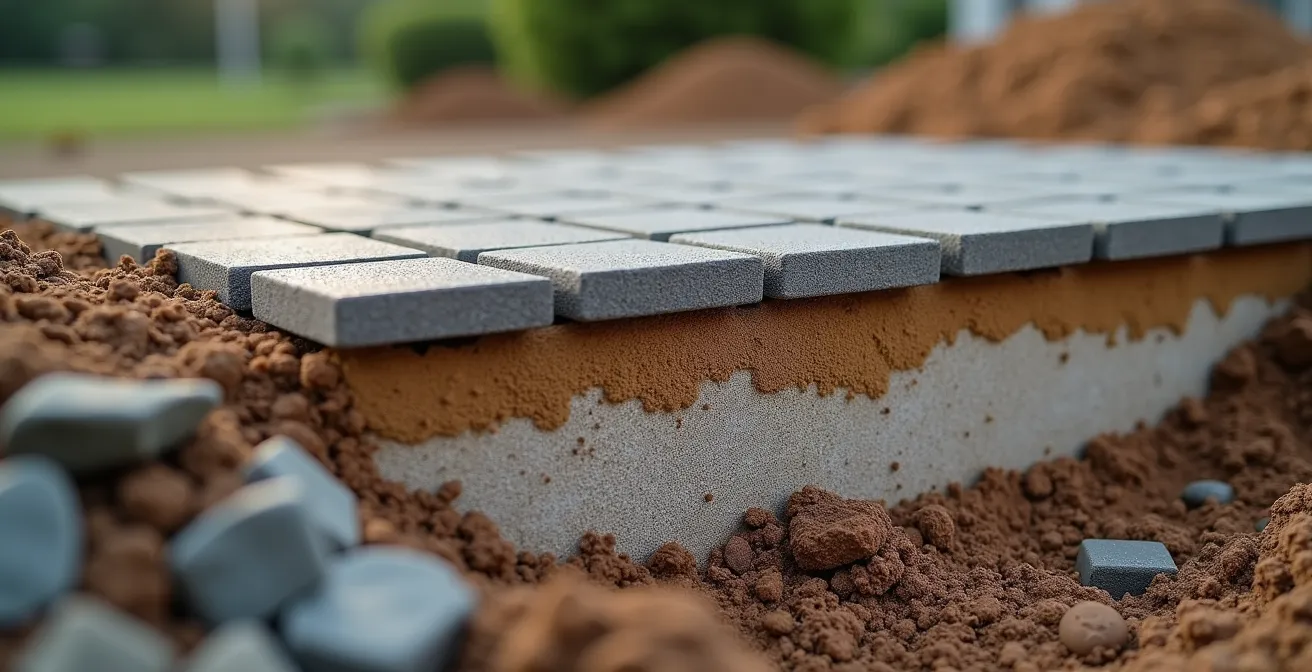
As this cross-section illustrates, the system is a sequence of engineered layers. It begins with excavation and the laying of a geotextile fabric, which prevents the sub-soil from migrating into the stone base. The deep layer of clear stone is then installed and compacted, followed by a bedding layer and the final permeable surface. This multi-layer construction is what provides both the necessary structural capacity and the essential hydrological function. For homeowners in flood-prone areas, some municipalities offer financial incentives for such robust installations. For instance, Toronto’s Basement Flooding Protection Subsidy Program provides up to $3,400 per property for approved flood protection measures, which can include advanced stormwater management systems.
How to vacuum your driveway to keep the drainage gaps from clogging?
The functionality of a permeable driveway hinges on one simple principle: water must be able to pass through it. Over time, organic debris like leaves, pine needles, and airborne sediment can accumulate in the joints of pavers or the pores of a resin-bound surface, compromising its infiltration rate. Unlike a sealed driveway where you simply sweep debris away, maintenance here is about keeping the drainage channels open. The most effective tool for this is not a broom or a pressure washer on high, but a high-CFM (Cubic Feet per Minute) shop vacuum.
Regular, preventative cleaning is far more effective than trying to remediate a fully clogged surface. The key is to address debris before it decomposes and compacts into a dense, impermeable layer. In the fall, it is crucial to remove leaves before the wet, snowy season turns them into a solid mat. Using a shop vac with a narrow crevice tool allows you to precisely target the gaps between pavers or run it over the surface of a resin-bound system to lift out fine particles. If minor pooling is observed after a heavy rain, it’s a sign that localized clogging has begun, and that specific area should be vacuumed within 48 hours to restore permeability. Professional maintenance in Canadian cities like Toronto is often straightforward and cost-effective, focusing on this type of preventative cleaning to ensure the system functions optimally for decades.
Your Action Plan: Seasonal Permeable Driveway Maintenance
- Autumn Inspection (October): Before the first snowfall, meticulously remove all organic matter. Focus on maple leaves and pine needles, which can create an impermeable paste. Use a leaf blower for initial clearing, followed by a shop vac with a narrow attachment to clean out joints.
- Winter Preparedness (December): Inspect the surface to ensure it is free of fine sand or debris. Procure a supply of ASTM No. 8 angular stone or an approved alternative for traction, and ensure snow removal equipment (blowers preferred over plows) is ready.
- Spring Refresh (April): Once the snow has fully melted, conduct a thorough cleaning. Use a high-CFM shop vacuum to remove any remaining winter grit and salt residue. A light rinse with a pressure washer on a low setting can follow, but vacuuming is the primary method.
- Summer Monitoring (June-August): Perform visual inspections monthly and after heavy rainstorms. Spot-weed by hand if any vegetation appears in joints. Address any signs of sediment buildup or localized water pooling immediately with spot-vacuuming.
- Annual Permeability Test: Once a year, pour a bucket of water on several areas of the driveway. The water should disappear almost instantly. If it pools for more than a minute, it indicates clogging that requires a more intensive vacuuming session.
Why you can never use sand on a permeable driveway in winter
In a Canadian winter, reaching for a bag of sand is an instinctual response to an icy driveway. On a permeable surface, this is the single most destructive action you can take. The fine particulate nature of sand is fundamentally incompatible with a system designed for water to flow through it. When sand is applied, it washes directly into the permeable joints or voids. It doesn’t just sit on top; it fills the very channels that are meant to drain water. Come spring, this sand will have compacted into a concrete-like plug, permanently clogging the system and turning your expensive permeable driveway into a standard, impermeable one.
This clogging not only negates the driveway’s primary function of stormwater management but also makes it more susceptible to ice. A functioning permeable driveway drains meltwater away, reducing the chance for refreezing and ice sheet formation. In fact, some surfaces like Dream Pave’s resin-bound pavement demonstrate up to 50% faster snow melting and greater resistance to ice build-up because water doesn’t pool on the surface. By clogging it with sand, you trap water at the surface, creating the exact icy conditions you were trying to prevent.
The correct approach is to use materials that provide traction without compromising porosity. The industry standard is clean, ASTM No. 8 angular stone grit. These particles are large enough to provide grip but too large to become lodged in the permeable gaps. They rest on top of the surface and can be easily swept or vacuumed up in the spring. For de-icing, calcium chloride should be used sparingly, as it is less harmful to concrete and a better choice than traditional sodium chloride (road salt).
- Use ASTM No. 8 angular stone grit, as its larger particles won’t wedge in joints.
- Apply calcium chloride sparingly, as it is less damaging to paving materials than sodium chloride.
- Consider installing heated driveway cables beneath the permeable surface in regions with extreme cold and ice accumulation.
- Designate strategic snow storage areas on your property, away from permeable surfaces, to prevent contamination from plowed snow containing municipal sand.
- Utilize a snow blower instead of a plow whenever possible to minimize surface contact and contamination.
How permeable paving helps you bypass maximum lot coverage bylaws?
In many dense Canadian municipalities, urban planning departments enforce strict bylaws regarding “lot coverage” or “building coverage.” This regulation limits the percentage of a property that can be covered by impermeable surfaces like buildings, sheds, patios, and traditional driveways. The goal is to control stormwater runoff and preserve green space. For a homeowner looking to build an extension, a garage, or even a large patio, these bylaws can be a significant roadblock. A large, impermeable driveway can consume a substantial portion of your allowable coverage, leaving no room for other projects.
This is where permeable paving becomes a powerful strategic tool for property development. Because these surfaces are engineered to manage stormwater on-site, many municipalities do not classify them as “impermeable” in the same way as asphalt or concrete. This reclassification can partially or even fully exempt the driveway’s square footage from the lot coverage calculation. For example, as a planning official might explain:
In Calgary’s Land Use Bylaw 1P2007, permeable surfaces can be partially or fully exempt from the ‘building coverage’ calculation.
– City of Calgary Planning Department, Calgary Land Use Bylaw 1P2007 – Development Standards
This is not just an environmental perk; it’s a direct financial and functional benefit. By installing a permeable driveway, you effectively “free up” valuable square footage on your lot. This newfound allowance could be the difference between being able to build a needed home addition or being denied a permit. This strategic advantage directly translates to increased property value. For homeowners who have leveraged this, the impact can be substantial; in some cases, the ability to add more functional space has led to customers reporting home value increases of as much as $150,000, by unlocking development potential that was previously restricted by lot coverage limits.
Why the land-to-structure ratio is the #1 predictor of 20-year appreciation
In real estate investment, a core principle dictates long-term value: you invest in the land, not just the building. Structures depreciate over time, requiring maintenance and updates. Land, especially in desirable urban and suburban areas across Canada, tends to appreciate. The land-to-structure ratio—the proportion of your property’s value tied to the land itself versus the building on it—is a key indicator of future growth potential. A property with a high land value component is a stronger long-term investment.
Permeable paving directly and positively influences this ratio by increasing the functional and monetary value of your land. Traditional surfaces are single-use liabilities; an asphalt driveway is only for parking and actively contributes to flood risk. A permeable system transforms that same plot of land into a multi-functional asset. It’s a parking area, a stormwater management facility, and potentially a usable hardscape that doesn’t count against lot coverage limits. By mitigating flood risk, it protects the primary structure (the house), preserving its value. By enabling further development (like an extension or garage), it allows you to increase the “structure” value on your existing “land” footprint, maximizing the property’s overall worth.
In high-density markets like Toronto or Vancouver, where land is the most valuable part of any real estate transaction, this is paramount. A system that enhances the land’s utility and resilience is a direct driver of appreciation.
| Surface Type | Functional Use | Climate Resilience | Impact on Land Value |
|---|---|---|---|
| Traditional Asphalt | Single-use (parking only) | Increases flood risk | Neutral to negative |
| Permeable Pavers | Multi-use space | Reduces flooding by up to 90L/second/m² | Positive appreciation |
| Concrete | Limited flexibility | Heat island effect | Minimal impact |
Key takeaways
- A permeable driveway is a civil engineering system, where the deep gravel base is the most critical component for both water storage and frost protection.
- Strict winter maintenance is non-negotiable: never use sand, which causes permanent clogging. Use ASTM No. 8 angular stone grit for traction.
- Permeable surfaces can be exempt from municipal lot coverage bylaws, unlocking significant development potential and increasing property value.
How to dig a dry well to divert downspout water away from the house?
While a permeable driveway is a powerful tool for managing precipitation that falls on its surface, a comprehensive water management strategy must also account for the significant volume of water collected by your roof. Disconnecting downspouts from the municipal sewer system is mandatory in many Canadian cities and a critical step in preventing basement flooding. Simply letting the water discharge at the base of your foundation, however, trades one problem for another. The solution is to direct this water to a location where it can safely infiltrate the ground, and a dry well is an effective, targeted engineering solution for this purpose.
A dry well is essentially a buried, hollow structure surrounded by gravel that collects and holds concentrated water flow from downspouts, allowing it to slowly percolate into the surrounding soil. For it to function correctly in Canada, it must be installed with careful consideration for our climate. Sizing is paramount and must be calculated based on your roof area and local rainfall intensity data from Environment Canada. Critically, the excavation must place the dry well below the regional frost line—a minimum of 4 feet deep in Southern Ontario and up to 5-6 feet in colder prairie provinces—to prevent freezing and damage. Placing it at least 10 feet from your foundation and downslope from the house is a standard safety requirement. Financial aid is often available; for instance, the City of Toronto offers a subsidy of up to 80% of costs (maximum $400) for downspout disconnection, which can offset the cost of implementing solutions like dry wells.
Action Plan: Installing a Climate-Resilient Dry Well
- Sizing Calculation: Determine the required volume. Use this formula: Roof Area (sq ft) draining to the downspout × Rainfall Intensity (from local Environment Canada IDF curves) ÷ Soil Infiltration Rate. When in doubt, oversize the well.
- Site Selection & Excavation: Choose a location at least 10 feet from the foundation and downslope from the house. Excavate a hole to a depth that places the entire system below the local frost line (e.g., minimum 4 feet in Southern Ontario).
- Base and Lining: Line the excavated pit with geotextile fabric. Add a 6-inch base of 3/4″ clear stone for drainage. Place the dry well chamber (pre-fabricated or a perforated drum) in the center.
- Backfill and Connection: Connect the downspout extension pipe to the inlet of the dry well. Backfill the area around the chamber with more clear stone, leaving a few inches at the top. Fold the geotextile fabric over the stone.
- Overflow and Finishing: Top the system with a layer of topsoil and sod. Critically, install an overflow pipe near the top of the dry well, directing excess water from extreme storms to a safe discharge point, such as a connected bioswale or the permeable driveway’s sub-base.
How to install a rain garden or bioswale to manage heavy downpours?
A truly resilient property employs a “treatment train” approach to stormwater, where water is managed in a series of steps. After the permeable driveway handles direct precipitation and a dry well manages roof runoff, a rain garden or bioswale serves as the next line of defense, designed to capture and treat overflow during the most intense downpours. A rain garden is a shallow, depressed garden bed designed to collect water, while a bioswale is a linear, channel-like feature that both conveys and treats water. Both use a combination of specific soil mixes and deep-rooted native plants to maximize infiltration and filter pollutants.
The success of these features in Canada is entirely dependent on plant selection. You must use native plants adapted to your specific hardiness zone and the unique conditions of a rain garden—alternating between periods of inundation and drought. For example, in Eastern Canada (Zones 3-5), species like Joe Pye Weed and Red Osier Dogwood thrive. In the prairies (Zones 2-3), Prairie Dropseed and Manitoba Maple are robust choices. These native plants have deep root systems that create channels in the soil, maintaining its porosity and helping it absorb large quantities of water. As a rule of thumb, a rain garden should be sized to be approximately 20-30% of the impervious area that drains into it.
Implementing these green infrastructure elements is not just an environmental choice; it’s an economic one. Recognizing their value in reducing the load on municipal systems, many Canadian cities offer significant financial incentives. For example, in the Ontario cities of Kitchener and Waterloo, homeowners can stack credits for various measures. Residents with approved systems like permeable driveways and rain gardens can qualify for up to a 45% credit on their monthly stormwater utility fees, providing a direct and ongoing return on their investment.
- Eastern Canada (Zones 3-5): Joe Pye Weed, Red Osier Dogwood, Blue Flag Iris, Sweet Gale.
- Western Canada (Zones 6-8): Saskatoon Berry, Sword Ferns, Pacific Ninebark, Kinnikinnick.
- Prairie Provinces (Zones 2-3): Prairie Dropseed, Manitoba Maple, Bur Oak, Canada Anemone.
By integrating these engineered and natural systems, you transform your property from a passive victim of weather into an active manager of its environment. This holistic approach not only provides robust protection against flooding but also enhances the ecological health and financial value of your home. To fully realize these benefits, consulting with a professional experienced in residential water management and local municipal codes is the critical next step.