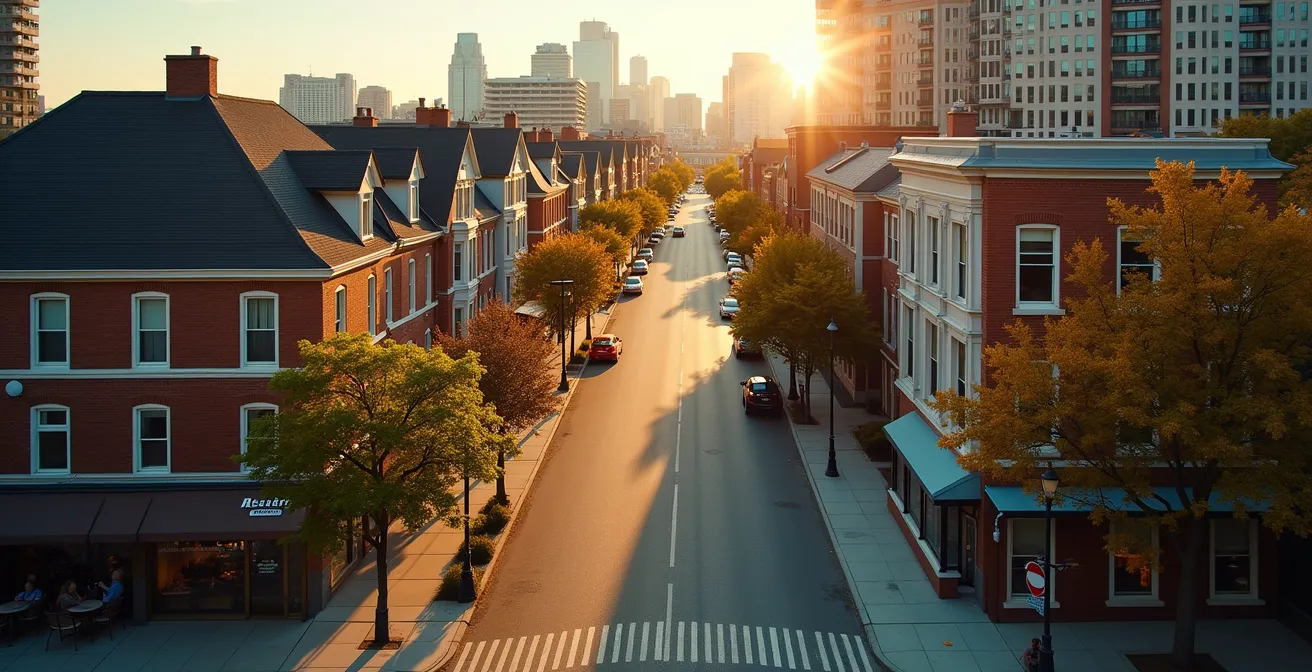
The most profitable real estate ‘sweet spot’ is found not by tracking generic trends, but by identifying the moment socio-cultural capital begins converting into tangible market value.
- Early cultural indicators like artist-run centres and independent bookstores signal latent growth potential before mainstream investors arrive.
- Ethical investment strategies, such as developing laneway housing, can increase density and returns while preserving community fabric.
Recommendation: Shift your focus from “where are the new coffee shops?” to “what is the velocity of retail change and what does it say about the community’s evolving identity?”
For the savvy real estate investor in Canada, the dilemma is timeless: invest in a blue-chip neighbourhood with established value and low growth, or take a gamble on an emerging area with the promise of high appreciation but significant risk. The common advice often circles around superficial markers—spotting new coffee shops or trendy restaurants. While not entirely wrong, this approach is a lagging indicator, capturing a wave that has already started to swell. It overlooks the deeper, more subtle currents of urban transformation that signal a neighbourhood’s true potential.
As a real estate sociologist, the perspective is different. The key to identifying the “sweet spot”—that perfect intersection of future value and current livability—isn’t about chasing trends. It’s about understanding the mechanics of community change. The real opportunity lies in decoding the flow of socio-cultural capital: the burgeoning art scenes, the unique retail ecosystems, and the architectural identity that precede the mainstream economic boom. It’s about learning to read a neighbourhood’s story and predicting the next chapter before it’s written.
This guide moves beyond the clichés to offer a framework for seeing neighbourhoods as complex social organisms. We will dissect the leading indicators of sustainable growth, from the migration patterns of artists to the subtle shifts in the local retail landscape. By understanding these dynamics, you can invest not just in property, but in the authentic, resilient character of a community on the cusp of transformation, securing value long before the market becomes saturated.
To navigate this complex landscape, this article breaks down the key sociological indicators that savvy investors can use to identify a neighbourhood’s true potential. The following sections will provide a detailed roadmap for reading the signs of sustainable change.
Summary: Decoding the Signals of Neighbourhood Transformation
- Why following the art galleries helps you predict the next property boom?
- How to invest in a changing neighborhood without displacing long-term residents?
- Vintage stores vs Starbucks: reading the retail landscape for investment clues
- What happens if the gentrification wave stops halfway through?
- Restoring character vs Modern flip: what do new buyers in these areas want?
- Why new coffee shops and microbreweries are leading indicators of property value jumps
- Why does crossing one street in Queen West change property value by $50k?
- Is buying a condo built on a former factory site safe and a good investment?
Why following the art galleries helps you predict the next property boom?
The “starving artist” is a powerful but misleading cliché. In reality, artists are the advance scouts of urban transformation. Their presence indicates an abundance of a key resource: affordable space with character. Before developers or mainstream investors take notice, artists, galleries, and creative collectives colonize areas with low rent and architectural interest, converting old warehouses and storefronts into studios and exhibition spaces. This initial injection of socio-cultural capital creates a vibrancy and identity that, over time, attracts wider interest and investment. The key is distinguishing between the early and late stages. An artist-run centre is an early signal of raw potential; a strip of commercial galleries selling established artists is a sign the market is already maturing.
In Canada, this pattern is empirically observable. Tracking public funding is a powerful tool for an investor. For instance, data from the Canada Council for the Arts reveals where grants are being concentrated. In 2024-25, more than 3,000 Canadian artists and 1,950 arts organizations received grants. By mapping the density of these recipients by postal code, an investor can identify emerging creative clusters years before they translate into property value spikes. This is not about aesthetics; it’s a data-driven approach to tracking the geographic flow of creativity, which is a direct precursor to economic growth.
Case Study: The Genesis of Urban Transition in Toronto
The gentrification story in Canadian cities like Toronto didn’t begin with condos, but with a cultural shift. Starting in the 1970s, neighbourhoods like Cabbagetown saw “white-painters”—middle-class buyers with an eye for architecture—move into historically working-class areas. They purchased undervalued Victorian homes, deconverted them from multi-unit rentals back to single-family residences, and painstakingly restored their heritage features. This process, driven by an appreciation for architectural character rather than pure profit, laid the groundwork for decades of subsequent investment, demonstrating how the initial influx of culturally-motivated buyers sets the stage for massive economic uplift.
Therefore, the astute investor doesn’t just visit galleries; they analyze the arts ecosystem. They look for the concentration of artist-run centres, the trends in municipal and federal arts funding, and the migration of creative professionals. These are the foundational signals of a neighbourhood developing an “authenticity premium” that will inevitably be reflected in its real estate market.
How to invest in a changing neighborhood without displacing long-term residents?
The term gentrification often carries a negative connotation, synonymous with the displacement of long-term, lower-income residents. However, for an investor with a sociological lens, neighbourhood change does not have to be a zero-sum game. The most sustainable, and often profitable, form of urban revitalization is one that embraces “gentle density”—a strategy that adds housing stock without demolishing the existing community fabric. This approach mitigates displacement risk and creates a more diverse, resilient, and ultimately desirable neighbourhood, which enhances long-term value.
In major Canadian cities like Vancouver and Toronto, the most prominent example of this is the laneway house. These are small, secondary dwellings built in the backyards of existing single-family homes. For a homeowner, they provide rental income, helping them to afford rising property taxes. For the community, they add rental units without altering the streetscape. For an investor, partnering with or financing these projects is a powerful strategy. It’s a targeted investment that directly increases a property’s value and cash flow while contributing a positive social good. According to current Canadian market data, the average cost to build a laneway house ranges from $200,000 to $400,000, an investment that can generate significant rental income and property appreciation.
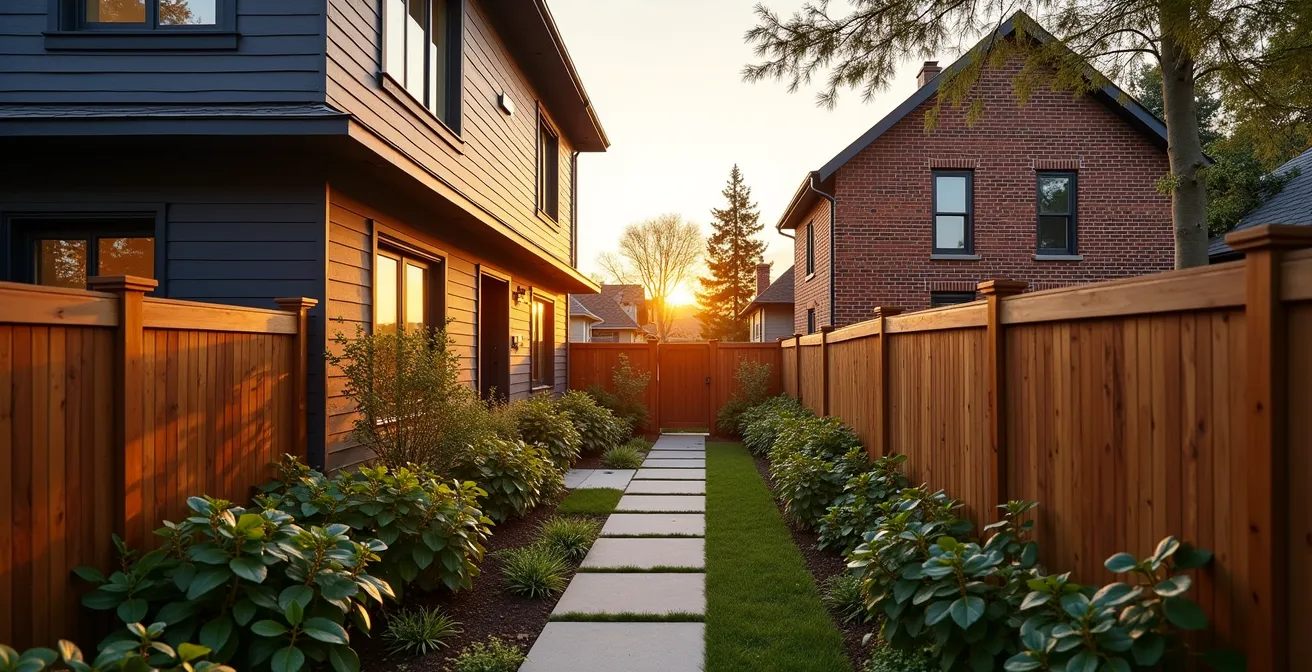
Financial institutions are recognizing this opportunity. Equitable Bank, for example, has launched a specific Laneway House Mortgage program in Canada. This innovative financing product was created to help homeowners overcome the significant out-of-pocket construction costs, thereby unlocking the potential for gentle density in established neighbourhoods. By investing in properties with the potential for such additions, or financing their construction, you directly participate in an ethical and economically sound form of neighbourhood evolution. It’s an investment in community stability, which is the bedrock of long-term property value.
This model allows investors to profit from densification while empowering existing residents to stay, transforming a potentially adversarial process into a symbiotic one. It represents the pinnacle of investing where value meets livability, creating neighbourhoods that are both economically vibrant and socially inclusive.
Vintage stores vs Starbucks: reading the retail landscape for investment clues
The retail composition of a street is a living document of its socio-economic status and trajectory. While the arrival of a Starbucks is a well-known, if late, indicator of gentrification, the real clues lie in the nuanced transition of retail types. A sociologist-investor reads the streetscape not for single data points, but for patterns and indicator velocity. The shift from a pawn shop to a vintage clothing store, then to an independent bookstore, and finally to a high-end boutique tells a story of evolving consumer demographics and disposable income. Each stage represents a window of investment opportunity with a different risk/reward profile.
The earliest stage is characterized by businesses that thrive on low overhead and cater to a niche, often creative, clientele: artist-run galleries, third-wave coffee shops focusing on craft over volume, and independent record or book stores. This is the “high risk, high reward” phase where property is most affordable. The next stage sees the arrival of more established local businesses, like a second location for a successful local restaurateur or a high-quality independent grocer like Farm Boy. This signals that the neighbourhood is stabilizing and has proven its commercial viability. The final, mature stage is marked by the arrival of national chains, banks, and luxury retailers like Loblaws CityMarket or Equinox, by which point the primary appreciation phase is largely over.
This table, based on an analysis of Canadian urban markets, codifies the retail transition and its corresponding investment implications, as detailed in a recent analysis of Toronto investment neighbourhoods.
| Stage | Retail Indicators | Investment Timing | Property Value Impact |
|---|---|---|---|
| Stage 1: Early | Independent bookstore, third-wave coffee, artist-run centres | High risk, high reward | 10-15% annual appreciation potential |
| Stage 2: Emerging | Farm Boy, local restaurant group’s second location | Moderate risk, strong growth | 8-12% annual appreciation |
| Stage 3: Mature | Loblaws CityMarket, Equinox, chain retailers | Low risk, stable returns | 5-7% annual appreciation |
Toronto’s Junction and Woodbine areas offer a real-world example. The Woodbine area, in its early gentrification phase, has seen the highest appreciation recently. The Junction, being further along its timeline, is maturing, and its growth rate is moderating. By learning to identify which stage a neighbourhood is in based on its retail mix, an investor can accurately calibrate their entry point to match their risk tolerance and investment goals.
What happens if the gentrification wave stops halfway through?
One of the greatest risks for an investor in transitional neighbourhoods is the prospect of stalled gentrification. A wave of change can lose momentum due to a regional economic downturn, a shift in city policy, or a failure to reach a critical mass of investment. This can leave an area in an awkward limbo, with some renovated properties next to dilapidated ones and a commercial strip that never fully materialized. The key to mitigating this risk is to invest in neighbourhoods that possess an intrinsic “value moat”—a set of enduring qualities that provide a baseline of desirability independent of the gentrification trend itself.
These qualities include proximity to unmovable assets: major parks, waterfronts, university campuses, or rapid transit lines. They also include strong architectural character protected by heritage designations, which prevents developers from erasing the very identity that makes the area attractive. A high-quality school district is another powerful moat, as it creates a permanent source of demand from families. These factors ensure that even if the wave of speculative investment recedes, the neighbourhood retains a fundamental appeal that will support property values.
The 2014 oil crash in Calgary provides a stark Canadian case study. The economic shock slammed the brakes on the city’s rapid growth. However, the impact on the housing market was not uniform. While there was a 25% drop in existing home sales, the price decline was only 2.5%, as CMHC data revealed. Furthermore, in the overbuilt condo market, it was the apartment segment that saw inventory levels begin to fall first, indicating resilience in specific property types even during a downturn. This demonstrates that properties in well-located areas with strong fundamentals can weather economic storms far better than those relying solely on speculative momentum.
Your Checklist for Identifying a Neighbourhood’s Value Moat
- Assess proximity to major, permanent urban amenities like Rouge Park in Toronto or Stanley Park in Vancouver.
- Evaluate the strength and scope of architectural heritage protection under local municipal bylaws.
- Research the quality of the local school catchment area using objective data like Fraser Institute rankings.
- Monitor provincial and municipal policy announcements for long-term commitments to transit or housing initiatives.
- Analyze the existing zoning for a healthy mix of residential and commercial uses that supports a complete community.
By prioritizing neighbourhoods with a strong value moat, an investor is not just betting on gentrification; they are investing in enduring quality. This is the ultimate defensive strategy, ensuring that the property holds its value even if the tide of change slows or stops.
Restoring character vs Modern flip: what do new buyers in these areas want?
As a neighbourhood transitions, so do the tastes of its new buyers. An investor who misreads these preferences risks making costly renovation mistakes. The generic “modern flip”—characterized by grey laminate flooring, pot lights, and builder-grade fixtures—can be profitable in some contexts, but in a neighbourhood prized for its character, it can actually destroy value. In these areas, buyers are not just purchasing square footage; they are buying a piece of the neighbourhood’s story. The most successful renovations are those that achieve a sophisticated balance between preserving authentic heritage elements and integrating modern functionality. This creates an “authenticity premium.”
This isn’t just a matter of taste; it’s a market reality. In heritage neighbourhoods across Canada, such as Montreal’s Plateau, market analysis consistently shows that properties with preserved ‘cachet’ command premium pricing. Buyers in these areas are often willing to pay more for original features like exposed brick walls, hardwood floors with a natural patina, intricate mouldings, or original stained glass. A successful renovation project honours these elements while introducing the comforts modern buyers expect, such as a high-end kitchen, updated bathrooms, and energy-efficient systems. The magic lies in the thoughtful juxtaposition of old and new.

So how does an investor make the right call? A data-driven approach is essential. Instead of guessing, one can mine MLS sold data, analyzing listing descriptions to see which keywords—”original charm” versus “fully renovated”—are associated with higher prices per square foot in that specific micro-market. It’s also crucial to research the buyer demographics. A younger, first-time buyer might prioritize a turnkey modern home, while a more established buyer in a historic district may be specifically seeking out that blend of character and quality. Understanding the city’s specific “architectural DNA” and leveraging green retrofit programs for heritage homes can further enhance a project’s appeal and profitability.
Ultimately, the most successful investors in these neighbourhoods act more like curators than flippers. They understand that they are stewards of the property’s character, and by preserving it, they unlock its maximum economic potential.
Why new coffee shops and microbreweries are leading indicators of property value jumps
The cliché of following the coffee shops holds a kernel of truth, but the sociological reason is more profound than simply “hipsters move in.” Quality coffee shops, independent microbreweries, artisanal bakeries, and bookstores are what sociologist Ray Oldenburg famously termed “third places.” These are the informal public spaces outside of home (the first place) and work (the second place) where community is built. Their emergence in a neighbourhood is a powerful leading indicator because they signal the formation of a strong local social fabric. A high density of walkable third places makes a neighbourhood more than just a collection of houses; it makes it a community with a high quality of life.
These establishments act as incubators for social connection and local identity. They are where neighbours meet, where local events are planned, and where a sense of shared ownership of the community develops. This enhanced social cohesion is a tangible asset that translates directly into desirability and, consequently, property values. An area with a vibrant network of third places is more resilient, safer, and more attractive to a broad range of potential residents, from young professionals to families and retirees.
Case Study: Vancouver’s Counterculture to Core Real Estate
The evolution of Vancouver’s Kitsilano neighbourhood is a prime example of the third place effect. After its industrial decline, its low rents and proximity to downtown and UBC made it a magnet for artists and students. It became the heart of the city’s counterculture, famously giving rise to Greenpeace. This vibrant, socially-connected environment, fostered in the area’s coffee shops and community hubs, gradually attracted young professionals. They were drawn not just by the affordable wood-frame houses, but by the dynamic community life. They began improving the housing stock, kickstarting a decades-long process that transformed the area into one of the city’s most desirable real estate markets.
For the investor, the strategy is to map this emerging third place ecology. It’s not about finding the single trendiest cafe. It’s about identifying a growing cluster of these businesses within a walkable radius. Tools like GIS mapping can be used to track new business openings and calculate the “third place density” per square kilometre. Monitoring provincial liquor license applications or commercial lease signings provides an even earlier signal. When you see a critical mass of these community-building businesses emerging, you are witnessing the foundational stages of a property value boom.
Why does crossing one street in Queen West change property value by $50k?
In urban real estate, value is not a smooth gradient; it’s a fractured landscape defined by invisible lines. An investor who understands these micro-boundaries can find remarkable value discrepancies, sometimes by simply looking across the street. A property on one side of a road can be worth significantly more than an almost identical one on the other. These boundaries are not arbitrary; they are drawn by powerful but often unseen forces like school districts, Business Improvement Area (BIA) delineations, and zoning regulations.
School districts are perhaps the most powerful and well-documented example in Canada. A home’s value can vary by 10-25% based on its inclusion in a catchment area for a top-ranked school. Parents are willing to pay a substantial premium for access to better public education, creating sharp value cliffs along district lines. Similarly, BIA boundaries create another layer. A commercial property located within a BIA benefits from coordinated marketing, street beautification, and security, making it more attractive to tenants and customers, and thus more valuable than a property just outside the BIA’s jurisdiction. Zoning changes, especially those that allow for greater density (upzoning), can create instant value uplift for properties within the newly designated zone.
These micro-boundaries create stark, measurable differences in value. For example, a comparison of Toronto’s Rosedale and West End reveals the power of neighbourhood identity. A renter pays a 53% premium for a one-bedroom in Rosedale. However, the ownership premium is far greater: a detached home in Rosedale averages $4.3 million, nearly four times the price of a home on the West End. While this is a macro example, the same principle applies at the micro, street-by-street level.
| Boundary Type | Detection Method | Typical Value Impact |
|---|---|---|
| School District Lines | Fraser Institute rankings + EQAO scores mapping | 10-25% price differential |
| BIA Boundaries | Municipal BIA maps and funding reports | 5-15% commercial property premium |
| Zoning Changes | Municipal zoning maps for density allowances | 20-40% value increase for upzoned properties |
| Transit Access | Walking distance to subway/LRT stations | 15-30% premium within 500m radius |
The savvy investor’s job is to become a cartographer of these invisible lines. This involves meticulous research: overlaying school district maps, BIA boundaries, and proposed zoning changes onto property maps. It’s about finding the “cheaper” side of the street that is poised to benefit from spillover demand or future boundary changes. This granular, hyper-local analysis is where some of the most compelling investment opportunities are found, often hidden in plain sight.
Key Takeaways
- Gentrification’s ‘sweet spot’ is a function of socio-cultural momentum, not just economic data.
- Ethical investment strategies like ‘gentle density’ can align profit with community preservation, enhancing long-term value.
- The most telling indicators are often the earliest and most subtle: artist-run centres, independent retailers, and the formation of ‘third places’.
Is buying a condo built on a former factory site safe and a good investment?
As Canadian cities densify, former industrial lands—or “brownfield” sites—are increasingly being redeveloped into residential communities, often in the form of loft-style condominiums. For investors, these properties present a unique combination of opportunity and risk. The opportunity lies in their character, location, and potential for significant value appreciation. The risk lies in their industrial past. Therefore, a purchase decision must be preceded by rigorous due diligence that goes far beyond a standard home inspection.
From a sociological perspective, the appeal of these adaptive re-use conversions is immense. They offer a tangible connection to a city’s industrial heritage, with features like high ceilings, large windows, and exposed structural elements that are impossible to replicate in new construction. This “authenticity premium” attracts a specific psychographic profile of buyer who values history and unique design. Market analysis often confirms this; a study on heritage conversions in Vancouver’s Commercial Drive showed a 68% property value increase over five years. These sites are often centrally located, offering a lifestyle that is both post-industrial chic and highly convenient.
However, the industrial legacy also brings risks of soil and groundwater contamination. An investor must verify that the site has been thoroughly remediated to provincial standards. This is not a step to be taken lightly. The financial and legal liability for environmental issues can be catastrophic. The key is to transform this risk into a certainty through a methodical due diligence process. This ensures both the physical safety of the residence and the security of the investment.
Due Diligence Checklist for Former Industrial Sites
- Request and review the Environmental Site Assessment (ESA) Phase I and II reports from the developer or seller.
- Verify that a Record of Site Condition (RSC) has been filed and accepted by the relevant provincial Ministry of the Environment.
- Confirm the building’s insurability and the willingness of major lenders, including the CMHC, to finance properties in the development.
- Research the property’s heritage designation status, as this can add a protected value premium and may come with renovation grants or restrictions.
- Review the developer’s environmental remediation insurance coverage to understand the long-term liability framework.
When due diligence is properly executed, buying a condo on a former factory site can be one of the most compelling investments in an urban market. It combines architectural uniqueness, prime location, and a strong narrative of urban renewal—a powerful formula for long-term value appreciation.