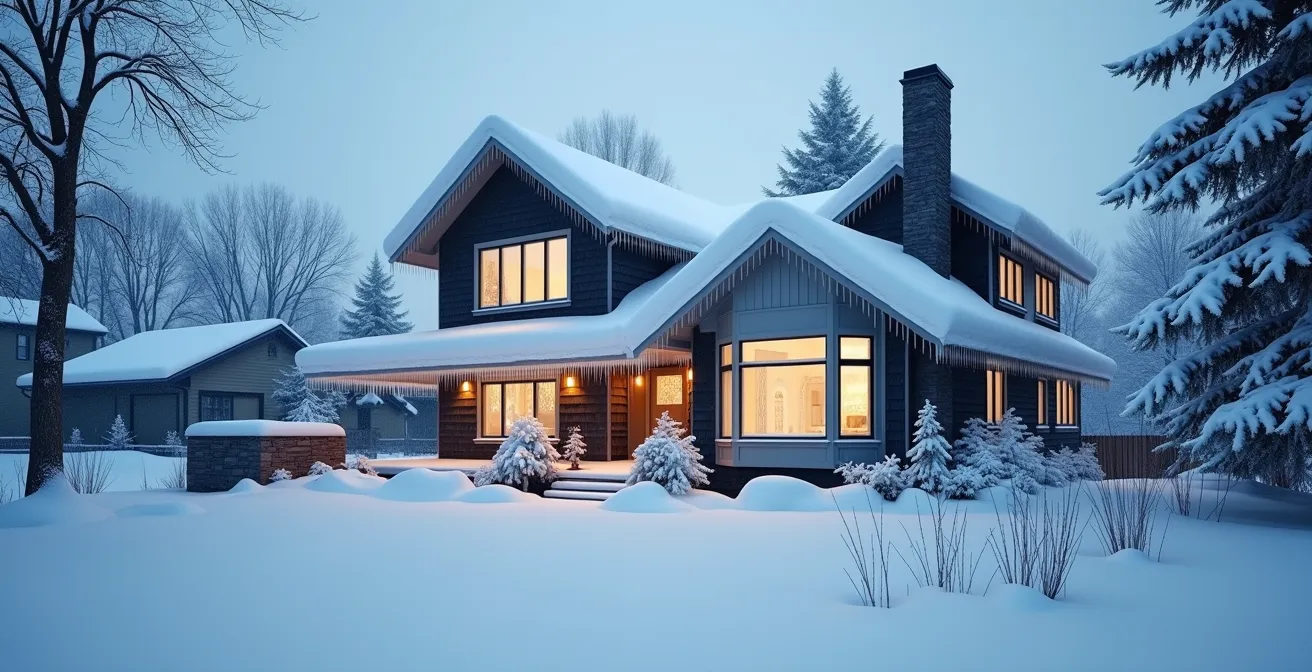
Protecting a vacant Canadian home in winter requires a multi-layered risk management system, not just turning down the thermostat.
- Active monitoring with a cellular temperature alarm is the first line of defense against furnace failure.
- Insurance compliance is non-negotiable; documented property checks every 48-72 hours are mandatory to prevent claim denial.
- A reliable backup power source is crucial to keep your heating system online during an ice storm blackout.
Recommendation: Before you travel, create a documented winterization plan that includes remote monitoring, a formal house-checking agreement, and a clear understanding of your insurance policy’s vacancy clause.
For any Canadian “snowbird” or winter traveller, the quiet fear of a home disaster during a deep freeze is all too real. You picture returning not to a peaceful sanctuary, but to a catastrophe of burst pipes, collapsed ceilings, and thousands of dollars in water damage. The common advice—”just leave the heat on low”—is dangerously simplistic. It ignores the cascading failure points that can occur when a furnace quits during an ice storm or a power grid fails under load. Protecting your most valuable asset while you’re away isn’t about a single action; it’s about building a robust, layered system of defense.
True peace of mind comes from shifting your mindset from passive prevention to active risk management. This involves understanding the nuances of your insurance policy’s vacancy clause, implementing redundant systems like backup power, and leveraging technology that alerts you to a problem the moment it happens, not weeks later. This guide moves beyond the basics to provide a comprehensive strategy. We will cover active monitoring, the critical details of insurance compliance, options for keeping your heat on during a blackout, and the definitive procedures for draining your system if you choose to turn the heat off entirely.
For those who prefer a visual walkthrough of a key winterization process, the following video provides a detailed demonstration of how to blow out plumbing lines to ensure no water remains to freeze.
This article is structured to provide a step-by-step framework for securing your property. By following this comprehensive approach, you can transform your winter absence from a period of anxiety into one of genuine relaxation, confident that your home is protected against the worst of a Canadian winter.
Summary: Safeguarding Your Vacant Home in a Canadian Winter
- Why you need a temperature alarm connected to your phone before traveling
- The step-by-step guide to draining pipes if you turn off the heat completely
- Hydronic heating with glycol: is the freeze protection worth the efficiency loss?
- The 48-hour rule: why your insurance denies your claim if no one checked the house
- Gas vs Battery generator: which keeps the furnace running during an ice storm blackout?
- The step-by-step guide to draining pipes so they don’t burst at -30°C
- Title Insurance: is it a cash grab or a savior against survey errors?
- How to manage a remote cottage property without spending every weekend fixing things?
Why you need a temperature alarm connected to your phone before traveling
Relying on a neighbor to “keep an eye on things” is a strategy based on hope, not certainty. The single most common point of failure for a vacant home in winter is an unexpected furnace shutdown. A simple power outage, a mechanical fault, or a tripped breaker can cause your home’s internal temperature to plummet, putting your plumbing at risk within hours. A cellular temperature alarm is your first and most critical line of defense, transforming your protection strategy from passive to active.
Unlike WiFi-based systems that fail the moment your internet router loses power, cellular monitors operate independently. They use their own mobile connection and have a backup battery, ensuring they can send you a critical low-temperature alert even during a widespread blackout. This instant notification is the difference between a minor inconvenience (calling a technician to restart a furnace) and a catastrophic flood. The financial stakes are enormous; according to one major insurer, over $181 million was paid for 9,000 frozen pipe claims, with the average cost exceeding $20,000. An investment in a reliable monitoring system is negligible by comparison.
When choosing a system, consider the key differences. A cellular system provides a major advantage during power outages and in remote areas without consistent internet.
| Feature | WiFi-Based Systems | Cellular Systems (e.g., CabinPulse) |
|---|---|---|
| Power Outage Operation | Fails when router loses power | Continues monitoring with backup battery (up to 3 days) |
| Temperature Accuracy | ±1-2°C typical | ±0.2°C precision |
| Alert Threshold | Fixed presets only | Customizable (e.g., 3°C, 5°C) |
| Coverage | Requires internet infrastructure | Works anywhere with cellular signal |
Ultimately, a temperature alarm acts as your digital proxy, watching over your property 24/7. It provides actionable data, allowing you to respond to a problem in real-time and providing invaluable peace of mind while you are thousands of kilometres away.
The step-by-step guide to draining pipes if you turn off the heat completely
In some situations, particularly for long-term absences or at a rustic cottage, you may choose the “nuclear option”: shutting off the heat and completely winterizing the plumbing. This method offers the most robust protection against frozen pipes but requires a meticulous, step-by-step process. Simply turning off the water and opening a tap is insufficient; residual water trapped in low points or horizontal runs is all it takes for ice to form, expand, and crack a pipe or fitting.
The goal is to remove every last drop of water from the supply lines, fixtures, and appliances. The most effective method involves using an air compressor to physically blow the water out of the system. This ensures that even complex plumbing layouts are thoroughly cleared. Remember to protect drains and toilets as well, as the water in P-traps and bowls can freeze, crack porcelain, and allow sewer gases to enter the home. For this, a non-toxic RV antifreeze is the industry-standard solution.
This image shows the critical connection point where a professional uses compressed air to ensure plumbing lines are completely free of water.
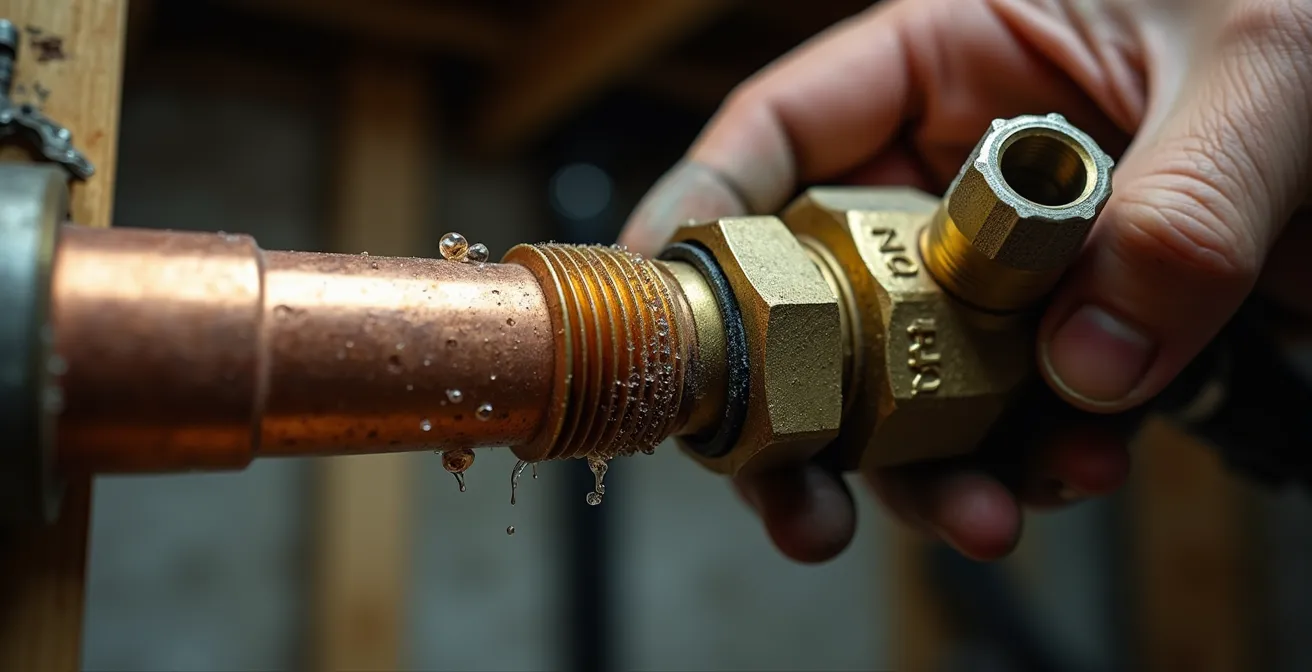
Following a precise checklist is not optional; it is essential to a successful winterization. Missing a single step, like forgetting to open the highest faucet to prevent an air lock, can render the entire process ineffective. Be systematic and thorough.
Hydronic heating with glycol: is the freeze protection worth the efficiency loss?
For homes with hydronic (hot water) heating systems, a burst pipe in the heating loop can be even more destructive than one in the domestic water supply. One solution to mitigate this specific risk is to introduce propylene glycol—an antifreeze—into the heating system’s water. This lowers the freezing point of the fluid significantly, providing robust protection against freezing even if the boiler fails and the house temperature drops below zero.
However, this protection comes at a cost. Glycol has a lower heat transfer capacity than water, meaning a glycol/water mixture is less efficient at carrying heat from the boiler to your radiators or in-floor tubing. This can lead to slightly higher energy bills, as the system must work harder to maintain the desired temperature. You must weigh this small, ongoing efficiency loss against the massive potential cost of a system failure. With Canadian insurance data showing water damage claims averaging $15,000-$25,000, the cost of a freeze-related rupture in a heating system can be financially devastating.
As Master Plumber Ben Goheen explains in the SharkBite Winterization Guide, the danger is acute during prolonged cold snaps:
Pipe bursts and flooding occur when water inside pipes freezes and expands, most likely when temperatures stay below freezing for 24-48 hours
– Ben Goheen, Master Plumber, SharkBite Winterization Guide
The decision to use glycol is a risk-benefit analysis. For a primary residence left vacant for a few weeks, it might be overkill if other systems (alarms, house-checkers) are in place. For a remote cottage that is difficult to access in winter, or for homeowners seeking the absolute highest level of protection, the slight reduction in heating efficiency is a small price to pay for a virtually freeze-proof heating system.
The 48-hour rule: why your insurance denies your claim if no one checked the house
This is the single most overlooked and financially devastating aspect of leaving a home vacant in winter. Many homeowners assume that as long as they pay their premiums, they are covered for events like burst pipes. This is a dangerous assumption. Buried in the fine print of most Canadian home insurance policies is a “vacancy clause” or “unoccupied property” exclusion, which stipulates specific conditions that must be met if you are away during the “usual heating season.”
The most critical condition is the requirement for a competent person to check the property on a regular basis. While the exact frequency varies, most insurers demand checks every 48 to 72 hours. The purpose is to ensure the heating system is operational and to detect any issues before they become catastrophic. If you leave your home for two weeks and have no documented proof of these checks, your insurer has the right to deny your entire water damage claim, even if the furnace failure was not your fault. Simply asking a neighbor to “drive by” is not enough.
You need a formal arrangement and, crucially, a detailed log of every visit. This documentation is your proof of compliance in the event of a claim. Without it, you are effectively self-insuring against a six-figure risk. The person checking must physically enter the home and verify that heat is maintained.
Action Plan: House-checker documentation checklist
- Record the date and time of each visit in a dedicated logbook or shared digital document.
- Note the indoor temperature reading from the thermostat at each check.
- Perform a visual inspection of all visible faucets and plumbing fixtures for drips or leaks.
- Confirm that the furnace or boiler is functioning correctly (e.g., by sound or by feeling warm air/pipes).
- Take a time-stamped photograph during each visit, showing a thermometer or the thermostat display as dated evidence.
Failing to adhere to these requirements is not a risk worth taking. It can void the very protection you count on. Treat this as a non-negotiable part of your pre-travel preparations.
Gas vs Battery generator: which keeps the furnace running during an ice storm blackout?
Your temperature alarm and diligent house-checker are rendered useless if the power goes out and your furnace has no energy to run. An ice storm can knock out power for days, which is more than enough time for a house to freeze. A backup power source is the final layer in a truly redundant home protection system. The primary choice is between a permanently installed natural gas generator and a portable gasoline or battery-powered unit.
A standby natural gas generator is the gold standard. It wires directly into your electrical panel, senses an outage automatically, and starts itself within seconds. Because it runs on your home’s natural gas line, it has a virtually unlimited runtime and requires no refueling during a blizzard. It provides clean, stable power suitable for the sensitive electronics in modern high-efficiency furnaces.
This image illustrates the sense of security a reliable backup power system provides during a severe winter storm.
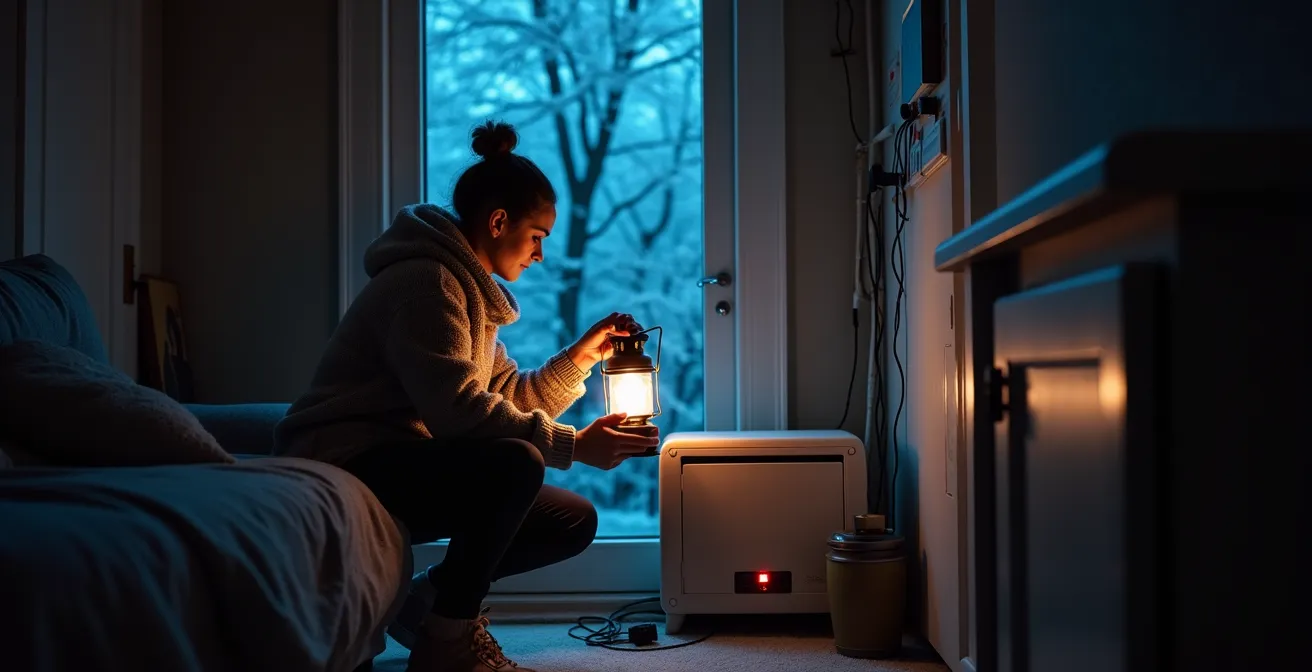
Portable gasoline generators are a cheaper alternative but come with significant drawbacks for this purpose. They require frequent refueling, which is impractical for an unattended home, and gasoline can “gel” and fail to ignite in extreme cold. Furthermore, only “inverter” models produce power that is clean enough for modern furnace electronics. A battery power station is a simpler, safer option for short-term outages, but its capacity is a major limitation. A large unit might only run a furnace blower for a few hours, and its performance degrades significantly in cold temperatures.
| Generator Type | Runtime | Furnace Compatibility | Cold Weather Performance |
|---|---|---|---|
| Natural Gas (Standby) | Unlimited with gas supply | Clean power for electronics | No fuel concerns in blizzards |
| Gasoline Portable | 8-12 hours per tank | Requires inverter type for modern furnaces | Fuel gelling below -20°C |
| Battery Power Station | 2-6 hours for furnace | Pure sine wave safe for electronics | Capacity drops 30-50% in extreme cold |
For a snowbird leaving for weeks, a standby generator offers true “set it and forget it” protection. For shorter trips or as a more budget-conscious measure, a large battery station can provide a critical buffer, but it is not a long-term solution.
The step-by-step guide to draining pipes so they don’t burst at -30°C
The act of draining pipes becomes exponentially more critical when facing the deep freeze of a Canadian winter, where temperatures can hold at -30°C for days. At these temperatures, any pocket of water, no matter how small, will freeze solid with immense expansive force. According to plumbing experts, the primary danger zone begins when pipes are exposed to temperatures of -6.7°C (20°F) or lower for a sustained period.
The material of your pipes plays a significant role in their vulnerability. While modern PEX (cross-linked polyethylene) tubing can expand slightly to accommodate some ice formation, it is not invincible. The weak points are the fittings and connection points, where the plastic cannot expand, and the pressure from the ice plug concentrates. Traditional copper pipes have zero tolerance for expansion and will split or burst when frozen solid. Draining the system completely is the only guaranteed method of protection for copper and the safest method for PEX.
Case Study: PEX vs. Copper Pipe Performance
Plumbing systems using push-to-connect fittings are compatible with both PEX and copper pipes. In controlled freeze tests and field observations, PEX tubing demonstrates superior resistance to bursting compared to rigid copper. However, failures in PEX systems almost always occur at the connection points, where the mechanical fitting creates a rigid stress point. An ice plug forming against a fitting can exert enough pressure to crack the fitting or push the pipe out, causing a major leak once a thaw occurs. This highlights that even with freeze-resistant pipes, complete draining remains the most reliable winterization strategy.
The draining process for extreme cold is identical to the general procedure but with an added emphasis on verification. After blowing the lines out with compressed air, it is wise to disconnect the lowest point in the system (like a washing machine hookup or basement utility sink) and check for any residual drips. This confirms the system is truly empty and secure against even the most severe cold snap.
Title Insurance: is it a cash grab or a savior against survey errors?
While protecting your home from internal threats like freezing pipes is paramount, a comprehensive risk management strategy also considers external, hidden threats to your property’s value. Title insurance is a policy that protects you from financial loss related to issues with your property’s title or ownership. While it may seem disconnected from winterization, it operates on the same principle: insuring against a low-probability, high-cost event that is beyond your direct control.
Common issues covered by title insurance include survey errors, where a fence or structure encroaches on a neighboring property; unresolved liens from previous owners’ unpaid debts; or fraudulent transfers of ownership. These are not physical damages but legal and financial problems that can cost tens of thousands of dollars to resolve and cloud your ability to sell the property. Like a burst pipe, a title defect is a problem you often don’t know you have until it’s too late.
A specific area of overlap with physical property management is coverage for external service lines. Some home insurance policies exclude the water and sewer lines running from your house to the municipal connection at the street. If this line were to freeze and burst under the driveway, the excavation and repair costs could be astronomical. Evaluating your home insurance for a “service line protection” rider—or confirming it’s covered by title insurance—is a critical step. The process is expensive, as Apollo Home Services notes, so you should be proactive about avoiding this issue through proper coverage.
The debate over whether title insurance is a “cash grab” often stems from a misunderstanding of its purpose. It’s a one-time premium paid at closing that provides protection for as long as you own the property. For a traveller leaving a significant asset unattended, it’s another layer in a complete risk mitigation plan, safeguarding the home’s legal and financial integrity just as a freeze alarm protects its physical integrity.
Key Takeaways
- Winter property protection is a system of redundancies, not a single action.
- Documented, regular checks by a competent person are non-negotiable for insurance compliance.
- A cellular-based temperature alarm is the most reliable first alert against furnace failure and power outages.
How to manage a remote cottage property without spending every weekend fixing things?
Managing a remote cottage, especially through a harsh Canadian winter, extends the principles of home protection into a long-term strategy. The challenge is magnified by distance and potentially unreliable infrastructure. The goal is to maximize enjoyment and minimize the “chore” aspect, which requires a smart, proactive approach combining technology, reliable personnel, and clear procedures.
The foundation of remote management is, once again, active monitoring. For a cottage in Muskoka or the Kawarthas, where cell service is often more reliable than rural internet, a cellular monitoring system is essential. It’s the only way to get a real-time alert for a power outage or a temperature drop, giving you the chance to dispatch help before a pipe freezes. Many cottage owners find this technology to be a complete game-changer, eliminating the constant “what if” anxiety that comes with owning a remote property.
The second pillar is your on-the-ground support. You must choose between relying on a neighbor or hiring a professional cottage watch service. While a neighborly agreement is cost-effective, it comes with significant limitations in liability and availability. A professional service provides bonded and insured personnel, guaranteed visit schedules, and detailed reports that are invaluable for insurance purposes.
| Aspect | Professional Service | Neighbor Agreement |
|---|---|---|
| Liability Coverage | Bonded and insured | Personal relationship only |
| Documentation | Professional reports for insurance | Informal or none |
| Availability | Guaranteed schedule | Subject to neighbor’s schedule |
| Emergency Response | 24/7 with contractors on call | Limited to neighbor’s ability |
Ultimately, effective remote property management is about creating a system you can trust. By investing in monitoring technology and establishing a formal, reliable house-checking protocol, you can spend your time planning your next trip to the cottage, not worrying about what you might find when you get there.
By implementing these layered strategies—from active monitoring and insurance compliance to backup power and thorough winterization procedures—you can leave your Canadian home with confidence. The next logical step is to perform a detailed risk assessment of your own property and create a customized winterization checklist based on these expert recommendations.
Frequently asked questions about Protecting a Vacant Canadian Home in Winter
What temperature must I maintain if leaving my home vacant in winter?
To help prevent pipes from freezing, you should keep the heat set to approximately 12°C or higher. This provides a safe buffer in case of a sudden drop in outdoor temperature or minor heating inefficiencies.
How often must someone check my vacant property?
Most Canadian insurance providers require a competent person to perform and document a check of your property every 48 to 72 hours during the winter months to ensure the heating system is operational.
What happens if I don’t follow vacant property requirements?
If you fail to meet the requirements of your policy’s vacancy clause, such as regular documented checks, insurance companies may have the right to deny any claims related to damage from frozen pipes.