
Massive icicles aren’t a winter feature; they’re a clear sign your house is haemorrhaging heat and money through a failing building envelope.
- Ice dams are caused by a “hot roof,” a symptom of systemic failure in your home’s entire thermal system, not just an attic problem.
- A permanent fix requires a balanced system: achieving R-60 insulation, comprehensive air sealing from basement to attic, and ensuring adequate ventilation.
Recommendation: Focus on eliminating thermal bypasses and balancing insulation with ventilation, not just adding depth. Qualify for the Canada Greener Homes Grant to offset the costs of a permanent fix.
If you’re a Canadian homeowner, you know the sight: a breathtaking, destructive curtain of icicles hanging from your eaves. Many people reach for a roof rake or install expensive heat cables, treating the symptom. These are temporary, costly band-aids. The truth is, those massive icicles are a distress signal. They’re telling you that heat from your living space is escaping into the attic, melting the snow on your roof from below, which then refreezes at the cold edge of your eaves. This is the birth of an ice dam.
The problem isn’t just the icicles; it’s the water trapped behind them, which can work its way under your shingles, causing rot, mould, and costly structural damage. The real culprit is a combination of inadequate insulation, air leakage, and poor ventilation. It’s a systemic failure of your home’s building envelope system. Upgrading your attic insulation to R-60 is a critical step, but it’s only one part of the equation. A permanent solution requires a holistic approach, addressing heat loss from the foundation all the way up to the roof peak.
This guide provides a pragmatic, no-nonsense approach from a contractor’s perspective. We’ll diagnose the root causes of heat loss throughout your home and lay out the exact steps to create a high-performance, ice-dam-proof system. We’ll cover not only *what* to do but *why* you’re doing it, empowering you to make informed decisions for a warmer, more efficient, and permanently protected home.
This comprehensive guide breaks down the essential components of a whole-home insulation strategy. We will explore how each part of your house contributes to the problem and how to implement the correct solutions, from material selection to qualifying for government incentives.
Summary: A Contractor’s Guide to Eliminating Ice Dams and High Energy Bills
- Why are massive icicles on your eaves a symptom of heat loss, not just weather?
- Why adding insulation without improving soffit venting makes ice dams worse
- Why fiberglass batts lose 40% of their R-value when compressed by wiring?
- How to find the hidden studs that are leaking heat right through your walls?
- Why the rim joist is the coldest part of your basement and how to fix it for under $200?
- Spray foam or Fiberglass: which offers better value for basement walls?
- The “sick building” syndrome: what happens when you insulate without adding ventilation?
- How to qualify for the Canada Greener Homes Grant for insulation upgrades?
Why are massive icicles on your eaves a symptom of heat loss, not just weather?
Seeing icicles on a house is so common in Canada that most people assume it’s a normal part of winter. It’s not. Those icicles are the final, visible stage of a process that starts inside your home. Every dollar you spend on heating creates warm, buoyant air that actively tries to escape, a phenomenon known as the stack effect. This air finds any and every path upward, through light fixtures, plumbing stacks, attic hatches, and countless other small gaps. When this warm air enters your cold attic, it raises the temperature of the underside of your roof deck above freezing.
Simultaneously, the snow on top of your roof acts as a surprisingly effective insulator. The roof deck warms up, melts the layer of snow it’s in contact with, and sends water flowing down toward the eaves. But your eaves overhang the heated part of your house, so they remain at the frigid outdoor temperature. As the meltwater reaches this cold zone, it refreezes, forming a small ridge of ice. This process repeats, layer by layer, creating a dam that traps more water behind it. The financial stakes are high; according to Insurance Information Institute data, water damage and freezing are a leading cause of homeowner claims.
This trapped water has nowhere to go but up, seeping back under shingles and penetrating your roof deck. This leads to water-stained ceilings, saturated insulation, rotted wood, and mould. The problem is a “hot roof,” and the only permanent solution is to keep your entire attic and roof deck consistently cold, just like the outdoors. As one building science expert on the Green Building Advisor forum notes, treating the symptom is a losing battle:
Heat cables are an expensive, energy-intensive band-aid that treats the symptom, whereas upgrading attic insulation to R-60 is the permanent cure that also lowers heating bills.
– Building Science Expert, Green Building Advisor Forum
Why adding insulation without improving soffit venting makes ice dams worse
A common mistake homeowners make is to simply blow more insulation into the attic without considering airflow. They believe more R-value is always better, but they inadvertently create a bigger problem. Insulation slows heat transfer, but it doesn’t stop air movement. A proper attic must function as a balanced system of insulation and ventilation, working together to keep the roof deck cold.
Ventilation’s job is to create a continuous flow of cold, dry outdoor air through the attic. This air enters through vents in the soffits (the underside of your eaves) and exits through vents at or near the roof’s peak (ridge vents, gable vents, etc.). This airflow serves two critical functions: it flushes out any heat that does manage to escape from your living space, and it removes moisture that migrates into the attic, preventing condensation and mould.
When you add deep insulation like R-60, it’s easy to block the soffit vents, effectively suffocating your attic. Without this cold air intake, the attic space stagnates. Heat builds up, the roof deck gets warm, and you’ve created the perfect conditions for the ice dam cycle you were trying to prevent. The National Building Code of Canada has specific requirements, but practical experience often calls for more. While the code might specify a 1:300 ventilation ratio, building science research indicates that ensuring a clear 2-inch air gap above the insulation at the eaves with baffles prevents the vast majority of ice dams. This small detail is non-negotiable for a successful upgrade.
Why fiberglass batts lose 40% of their R-value when compressed by wiring?
Fiberglass batts are a popular choice for DIY insulation projects, but their effectiveness is entirely dependent on proper installation. The “R” in R-value stands for resistance to heat flow, and that resistance comes from the millions of tiny air pockets trapped within the fiberglass fibers. When you compress a batt, you squeeze out that air, destroying its insulating capability.
A common culprit for this is electrical wiring. In many attics, especially in older Canadian homes, wiring runs across the top of the ceiling joists. A homeowner might simply lay a new layer of batts directly over these wires, compressing the insulation. An R-19 batt (typically 6 inches thick) compressed to fit a 3.5-inch space doesn’t become R-19 in a smaller package; its effective R-value drops to around R-11, a loss of over 40% of its performance. This compression not only reduces the R-value but also creates convection pathways, or air channels, along the wiring where heat can bypass the insulation entirely.
The correct method is to split the batt lengthwise, placing one half under the wire and the other half over it, maintaining the full loft of the insulation. For areas with complex wiring, blown-in insulation (like cellulose or fiberglass) is often a superior choice as it naturally fills all voids without compression. This issue is even more critical in heritage homes. The “Montreal Heritage Home Retrofit Challenge” provides a stark warning: a homeowner attempting a DIY project compressed batts over old knob-and-tube wiring, which requires open air for cooling. This led to overheating and a small electrical fire, necessitating a costly $15,000 rewiring job before proper insulation could be safely installed.
How to find the hidden studs that are leaking heat right through your walls?
While your attic is the primary culprit for ice dams, it’s part of a larger system. Heat also escapes directly through your walls via a process called thermal bridging. Your wall insulation might be R-20, but the wood studs that frame the wall are only about R-4. These studs act like highways for heat, bypassing the insulation and creating cold stripes on your exterior walls. In fact, research from MyHEAT thermal imaging studies shows that up to 25% of a home’s total heat loss can occur through thermal bridging.
Professionals use thermal imaging cameras to see these patterns of heat loss, which are invisible to the naked eye. These devices show exactly where the building envelope is failing, allowing for targeted fixes. You can see the studs, headers over windows, and other framing members glowing with escaping heat.

As you can see, the camera reveals a story the wall itself conceals. But you don’t necessarily need expensive equipment to identify these thermal bridges. There are low-tech methods you can use, especially during a cold Canadian winter, to get a good idea of where your walls are underperforming.
Your Action Plan: Low-Tech Thermal Bridge Detection
- Wait for a very cold day when the outdoor temperature drops below -10°C, which creates a strong temperature differential.
- Ensure your indoor thermostat is set to a steady 21°C for several hours to establish a consistent heat flow.
- In the early morning, inspect your exterior walls for frost patterns. Faint vertical lines of frost can indicate the colder surface temperatures above your studs.
- After a light snowfall, observe how the snow melts on your walls. Areas that melt faster are clear indicators of thermal bridges leaking heat.
- Inside, use a non-contact infrared thermometer (available for under $40) to scan your walls. A sudden temperature drop of 3-5°C often pinpoints a stud location.
Why the rim joist is the coldest part of your basement and how to fix it for under $200?
The “stack effect” that drives heat into your attic begins its journey in the lowest part of your house: the basement. The single biggest point of heat loss and air leakage here is often the rim joist (also known as the band joist). This is the wooden perimeter that sits on top of your concrete foundation, where the floor joists of the main level end. In many older Canadian homes, this area is completely uninsulated.
The rim joist is essentially a thin piece of wood separating your heated basement from the frigid outside air. It’s a massive thermal bridge and a major source of air infiltration that fuels the upward flow of air in your home. Sealing and insulating this area is one of the highest-impact, lowest-cost energy retrofits you can perform. As Natural Resources Canada’s Keeping the Heat In guide confirms, an up to 30% reduction in basement heat loss can be achieved by properly insulating the rim joist alone. This simple fix slows the engine that drives warm air towards your attic.
Best of all, this is a very DIY-friendly project that can be done for well under $200. The most effective method is the “cut-and-cobble” approach. You’ll need a few sheets of rigid foam insulation (like XPS or polyisocyanurate), a tape measure, a utility knife, and a can of low-expansion spray foam. Simply measure each cavity between the floor joists, cut a piece of rigid foam to fit snugly, and push it into place against the rim joist. Then, use the canned spray foam to seal all four edges of the foam board. This creates a robust air and thermal barrier, dramatically improving comfort and reducing the stack effect in your home.
Spray foam or Fiberglass: which offers better value for basement walls?
Once you’ve addressed the rim joist, you might consider insulating your basement walls. This further reduces the stack effect and creates a more comfortable, usable space. The two most common choices are fiberglass batts and closed-cell spray foam, and they offer very different value propositions, especially in a Canadian climate.
Fiberglass batts are inexpensive and easy for a handy homeowner to install. However, they are not a complete solution on their own. Fiberglass is not an air barrier or a vapour barrier. To meet building codes, you must meticulously install a separate 6-mil polyethylene vapour barrier on the warm side of the wall, carefully sealing every seam and penetration. Any mistake can lead to air leakage and condensation within the wall assembly. Fiberglass also offers no protection against soil gases like radon, a significant concern in many parts of Canada.
Two-pound closed-cell spray foam, while more expensive upfront and requiring professional installation, is an all-in-one solution. It acts as high-performance insulation (around R-7 per inch), an air barrier, and an approved vapour barrier in a single application. Its rigid, adhesive nature also means it can serve as an effective radon barrier when properly applied. The superior air-sealing properties of spray foam often lead to a higher EnerGuide rating, unlocking larger rebates through programs like the Canada Greener Homes Grant.
The following table, based on typical Canadian material and labour costs, breaks down the long-term value:
| Factor | 2lb Closed-Cell Spray Foam | Fiberglass Batts + Vapor Barrier |
|---|---|---|
| Upfront Cost (per sq ft) | $3.50-$5.00 CAD | $1.50-$2.50 CAD (DIY) |
| R-Value per inch | R-7 | R-3.5 |
| Vapor Barrier | Built-in (approved) | Separate poly required |
| Radon Barrier | Yes (when properly sealed) | No |
| Air Sealing | Excellent (increases EnerGuide score) | Poor (requires additional sealing) |
| Greener Homes Grant Potential | Higher rebate due to air-tightness | Lower rebate potential |
Case Study: Manitoba Home Retrofit
A Winnipeg homeowner with high radon levels (above the Canadian guideline of 200 Bq/m³) chose closed-cell spray foam for their basement. The installation not only reduced radon infiltration by 85% but also qualified them for a $1,500 rebate through the Canada Greener Homes Grant due to the dramatic improvement in the home’s air-tightness score. Their heating costs dropped by $450 annually, resulting in a 7-year payback period.
The “sick building” syndrome: what happens when you insulate without adding ventilation?
In our drive for energy efficiency, we’ve made our homes increasingly airtight. This is great for stopping drafts and lowering heating bills, but it comes with a serious consequence if not managed properly. Older, leaky houses had “natural” ventilation—drafts. A well-sealed modern or retrofitted home doesn’t. Without a way to exchange stale indoor air with fresh outdoor air, you can create “sick building syndrome.”
As you seal up air leaks and add insulation, you trap more than just heat. You trap moisture from cooking, showering, and even breathing. You also trap indoor air pollutants like VOCs (from paint and furniture), dust, and allergens. In a Canadian winter, this moisture-laden indoor air finds the coldest surfaces, typically windows, and condenses, leading to weeping windows, mould growth, and a musty smell. Indoor humidity can skyrocket, creating an unhealthy living environment.
As Ryan Carr, an HVAC expert, explained in HPAC Magazine, we have to engineer what used to happen naturally:
In our quest for energy efficiency we have tightened up that building envelope and we no longer have that natural heat exchange, so we have to give the house lungs.
– Ryan Carr, HPAC Magazine
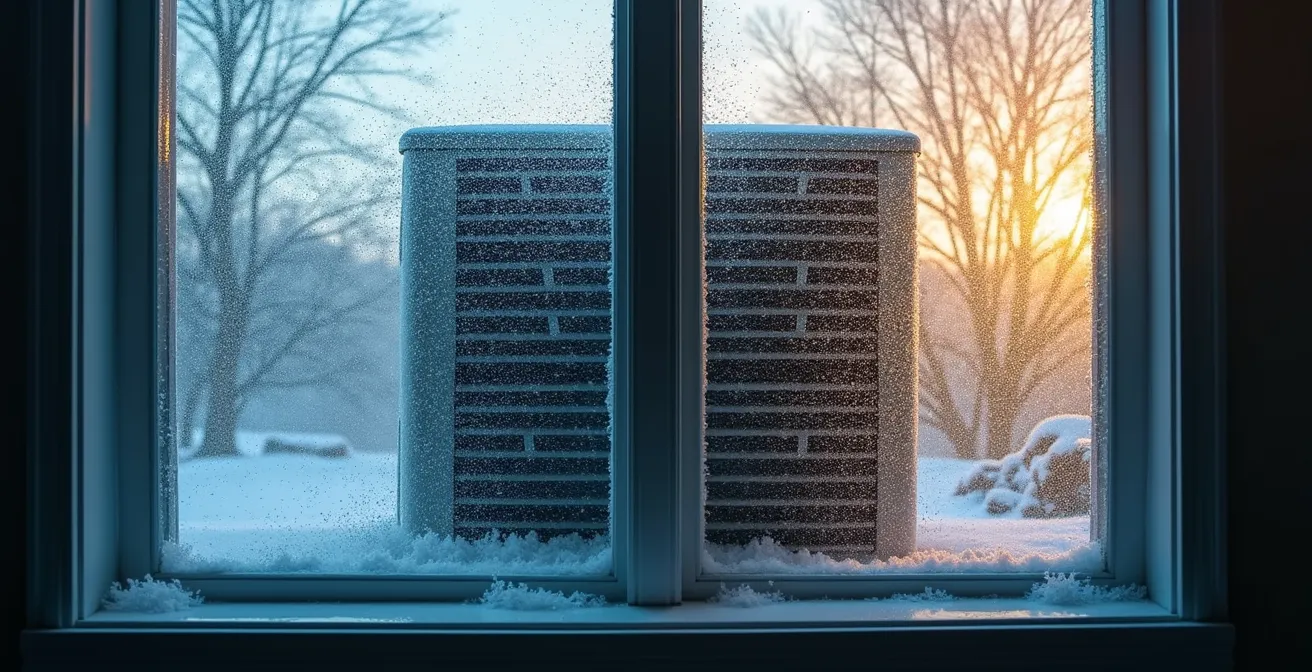
Those “lungs” are a mechanical ventilation system, most often a Heat Recovery Ventilator (HRV). An HRV is a device that continuously exhausts stale, humid indoor air while bringing in fresh, dry outdoor air. Inside the unit’s core, the heat from the outgoing air is transferred to the incoming cold air, so you get fresh air without a significant energy penalty. A case study of a 1980s Ottawa home illustrates this perfectly: after extensive air-sealing, the home developed severe condensation and mould. The installation of an HRV resolved all moisture issues within weeks while preserving the energy savings from the insulation work.
Key Takeaways
- Ice dams are a symptom of a systemic heat loss problem, not just a roof issue. A “hot roof” is the enemy.
- A permanent solution requires a balanced system of insulation (R-value), air sealing (stopping leaks), and ventilation (airflow). One without the others will fail.
- Use Canadian government grants like the Canada Greener Homes Grant to help fund a permanent, whole-home solution instead of wasting money on temporary band-aids.
How to qualify for the Canada Greener Homes Grant for insulation upgrades?
Fixing your home’s building envelope is a significant investment, but the Canadian government offers substantial financial help through the Canada Greener Homes Grant. This program provides grants to help homeowners make their homes more energy-efficient. Getting the maximum rebate, however, requires following the process exactly. You cannot start any work before you’ve had your initial evaluation.
The program is designed to work in tandem with provincial initiatives, allowing you to “stack” rebates. For example, according to Natural Resources Canada program guidelines, you can get up to $10,000 in combined rebates when pairing the federal grant with Ontario’s Home Efficiency Rebate Plus program. Similar top-ups exist in other provinces like British Columbia and Manitoba. The key is to work with a registered Energy Advisor who will conduct pre- and post-retrofit EnerGuide evaluations. This advisor’s report is your roadmap, detailing which upgrades will provide the best energy savings and qualify for the largest rebates.
For attic insulation, a key target is to upgrade a minimum of 20% of the total attic area to at least R-60 to qualify for the highest rebate tier for that specific measure. Critically, the program also offers separate rebates for air-sealing work, which is essential for stopping ice dams. Bundling comprehensive air-sealing with your insulation upgrade will not only solve your problem but also maximize your total grant amount. The following plan outlines the mandatory steps to ensure you receive every dollar you’re entitled to.
Your Action Plan to Secure the Canada Greener Homes Grant
- Register online through the official Canada Greener Homes portal. This must be done before you sign any contracts or start any work.
- Book a pre-retrofit EnerGuide evaluation with an NRCan-registered Energy Advisor. The cost of this evaluation (around $600) is reimbursable.
- Carefully review the Renovation Upgrade Report provided by your advisor. It will list eligible retrofits and their potential rebate amounts.
- Investigate and apply for any available provincial programs to stack on top of the federal grant.
- Hire only registered and insured contractors for the work. Verify their credentials before they begin.
- Complete all work as recommended in your report, ensuring you meet minimum requirements like insulating to R-60.
- Document everything. Keep all receipts and take photos of the work in progress and after completion. You must keep these until March 31, 2028.
- Schedule your post-retrofit EnerGuide evaluation with the same Energy Advisor to verify the improvements.
- Submit all your documentation through the portal to receive your rebate. Be mindful of program deadlines.
Frequently Asked Questions about Upgrading Home Insulation
Can I insulate over knob-and-tube wiring in my Toronto home?
No, this violates the Canadian Electrical Code. Knob-and-tube wiring requires air circulation to dissipate heat. You must have it replaced by a licensed electrician before adding any insulation.
How do I properly insulate around modern electrical wiring?
Split fiberglass batts lengthwise and wrap them around wires to maintain loft. Never compress batts over wiring. For complex wiring, consider blown-in insulation which naturally fills voids without compression.
What happens to R-value when batts are compressed?
A 6-inch R-19 batt compressed to 3.5 inches provides only R-11, losing 40% of its insulating value. Additionally, compression creates air channels that allow moisture-laden air to bypass insulation entirely.