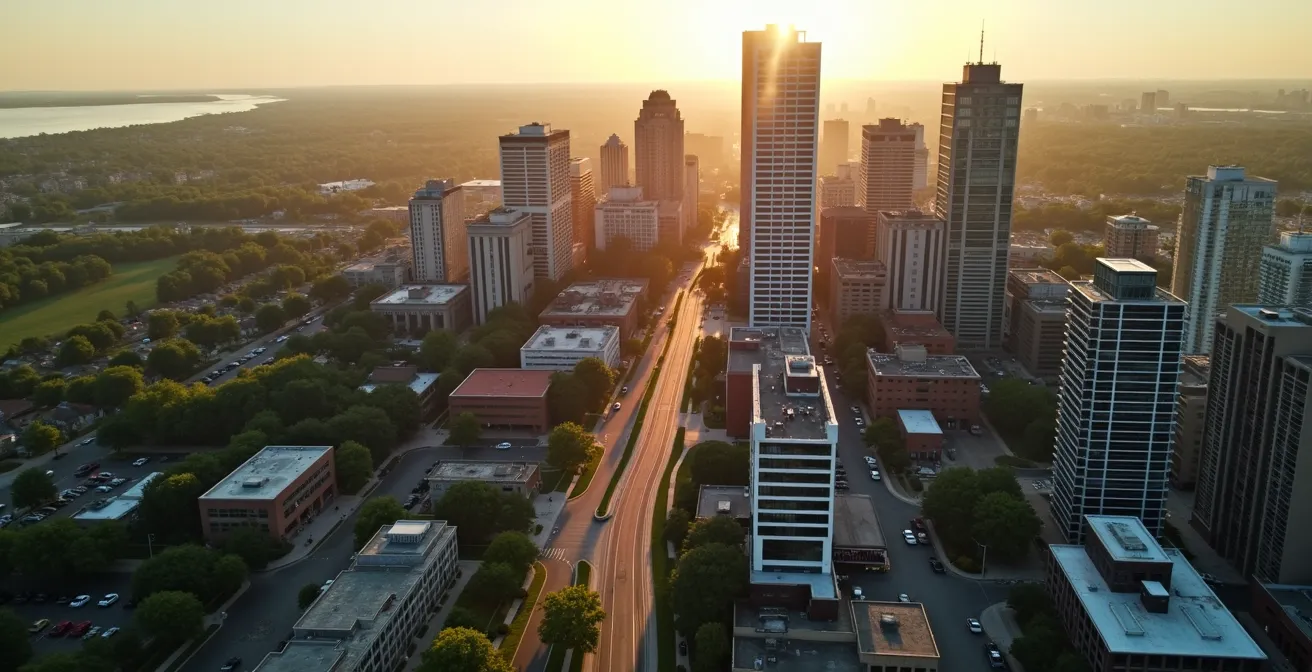
Your property is a thermal system, and mastering its surfaces—from the roof to the driveway—is the most effective way to cut summer cooling costs.
- Reflective or green materials on roofs and pavement dramatically lower heat absorption (the albedo effect).
- Vegetation like trees and green walls actively cools the air through shade and evapotranspiration.
- Stopping solar radiation before it enters your windows is far more effective than blocking it from inside.
Recommendation: Begin by identifying your property’s largest, darkest, sun-exposed surfaces; these are your primary targets for intervention and offer the greatest potential for savings.
That feeling of a city that never cools down, even long after sunset, is a shared experience for millions of Canadians. As you walk through dense urban neighbourhoods, the air shimmers above the asphalt, and buildings radiate a warmth that seems to follow you indoors, forcing the air conditioner to run endlessly. This phenomenon, the urban heat island (UHI) effect, is more than just a comfort issue; it’s a significant financial drain and a growing public health concern.
Common advice often revolves around large-scale solutions like municipal tree-planting programs or simply using your AC more efficiently. While important, these approaches can make the individual homeowner feel powerless. They overlook the fundamental physics at play right at your property line. Your home, your yard, and even your street are not just passive structures; they are an active thermal system constantly absorbing, storing, and releasing solar energy.
The key to reclaiming your comfort and lowering your energy bills isn’t just to combat the heat, but to manage the thermal performance of your immediate environment. This article will deconstruct the UHI effect at a micro-level, exploring your property as an urban climatologist would. We will move beyond simply stating *what* to do and explain *why* these strategies work, giving you control over the heat flow around your home.
We’ll analyze everything from your roof and driveway to your windows and local greenery, providing a blueprint for transforming your home from a heat trap into a cool refuge. By understanding these principles, you can make targeted, effective changes that have a real impact on your wallet and well-being.
For those who prefer a visual introduction, the following video explores how the city of Chicago is tackling these same challenges with innovative green solutions that are increasingly relevant for Canadian cities.
This guide is structured to walk you through your property’s key thermal components. From the top down, we’ll examine each element’s role in the urban heat island effect and outline actionable, evidence-based strategies for mitigation.
Summary: A Homeowner’s Guide to Beating the Urban Heat Island Effect
- White Roofs vs Green Roofs: Which Is More Effective at Cooling the Top Floor?
- How to Petition the City to Plant Shade Trees on Your Street?
- Asphalt vs Concrete vs Pavers: How Driveway Color Affects Local Temperature?
- Why Heat Islands Prevent Your House From Cooling Down at Night
- External Blinds vs Internal Curtains: Stopping the Heat Before It Enters
- Why Does Crossing One Street in Queen West Change Property Value by $50k?
- Does Seeing Greenery From Your Window Actually Improve Productivity?
- Why Living Buildings With Green Walls Reduce Stress and Energy Bills?
White Roofs vs Green Roofs: Which Is More Effective at Cooling the Top Floor?
Your roof is the single largest surface of your home exposed to direct sunlight, making it the primary engine of heat gain. A traditional dark asphalt shingle roof can reach scorching temperatures in the summer sun, radiating that heat downwards into your living space. Tackling the roof is therefore the most impactful first step. The two leading strategies, cool “white” roofs and “green” roofs, approach the problem with different scientific principles.
A cool roof utilizes materials with high solar reflectivity (albedo) to bounce sunlight and its associated heat back into the atmosphere before it can be absorbed. This is a direct, brute-force method of preventing heat gain. A green roof, or living roof, is a layer of vegetation planted over a waterproof membrane. It works through a combination of shading, insulation from the soil medium, and a powerful cooling process called evapotranspiration, where plants release water vapor, actively cooling the surrounding air much like sweat cools the skin.
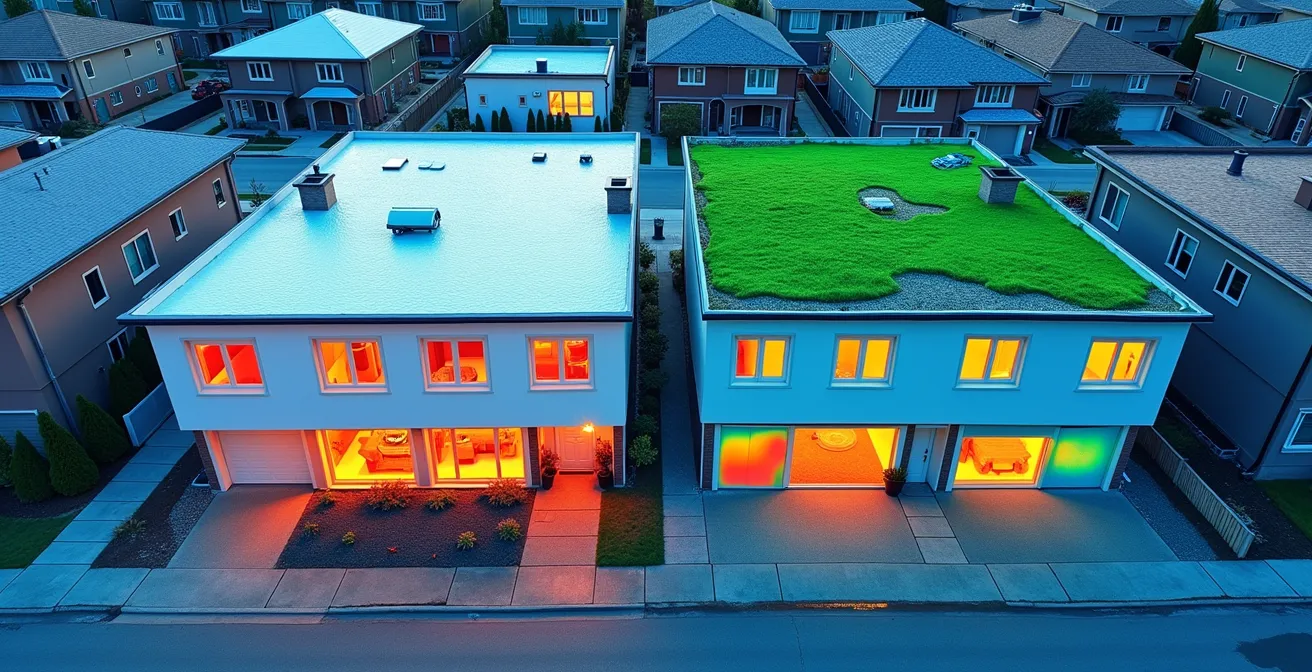
As the thermal image above illustrates, both methods are vastly superior to a conventional dark roof. For sheer temperature reduction on the top floor, a white roof is often the most effective and lower-cost option. However, a green roof offers a suite of co-benefits, including stormwater management, extended roof lifespan, and habitat creation. A well-known case study from Chicago’s City Hall demonstrated proven energy savings of about $3,600 per year from its green roof. In Canada, the ability of a green roof to manage heavy rainfall and snowmelt is a significant advantage.
Your Action Plan: Evaluating Cool Roof Options
- Assess current roof temperature: On a hot day, safely measure your roof’s surface temperature. Dark roofs can be significantly hotter than the ambient air temperature.
- Calculate potential savings: Research shows cool roofs can reduce air conditioning load by up to 20%, a substantial saving on summer energy bills.
- Consider winter heating impact: In Canadian climates, a reflective roof can have a slight “winter penalty” by reflecting solar heat you’d want to gain. This must be weighed against summer savings.
- Evaluate green roof co-benefits: Factor in the value of managing stormwater from snowmelt and heavy rainfall, which can reduce strain on municipal systems.
- Check for local incentives: Many Canadian municipalities, like Montreal’s Rosemont-La Petite-Patrie borough, offer rebates or have bylaws encouraging cool or green roofs.
How to Petition the City to Plant Shade Trees on Your Street?
Moving from your roof to your street, the presence—or absence—of a mature tree canopy is one of the most significant factors defining your local micro-climate. Trees are nature’s air conditioners, combating urban heat through two primary mechanisms: direct shading and evapotranspiration. A large tree can transpire hundreds of litres of water on a hot day, providing a cooling effect equivalent to several room-sized air conditioners running for 20 hours.
The impact of this is not trivial; it’s a matter of public health. For instance, Toronto research shows marginally increasing tree cover in neighbourhoods with less than 5% coverage could reduce heat-related ambulance calls by a staggering amount. If your street lacks this vital green infrastructure, collective action is often the most effective path forward. Most Canadian municipalities have urban forestry departments and tree-planting programs that can be leveraged by organized residents.
The first step is to document the need. Use online tools like Google Earth to estimate your street’s current canopy coverage. Note the large expanses of unshaded asphalt and concrete. The second step is to build a coalition of your neighbours. A petition or a collective letter from multiple households carries far more weight than an individual request. Frame your request not as a simple beautification project, but as a public health and climate resilience initiative. A powerful local example comes from a study in Brampton, Ontario, which projected that increasing the city’s tree cover in heat-vulnerable areas would reduce average temperatures by 1.5 degrees Celsius, leading to millions in energy and healthcare savings. Citing such data strengthens your case immensely.
Finally, engage with your local city councillor. Their office can help navigate the municipal bureaucracy, identify the correct department to petition, and champion your street’s inclusion in the next planting cycle. Present a clear, data-supported, and unified request from the community. Emphasize the long-term benefits: lower energy costs for residents, reduced strain on the power grid, improved air quality, and increased property values.
Asphalt vs Concrete vs Pavers: How Driveway Color Affects Local Temperature?
The dark, expansive surface of a traditional asphalt driveway is a major contributor to your property’s specific heat island effect. Like a dark roof, it has a very low albedo, meaning it absorbs a vast majority of incoming solar radiation. This stored energy, or thermal mass, is then slowly released throughout the evening, warming the air around your home and preventing it from cooling down effectively. Choosing the right material for your driveway, patio, and walkways is a critical, yet often overlooked, strategy for micro-climate management.
The alternatives to traditional black asphalt focus on two principles: increasing reflectivity (albedo) and improving permeability. Lighter-coloured concrete, for example, can be significantly cooler than asphalt. Even better are permeable pavers, which are interlocking blocks that allow water to pass through the gaps into the ground below. This not only helps manage stormwater but also allows the ground beneath to retain moisture, contributing to passive cooling through evaporation.
The following table, based on industry data, compares the thermal and practical performance of these common materials, with a specific consideration for Canadian winters, where freeze-thaw cycles and snowmelt management are critical.
| Material | Surface Temperature Reduction | Permeability Benefit | Canadian Winter Performance |
|---|---|---|---|
| Traditional Asphalt | Baseline (hottest) | None | Prone to cracking |
| Light Concrete | 11-25°C cooler with shade | Minimal | Better freeze-thaw resistance |
| Permeable Pavers | Up to 5°F reduction | Manages stormwater | Excellent drainage for snowmelt |
As this comparative analysis demonstrates, moving away from conventional asphalt offers significant thermal advantages. While a full replacement may be a long-term project, even applying a lighter-coloured sealant to an existing asphalt driveway can increase its albedo and reduce heat absorption. For new projects or replacements, prioritizing light-coloured, permeable options is a powerful investment in lowering your property’s baseline temperature and, by extension, your summer cooling bills.
Why Heat Islands Prevent Your House From Cooling Down at Night
The most frustrating aspect of the urban heat island effect is its persistence after dark. While rural and suburban areas cool down quickly after sunset, city centres and dense neighbourhoods retain their heat. The reason lies in the concept of thermal mass. The materials that define our cities—concrete, asphalt, brick—are incredibly effective at absorbing and storing solar energy throughout the day. At night, when the sun is gone, these surfaces become radiators, slowly releasing all that stored heat back into the environment.
Your house is caught in the middle of this process. It is being warmed from below by the radiating pavement and from the sides by adjacent buildings. This constant bath of long-wave radiation prevents your home’s exterior from cooling, which in turn makes it impossible for the interior to shed its accumulated heat. This is why, on a hot summer night, your top-floor bedroom can feel like an oven, even when the outside air temperature has dropped. The building itself is still saturated with the day’s heat.
This isn’t just a matter of discomfort; it’s a serious health risk. The inability of the body to recover at night during heatwaves leads to heat stress and exacerbates pre-existing health conditions. The tragic reality of this was laid bare in Canada when, during the 2021 British Columbia heat dome, the urban heat island effect contributed to 619 deaths. Many of these occurred in dense urban areas where nighttime temperatures remained dangerously high. As Sarah Henderson of the BC Centre for Disease Control noted, the social context is inseparable from the environmental one:
There were almost 100 people who had schizophrenia who died. I don’t want to downplay the importance of the urban heat island, but you can put two different populations in the urban heat island and it can have two very different outcomes.
– Sarah Henderson, BC Centre for Disease Control
This underscores that mitigating the heat island effect is a matter of equity and public health. Every measure taken to reduce thermal mass and increase cooling capacity—from planting a tree to choosing a lighter-coloured driveway—contributes to creating a safer, more resilient community by allowing the built environment to finally cool down at night.
External Blinds vs Internal Curtains: Stopping the Heat Before It Enters
Windows are the thermal weak points of any building. An unshaded, sun-facing window acts like a greenhouse panel, allowing immense amounts of short-wave solar radiation to enter the home. Once inside, this energy is absorbed by floors and furniture and re-radiated as long-wave heat, which cannot easily escape back through the glass. This is the essence of the greenhouse effect, happening right in your living room.
The crucial distinction in window treatments is whether they block the sun’s energy *before* or *after* it passes through the glass. Internal curtains and blinds, even “blackout” models, are a mitigative strategy. They block the light, but the solar energy has already entered the room. The heat is trapped between the blind and the window, where it still radiates into the living space. They help, but the heat is already inside the gates.
External blinds, shades, or awnings are a preventative strategy. They intercept the solar radiation *before* it ever touches the window pane. This is exponentially more effective at preventing heat gain. The same principle applies to advanced window films and reflective coatings, which can be applied to the exterior of the glass. The potential is enormous; effective window treatments and cool surfaces can stay up to 60°F cooler than their traditional, dark counterparts in direct sun. For Canadian condo dwellers, where strata bylaws might prohibit exterior modifications, high-performance solar control window films applied to the interior surface or dual-purpose thermal curtains offer a practical compromise, providing summer cooling and valuable winter insulation benefits.
When choosing a solution, the hierarchy of effectiveness is clear:
- External Shading (most effective): Awnings, exterior roller blinds, or even a strategically planted deciduous tree that provides summer shade and allows winter sun.
- Reflective Window Films: Films with a high solar reflectance value applied to the exterior or interior of the glass.
- Internal Coverings (least effective, but still useful): Light-coloured blinds angled to reflect light upwards, or heavy thermal curtains that create an insulating air gap.
The most effective approach is to stop the sun’s energy from becoming heat inside your home in the first place.
Why Does Crossing One Street in Queen West Change Property Value by $50k?
The micro-climates created by the urban heat island effect have a direct, measurable, and often surprising impact on real estate values. Imagine walking through a Toronto neighbourhood like Queen West. On one side of the street, you have a block of older homes shaded by a canopy of mature maple trees, with small front gardens and lighter-coloured walkways. On the other side, a row of newer townhomes with large black asphalt driveways, minimal greenery, and full sun exposure. The ambient temperature difference can be palpable.
This isn’t just a feeling; it’s a quantifiable economic factor. In many cases, the street with the mature tree canopy will command higher property values. Why? Because the “cooling services” provided by those trees—shade, lower ambient temperatures, better air quality—translate into lower energy bills, increased comfort, and a more desirable living environment. Potential buyers, consciously or not, are pricing in the value of that natural air conditioning. It’s not uncommon for highly developed urban areas to experience mid-afternoon temperatures 1°C to 3°C warmer than the surrounding countryside, with localized hot spots being even more extreme.
This premium for cooler, greener streets is a well-documented phenomenon. Environment and Climate Change Canada has used thermal mapping in cities like Toronto to show a direct correlation between areas with higher tree canopy coverage, lower surface temperatures, and higher property values. A home on a cool, tree-lined street is simply a more valuable asset than an identical home on a hot, exposed one.
This creates a powerful financial incentive for homeowners and communities to invest in green infrastructure. Planting a tree is not just an aesthetic choice; it’s a long-term investment in your property’s value. Advocating for permeable pavements or a “green street” redesign in your neighbourhood can have a direct return on investment for every homeowner on the block. The $50,000 difference across a single street is no longer a hypothetical; it’s the market’s way of valuing a more resilient and livable micro-climate.
Does Seeing Greenery From Your Window Actually Improve Productivity?
Beyond the direct physical cooling and financial benefits, interacting with nature in an urban setting has a profound impact on our psychological well-being and cognitive function. The concept of biophilia suggests that humans have an innate tendency to seek connections with nature. In a dense urban environment, even small doses of green—like the view from your home office window—can have a significant, measurable effect.
Numerous studies have shown that having a view of natural elements like trees, parks, or green walls can reduce stress, improve concentration, and boost creativity. When you’re working from home on a stressful project, taking a moment to look out at a leafy green canopy is more than just a pleasant distraction; it’s a “micro-restoration” for your brain. This visual connection to nature helps to lower cortisol levels and restore directed attention, making you more productive and less prone to burnout.
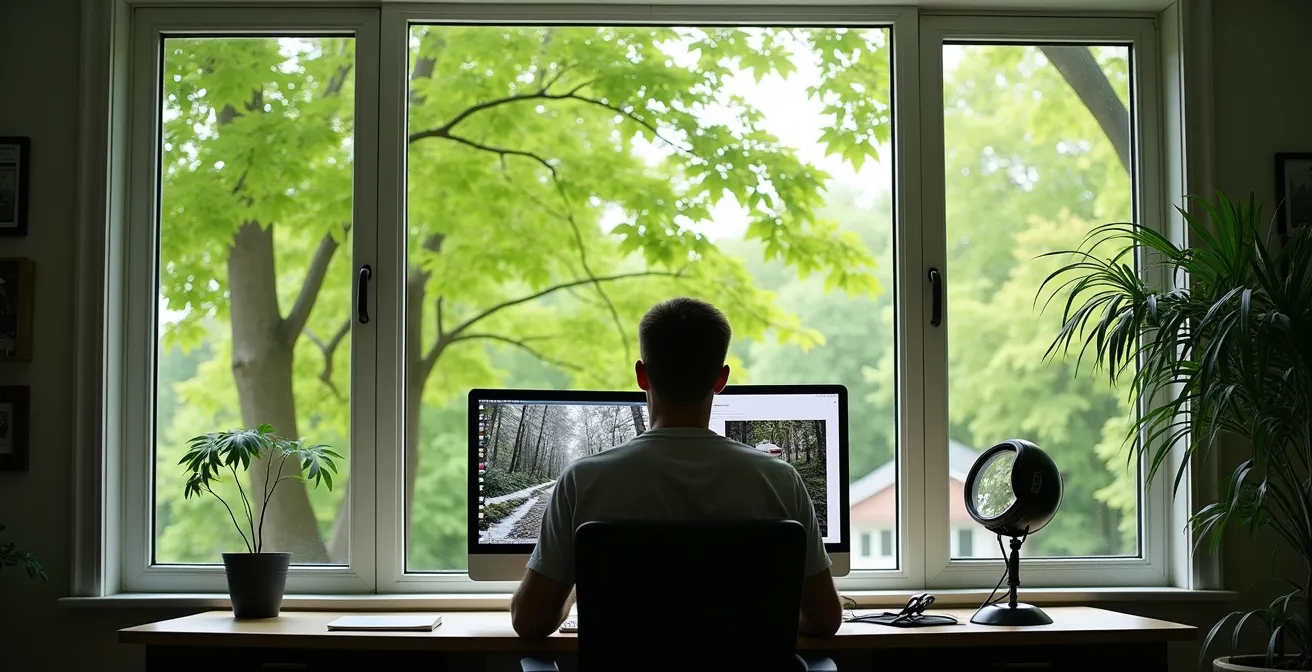
This effect complements the physical benefits. That same tree providing you with a moment of mental respite is also casting shade on your building and actively cooling the air. The shade provided by urban trees can decrease cooling-related energy costs, saving you money while it improves your focus. This creates a powerful synergy where investments in green infrastructure pay double dividends: one for your bank account and one for your mental health.
This is a crucial consideration for the modern Canadian home, which is increasingly also a workplace. Designing our living spaces to include views of nature—whether it’s a backyard garden, a balcony planter, or a nearby park—is not a luxury. It is a functional requirement for a healthy and productive life in the city. The simple act of positioning your desk to face a window with a green view can be one of the most effective productivity hacks available, with zero cost and significant, scientifically-backed benefits.
Key Takeaways
- Manage Your Roof First: Your roof is the primary source of heat gain. A cool (reflective) or green (living) roof is the single most impactful intervention you can make.
- Maximize Greenery at Every Level: Trees, green walls, and even small gardens provide both direct shade and active cooling through evapotranspiration, while also boosting well-being.
- Block Heat at the Source: It is far more effective to stop solar energy before it enters your home with external shading or reflective films than it is to manage it with internal curtains.
Why Living Buildings With Green Walls Reduce Stress and Energy Bills?
The principles we’ve discussed—reflective roofs, strategic planting, permeable surfaces—are not isolated tactics. When integrated into a holistic design philosophy, they give rise to the concept of “living buildings.” These are structures that function more like an ecosystem than an inert box, actively managing energy and water while enhancing the well-being of their inhabitants. A key feature of this approach is the use of green walls, or vertical gardens.
A green wall, much like a green roof, provides a layer of insulation that stabilizes the building’s interior temperature, reducing the energy needed for both heating in winter and cooling in summer. The plants also actively cool the building’s facade and the surrounding air through shading and evapotranspiration. Research from organizations like Tree Canada confirms that the combined effects of these processes can reduce local summer temperatures by 1-5°C, a significant drop that lessens the load on air conditioning systems.
But the benefits extend beyond energy bills. Like having a green view from a window, being in close proximity to a living wall has been shown to reduce stress, lower blood pressure, and improve mood. They absorb air pollutants and can even dampen urban noise, creating a calmer, healthier indoor environment. This integration of nature directly into the building’s architecture is a powerful strategy for mitigating the harshness of the concrete jungle.
Canadian cities are increasingly recognizing and promoting this approach. In Montreal, the Rosemont-La Petite-Patrie borough’s mandate for cool roofs on new buildings is one part of the puzzle. In Vancouver, the city’s focus on creating Street Tree Cooling Networks demonstrates a commitment to green infrastructure at a neighbourhood scale. These municipal initiatives showcase the shift towards seeing buildings and streets not as problems, but as opportunities for ecological design that reduces both stress and energy consumption for all residents.
To apply these principles, begin by conducting a simple thermal audit of your own property. Identify your largest dark surfaces and sun-exposed windows—this is your starting point for creating a cooler, more efficient, and healthier home.