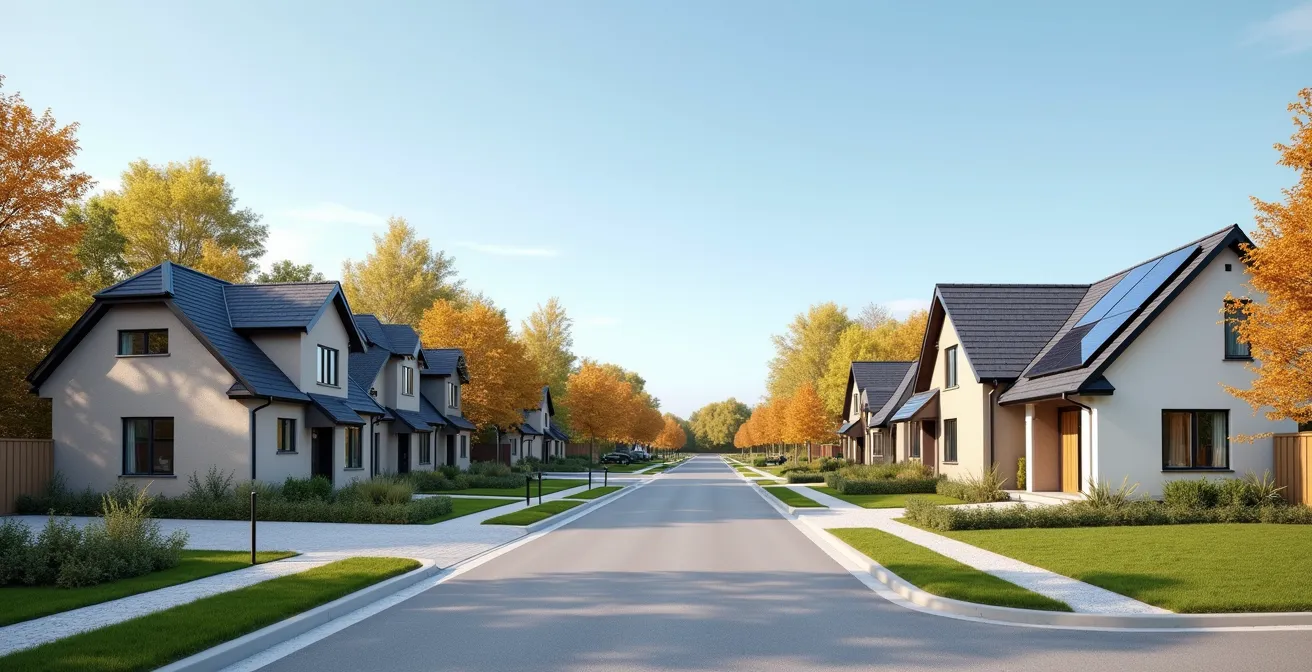
The 2030 Net Zero building codes are not just an environmental goal; they are a direct financial test that will determine your home’s market value in the next decade.
- Technical choices like airtightness (ACH50) and material selection (mass timber) translate directly into quantifiable assets or future liabilities.
- Homes dependent on natural gas face a significant and growing risk of depreciation due to mandatory retrofit costs.
Recommendation: Focus on building or renovating to ‘Net Zero Certified’ standards, not just ‘Ready’, to maximize government rebates and secure long-term asset value.
By 2030, a seismic shift will occur in the Canadian real estate market. It won’t be a bubble or a crash, but a regulatory change: the widespread adoption of Net Zero building codes. For many forward-thinking buyers and builders, this transition is viewed through the lens of energy bills and environmentalism. They focus on the obvious benefits like lower utility costs or the abstract notion of “being green,” which are valid but incomplete perspectives.
This view misses the most critical point. The 2030 codes are creating a new financial paradigm, acting as a future stress test for your property’s value. Decisions made today about airtightness, electrification, and material choices are no longer just construction details; they are investment strategies. These choices will forge either a highly desirable, future-proof asset or a significant financial liability that will become apparent on a future sales listing.
This analysis will deconstruct the key technical requirements of Canada’s evolving codes, framing them not as abstract science, but as crucial inputs in a future property valuation. We will explore the tangible difference between “Ready” and “Certified,” why a single performance metric is your most valuable asset, and how renovating an existing structure can be a surprisingly shrewd financial and environmental maneuver. The goal is to equip you to see a property not just for what it is today, but for what it will be worth tomorrow.
To navigate this complex landscape, it’s essential to understand the specific components that build value and mitigate risk. The following sections break down the core concepts and strategic choices you’ll face on the path to Net Zero compliance and profitability.
Summary: Navigating the Financials of Future Building Codes
- What Is the Difference Between “Ready” and “Certified” and Which Should You Pay For?
- How to Use an Energy Model to Design a House That Generates as Much Power as It Uses?
- Roof Orientation and Pitch: Designing Your Roof to Actually Hit Net Zero Targets
- Why Gas-Dependent Homes Might Sell at a Discount in 15 Years
- Why Hitting 1.5 ACH50 Is the Single Most Important Step to Net Zero
- Turnkey Renovation or New Build: Which Offers Better Warranty Protection in Ontario?
- Why Choosing Mass Timber Over Concrete Reduces the Building’s Carbon Footprint?
- Why Renovating an Existing Building Is Greener Than Building a Net Zero New Home?
What Is the Difference Between “Ready” and “Certified” and Which Should You Pay For?
In the evolving lexicon of high-performance homes, “Net Zero Ready” and “Net Zero Certified” are often used interchangeably, but they represent vastly different levels of investment and future value. A “Net Zero Ready” home is built with superior insulation and airtightness and is pre-wired for solar panels, but it doesn’t have them installed. It’s an investment in potential. A “Net Zero Certified” home, in contrast, has the renewable energy system (typically solar panels) installed and has been proven through modeling and testing to produce as much energy as it consumes annually. It’s an investment in proven performance as an asset.
From a financial perspective, the distinction is critical. While a “Ready” home is a significant step up from a standard build, a “Certified” home unlocks the highest level of financial incentives. For instance, homeowners may qualify for a mortgage insurance refund of up to 25% from the CMHC Green Home program with a certified home, compared to a smaller 15% for a ready home. This immediate cash-back further closes the gap on the upfront investment.
| Feature | Net Zero Ready | Net Zero Certified |
|---|---|---|
| Energy Efficiency | 80% more efficient than code | 80% more efficient than code |
| Solar Panels | Infrastructure ready | Installed and operational |
| Annual Energy Balance | Reduced consumption only | Produces as much as consumed |
| CMHC Rebate | 15% insurance refund | 25% insurance refund |
| Additional Cost | $22,000-$40,000 | $40,000-$60,000+ |
Choosing “Certified” is a strategic decision to maximize ROI. You are not only eliminating future energy bills but also creating a premium asset with documented performance and access to the best available government incentives, enhancing its appeal and resale value in a market that will increasingly demand proven results.
How to Use an Energy Model to Design a House That Generates as Much Power as It Uses?
Achieving Net Zero is not a matter of guesswork or simply adding solar panels to a standard home. It is a calculated science, and the primary tool for this calculation is an energy model. In Canada, this is typically done using software like HOT2000. This model acts as a digital twin of the home, allowing designers and builders to simulate how different components—windows, insulation, mechanical systems, and orientation—will perform together in a specific Canadian climate zone.
This process is the key to regulatory arbitrage: making informed, cost-effective decisions upfront to meet future performance standards. Instead of over-investing in one area, the model helps identify the most impactful trade-offs. Perhaps slightly less expensive windows can be used if the wall insulation is increased, or a different mechanical system can reduce the required size of the solar array. The model makes these complex interactions visible and quantifiable, turning design into a data-driven financial strategy.

As the diagram visualizes, the goal is to create a building that functions as a complete system, minimizing heat loss while maximizing passive gains and renewable energy generation. The energy model is the blueprint for this system, ensuring that the final construction meets its performance target on paper before a single shovel hits the ground. This documentation is also becoming invaluable for appraisals, proving the home’s superior quality to lenders and future buyers.
Your Action Plan: Energy Modeling for Net Zero Design
- Design the home to produce as much renewable energy as it uses annually, accounting for all energy used including heating, hot water, ventilation, appliances, and lighting.
- Utilize HOT2000 software, the Canadian standard, to model energy consumption based on specific climate zone data.
- Examine building envelope and system alternatives to implement energy-efficient solutions in the most cost-effective manner.
- Work closely with a Certified Energy Advisor (CEA) to optimize the trade-offs between different building components and systems.
- Generate the final energy model report as essential documentation for securing appraisals, mortgages, and federal grants and incentives.
Roof Orientation and Pitch: Designing Your Roof to Actually Hit Net Zero Targets
In a Net Zero home, the roof transforms from a passive structural element into an active power plant. Its design is therefore not just an aesthetic choice, but a critical factor in the home’s ability to meet its energy-generation targets. The two most important variables are orientation and pitch (or angle). For optimal solar production in Canada, a roof should be oriented as close to true south as possible to maximize exposure to the sun throughout the day.
The pitch is equally important and is dependent on latitude. Data from Natural Resources Canada shows that for most populated areas of the country, the ideal roof pitch for year-round solar generation falls between 30 and 45 degrees. A roof pitched in this range will optimize energy capture during both the high-sun summer months and the low-sun winter months, which is crucial for achieving an annual Net Zero balance. Designing a roof outside this range can significantly compromise the efficiency of a solar array, requiring a larger, more expensive system to produce the same amount of power.
The financial implications are profound. A well-designed roof becomes a revenue-generating asset. As demonstrated in the Cooke Family Cottage case study in Ontario, a solar-ready roof designed with optimal orientation and pitch doesn’t just offset the home’s energy use; it can generate surplus electricity that is sold back to the grid through provincial net-metering programs. This turns a structural expense into an income stream, directly enhancing the property’s long-term investment profile and shortening the payback period for the renewable energy system.
Why Gas-Dependent Homes Might Sell at a Discount in 15 Years
For decades, natural gas has been the backbone of home heating in Canada, valued for its reliability and low cost. However, in the context of 2030 and beyond, a dependence on gas is rapidly becoming a significant financial liability. As Canada pushes toward its emissions reduction targets, the electrification of heating is no longer an option but a necessity. A home built today with a gas furnace and water heater is a home with a built-in, mandatory, and expensive future upgrade.
The numbers are stark. According to new research from Efficiency Canada, full electrification of new homes can reduce their operational emissions by up to 67%. As building codes progressively prohibit gas installations and carbon taxes continue to rise, homes reliant on fossil fuels will face a “retrofit discount” on the resale market. Prospective buyers will factor the inevitable cost of replacing a gas furnace with an electric heat pump—an expense estimated at $20,000 to $30,000—directly into their purchase offer.
The financial risks for gas-dependent properties extend beyond simple retrofit costs. As climate risks become more central to financial calculations, homeowners may face:
- Forced heat pump retrofit costs to meet future municipal or federal regulations.
- Potentially higher insurance premiums associated with aging gas infrastructure.
- Less favorable mortgage terms from lenders who view gas dependency as a long-term liability.
- A distinct market disadvantage in municipalities that implement bans on new natural gas hookups.
- A direct discount on resale value that reflects the future cost and complexity of full electrification.
In essence, choosing gas heating today is akin to taking out a loan against your home’s future value. As the market fully prices in the cost of decarbonization, all-electric homes will command a premium, while gas-dependent homes will be viewed as financially and environmentally obsolete.
Why Hitting 1.5 ACH50 Is the Single Most Important Step to Net Zero
While solar panels and heat pumps are the visible technologies of Net Zero homes, the single most important factor for success is invisible: airtightness. Measured in Air Changes per Hour at 50 Pascals (ACH50), this metric quantifies how leaky a building is. The Net Zero standard typically requires a home to achieve 1.5 ACH50 or less, meaning the entire volume of air inside the house changes no more than 1.5 times per hour when depressurized. For comparison, a typical new home might be 3.0 to 5.0 ACH50, while an older home could be 10.0 ACH50 or higher.
Airtightness is the foundation upon which the entire Net Zero system is built. An airtight home dramatically reduces heat loss in the winter and heat gain in the summer. This simple principle, “build tight, ventilate right,” means the heating and cooling systems don’t have to work as hard, which in turn reduces the size and cost of the required mechanical systems and solar array. Studies show that proper air sealing can lead to a 50% reduction in energy consumption for heating and cooling, a permanent saving baked into the structure of the house.

Unlike a furnace or a window, airtightness is a feature that cannot be easily or cheaply upgraded later. It is achieved through meticulous attention to detail during construction—sealing every joint, penetration, and connection in the building envelope. This upfront investment in quality construction creates a permanent structural asset. A low ACH50 number is a direct indicator of a durable, comfortable, and highly efficient home, a metric that will become a key selling point and a powerful driver of resale value in a performance-based market.
Turnkey Renovation or New Build: Which Offers Better Warranty Protection in Ontario?
When considering a high-performance home, buyers in Ontario often weigh a new build against a major turnkey renovation. A key factor in this decision is warranty protection. For new builds, the path is clear: homes are protected by the Tarion warranty program, which provides comprehensive, provincially-mandated coverage against construction defects for up to seven years. This creates a strong safety net and a clear standard of quality for consumers.
For renovations, the warranty landscape has historically been more fragmented. Protection typically depends on the individual contractor’s warranty, which can vary widely in scope and duration. This perceived gap in protection has often made buyers hesitant to undertake large-scale, deep energy retrofits. However, this is changing with the formalization of high-performance renovation standards in Canada.
The Canadian Home Builders’ Association (CHBA) has launched a dedicated Net Zero Renovation Program. This program provides clearly defined technical requirements for homes to be recognized as “Net Zero Renovated.” Crucially, participating renovators must be members of the RenoMark™ program, which has its own code of conduct that includes providing a two-year warranty on all work. By choosing a certified Net Zero Renovator, homeowners gain access to a standardized level of quality and warranty protection that begins to bridge the gap with the new-build market. This program provides the framework and consumer confidence needed to unlock the immense value in Canada’s existing housing stock.
Key Takeaways
- A “Net Zero Certified” home offers quantifiable financial returns through higher rebates (like CMHC’s) and is a more secure long-term asset than a “Ready” home.
- Airtightness (achieving 1.5 ACH50 or better) is the most critical and foundational investment for future-proofing a home’s value, as it permanently reduces energy demand.
- The “embodied carbon” of building materials is a growing factor in green valuation; renovating existing structures or using materials like mass timber offers a significant advantage over new concrete builds.
Why Choosing Mass Timber Over Concrete Reduces the Building’s Carbon Footprint?
The conversation around green buildings is expanding beyond operational carbon (the energy used to run a home) to include embodied carbon. This refers to the total greenhouse gas emissions associated with a material’s entire lifecycle, from extraction and manufacturing to transportation and installation. When viewed through this lens, the choice between structural materials like mass timber and concrete has profound environmental and, increasingly, financial implications.
Concrete and steel production are incredibly energy-intensive processes that account for a significant portion of global industrial emissions. A building constructed with these materials starts its life with a massive carbon deficit. Mass timber, on the other hand, is a family of engineered wood products like cross-laminated timber (CLT) that are strong enough to replace concrete and steel in many applications. Because trees absorb and store carbon dioxide as they grow, mass timber buildings effectively begin life as carbon-negative structures, having sequestered more carbon than was emitted during their production.
As Canada’s construction sector moves toward a greener future, material choice will become a key differentiator. A leading voice in this area, Efficiency Canada, highlights this potential in their analysis of future building trends.
Canada can lead North America’s construction sector into a new greener era, one defined by novel building materials, smart building systems and the rapid deployment of low-carbon heating and cooling.
– Efficiency Canada, Building for Tomorrow Report 2024
For a forward-thinking builder or buyer, choosing mass timber is a way to get ahead of the curve. As carbon accounting becomes more sophisticated and potentially regulated in the building industry, homes with a lower embodied carbon footprint will hold a distinct market advantage, representing a deeper level of sustainability that goes beyond the monthly utility bill.
Why Renovating an Existing Building Is Greener Than Building a Net Zero New Home?
In the quest for sustainability, an intuitive assumption is that a brand-new, ultra-efficient Net Zero home is the greenest possible option. However, when you account for embodied carbon, this assumption is often incorrect. The greenest building is frequently the one that is already standing. The construction of any new home, regardless of its operational efficiency, requires a massive upfront expenditure of carbon to produce materials like concrete for the foundation, lumber for the frame, and components for the systems. A renovation, by contrast, preserves the vast majority of this embodied carbon.
This has given rise to the concept of the Deep Energy Retrofit (DER), a comprehensive renovation designed to achieve massive energy savings. The Canadian federal government defines a DER as a project that achieves a 50% minimum reduction in a building’s energy consumption. This isn’t a simple window upgrade; it’s a whole-house overhaul that can bring an older home up to, or even exceed, the performance of a new build.
Innovative models are proving this is possible at scale. The Energiesprong model from the Netherlands, which uses prefabricated, insulated panels and integrated mechanical systems to rapidly upgrade homes, is being adapted for Canada. Pilots such as Ottawa Community Housing’s Presland project and Edmonton’s Sundance Cooperative are demonstrating how this industrialized approach can transform Canada’s diverse housing stock. These projects prove that renovating to Net Zero standards is not only feasible but is often the superior choice for minimizing total carbon impact. By avoiding the carbon cost of a new build, a DER offers a faster path to meaningful emissions reductions.
For a buyer or investor, this opens up a new strategic avenue. Instead of competing for a limited number of new Net Zero homes, there is immense opportunity in identifying older properties in prime locations and transforming them into high-performance assets. This approach combines the financial benefits of a renovation with the most responsible environmental strategy.
To ensure your property is positioned as an asset, not a liability, in 2030 and beyond, the most crucial first step is a professional energy audit. This assessment will establish your home’s current performance baseline and provide a clear roadmap of the strategic upgrades needed to achieve Net Zero compliance and secure its long-term value.