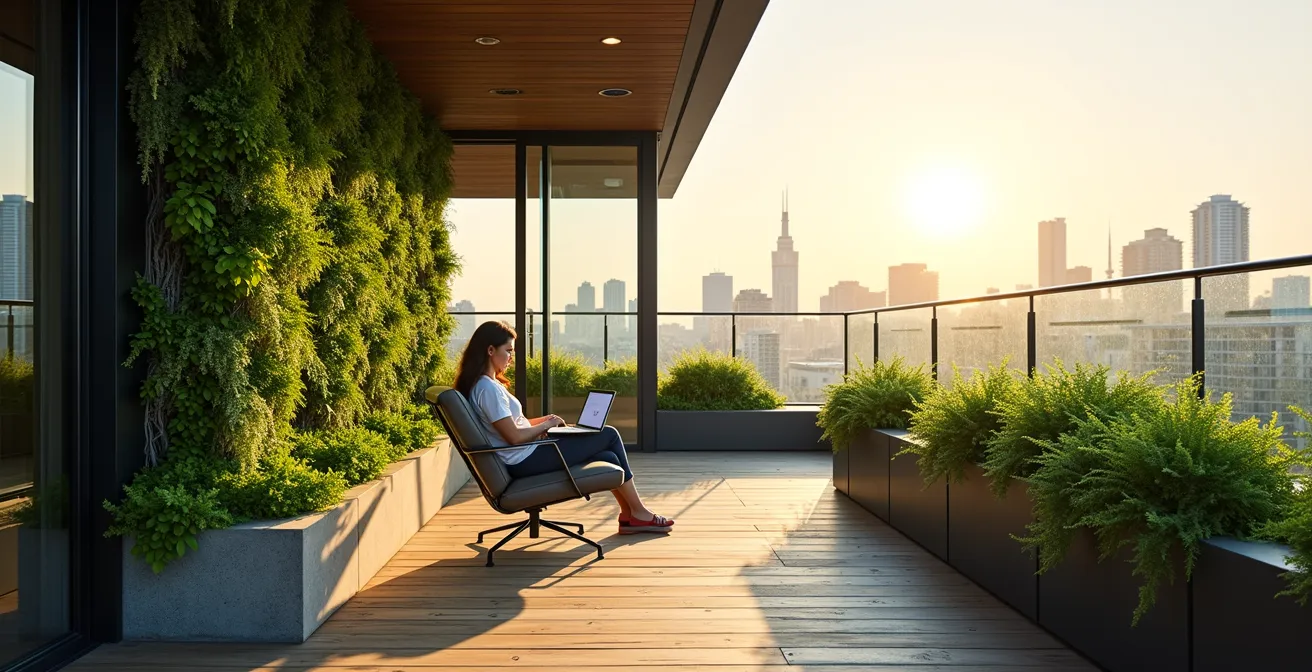
Living green walls are not cosmetic additions; they are high-performance building systems that deliver quantifiable returns in energy efficiency, acoustic comfort, and human well-being.
- They function as a second skin for buildings, reducing air conditioning needs by up to 33% and offering acoustic insulation equivalent to foam earplugs.
- Modern systems are engineered to be leak-proof and structurally sound, integrating root barriers and air gaps to protect the building envelope.
Recommendation: Developers and residents should evaluate green walls based on their lifecycle value and performance metrics, not just initial installation cost, to maximize ROI in Canada’s diverse climates.
Look out from a high-rise window in any major Canadian city, and you’ll likely see a canyon of glass, steel, and concrete. In our pursuit of vertical living, we’ve often created sterile environments, detached from the natural world. The common response is to add a few potted plants to a balcony, a small gesture of green in a sea of grey. But this addresses only a fraction of the problem. Our buildings contribute to urban heat islands, suffer from noise pollution, and can inadvertently create stressful, disconnected living and working spaces.
What if the solution wasn’t just *adding* nature, but *integrating* it into the very fabric of our architecture? This is where a critical shift in perspective is needed. We must stop seeing living walls as mere decoration and start recognizing them for what they are: engineered biophilic systems. They are a dynamic component of the building envelope, a high-performance technology that actively works to regulate temperature, manage sound, and improve our mental state. This is not gardening on a wall; this is architectural performance driven by engineered ecology.
This guide moves beyond the simple aesthetic appeal to deconstruct the technical and financial viability of living buildings. We will explore how to select plants that can survive the harsh exposure of a 20th-floor balcony, how modern irrigation systems prevent leaks, and how to ensure the building’s structural integrity is never compromised. By understanding the performance metrics behind these green facades, you will see how they deliver a quantifiable return on investment through energy savings, enhanced productivity, and a profound reduction in urban stress.
To fully grasp the potential of these living systems, we will explore the key technical considerations and tangible benefits they offer. The following sections break down everything from plant selection and water management to structural safety and long-term financial returns, providing a comprehensive framework for architects, developers, and residents alike.
Summary: Why Living Buildings With Green Walls Reduce Stress and Energy Bills?
- Which plants can actually survive wind and sun on a 20th-floor balcony wall?
- How to water a green facade without leaking onto the neighbor below?
- Does seeing greenery from your window actually improve productivity?
- How to prevent roots from compromising the building envelope integrity?
- Who trims the plants on the 10th floor: the cost of specialized maintenance?
- How to soundproof a condo bedroom against neighbors without major renovations?
- White roofs vs Green roofs: which is more effective at cooling the top floor?
- How urban heat islands increase your cooling costs and what you can do about it?
Which Plants Can Actually Survive Wind and Sun on a 20th-Floor Balcony Wall?
The success of any living wall begins with a crucial, non-negotiable factor: plant selection. A high-rise balcony is an extreme environment, subject to high winds, intense solar radiation, and rapid temperature fluctuations. Simply choosing attractive plants is a recipe for failure. Instead, an approach based on engineered ecology is required, selecting species proven to thrive in harsh, alpine-like conditions. Far from being a gamble, modern installations have an exceptional track record when properly designed. For example, careful research and selection have led to a nearly 100% plant survival rate on a 12th-floor green wall in Boston since 2017, proving long-term viability is achievable.
The key is to match plant hardiness to the specific climate zone and microclimate of the building. Canada’s diverse geography demands a localized approach. What thrives in Vancouver’s mild, coastal air will perish in a Montreal winter. Therefore, plant palettes must be rigorously curated:
- Zone 5b (e.g., Montreal): The focus should be on species that can withstand temperatures dropping to -26°C. Excellent choices include alpine sedums, which are drought-tolerant and hardy, and dwarf conifers that provide year-round structure and greenery.
- Zone 6a (e.g., Toronto): Here, native prairie grasses are a superb option, as they are adapted to open, windy conditions. For visual interest, Red Osier Dogwood can be incorporated for its vibrant red stems that provide a splash of color in the winter.
- Zone 8b (e.g., Vancouver): With milder, wetter winters, the palette expands. Evergreen ferns and salt-tolerant coastal species are ideal, designed to handle the sea-breeze and humidity.
Across all zones, the guiding principle is to prioritize plants with a wide tolerance range. A south-facing wall can bake in the summer sun while a north-facing one remains in shadow, creating distinct microclimates on the same building. Furthermore, winter preparation, such as using insulated planters and selecting species with deep-freeze root tolerance, is a fundamental aspect of the system’s design, ensuring the living wall is a permanent, resilient feature of the architecture.
How to Water a Green Facade Without Leaking Onto the Neighbor Below?
One of the most significant concerns for residents and developers in multi-story buildings is water management. The fear of leaks, drips, and potential water damage to units below is a valid and critical consideration. However, modern living wall systems are not simply ‘watered’; they are precision-engineered with closed-loop irrigation systems designed for maximum efficiency and zero leakage. These systems are a far cry from a simple hose or sprinkler; they are integrated networks of drip lines, moisture sensors, and collection trays that make uncontrolled water runoff a problem of the past.
The core technology is drip irrigation. Water is delivered directly to the growing medium of each plant through a network of small tubes with precisely spaced emitters. This method eliminates water wastage from evaporation and wind, ensuring that every drop is used effectively. More advanced systems incorporate moisture sensors that trigger irrigation only when the soil reaches a specific dryness level, preventing overwatering. Any minimal excess water is captured in an integrated gutter or collection tray at the base of the system, from which it can be recirculated back into the reservoir. This creates a self-contained ecosystem that protects the building and conserves water.
The effectiveness of these systems is well-documented. For instance, a two-year monitoring project by the BC Institute of Technology Centre for Architectural Ecology on their green wall demonstrated remarkable performance. The system not only retained an average of 36% of precipitation but also reduced peak runoff flow by over 90% and delayed it by nearly two hours. This data proves that a professionally designed and installed system poses no threat to neighbors below and, in fact, helps manage stormwater.
To better understand this, visualize the intricate network working behind the foliage. It’s a system of precision and control, not of unpredictable flow.
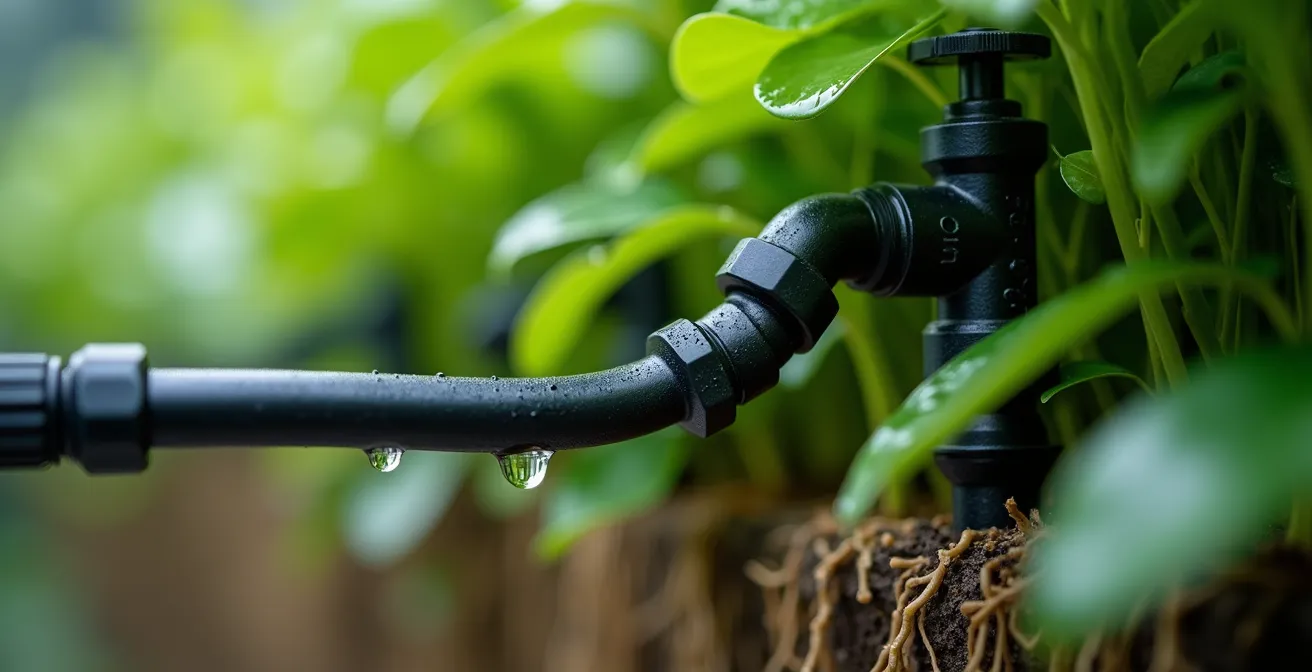
As this image illustrates, the technology is sophisticated and reliable. The integration of sensors and controlled emitters ensures that water is a nutrient, not a liability. This engineered approach to hydration is fundamental to the living wall’s role as a responsible and high-performance piece of building technology.
Does Seeing Greenery From Your Window Actually Improve Productivity?
While the technical performance of living walls is impressive, their most profound impact may be on the building’s inhabitants. The concept of biophilia—the innate human tendency to connect with nature—suggests that exposure to natural elements has a direct and positive effect on our psychological well-being. In an urban context, a living wall can be a primary source of this connection, transforming a sterile office or residential view into a dynamic, living landscape. This is not just a feel-good notion; it translates into measurable improvements in health and productivity.
Numerous studies have quantified the “biophilic effect.” For instance, compelling research has found a significant 12% productivity increase for employees who have views of plants from their workspace. This boost is attributed to reduced mental fatigue, improved concentration, and lower stress levels. The subtle, natural movements and textures of a living wall provide a ‘soft fascination’ that helps restore our capacity for directed attention, which is often depleted by the hard focus required in an office environment. This translates into more effective work and a more positive perception of the workplace.
The health benefits extend beyond mental well-being into physical health. As CRD Environmental Services noted in the Capital Regional District Green Infrastructure Report, the presence of green infrastructure has a tangible impact on employee absenteeism:
Access to green space improves a person’s mental and physical state. There were fewer sick days taken by employees in a building with a green roof compared with those working in a building without a green roof.
– CRD Environmental Services, Capital Regional District Green Infrastructure Report
This “wellness dividend” is a powerful component of a living building’s return on investment. Furthermore, the plants themselves act as natural air purifiers, filtering volatile organic compounds (VOCs) and producing oxygen. Offices with interior green walls have reported measurable improvements in air quality and a decrease in symptoms associated with sick building syndrome, such as headaches and eye irritation. By integrating a living wall, a building is not just getting an aesthetic feature; it is investing in a healthier, happier, and more productive population.
How to Prevent Roots From Compromising the Building Envelope Integrity?
For any developer or property manager, the term “root penetration” is a major red flag. The fear that a living wall could compromise the building’s waterproof membrane or structural facade is a primary obstacle to adoption. This concern is valid if one imagines a traditional vine growing directly on a wall. However, modern green wall systems are specifically engineered to make this impossible. They are designed with an explicit focus on building envelope integration, ensuring a clear separation between the plant life and the building structure itself.
The primary defense is the system’s construction. Most professional systems are not attached directly to the wall surface. Instead, they are mounted on a sub-frame or vertical tracks that create a crucial air gap between the back of the living wall panels and the building facade. This gap serves two purposes: it prevents any moisture from being trapped against the building, allowing the wall to breathe and dry, and it creates a physical barrier that roots cannot cross. The plants are contained within modular panels or integrated containers, each acting as a self-contained ecosystem.
Within these systems, a robust, impenetrable root barrier is the second line of defense. This is not a thin fabric but a solid, durable material engineered to be completely impermeable to roots. High-quality systems use materials tested for long-term durability, including flexibility in sub-zero Canadian temperatures. The combination of a structural air gap and an integrated root barrier provides a dual-layer of protection that makes root damage a non-issue. The choice of system is therefore critical, as some are inherently safer than others.
The following table, based on analysis from system manufacturers, compares the protective methods of different common green wall types.
| System Type | Wall Protection Method | Root Barrier | Air Gap |
|---|---|---|---|
| LiveWall System | Mounted on vertical tracks | Integrated containers | Yes – allows moisture escape |
| Mat Systems | Direct attachment | Thin membrane only | No – moisture retention risk |
| Modular Panels | Framework mounting | Solid barriers | Yes – prevents wall contact |
| Loose Soil | Contained beds | Requires shielding | Varies by installation |
As the comparison shows, systems mounted on frameworks with integrated containers and a clear air gap offer the highest level of protection. To ensure absolute safety, a rigorous verification process is essential before installation.
Your Checklist for Protecting the Building Envelope
- Verify that the chosen green wall system meets or exceeds CAN/CGSB waterproofing standards.
- Engage a certified Building Envelope Consultant to conduct a thorough pre-installation assessment of the wall.
- Insist on systems that use integrated root barriers specifically tested for flexibility in sub-zero temperatures.
- Ensure the installation plan includes a minimum specified air gap between the system and the building surface.
- Obtain and file documentation confirming compliance with all relevant sections of the National Building Code of Canada.
Who Trims the Plants on the 10th Floor: The Cost of Specialized Maintenance?
A living wall is a dynamic system, and like any high-performance asset, it requires professional maintenance to ensure its longevity and appearance. The question of “who trims the plants?” on an upper-floor facade is a practical one that directly relates to the lifecycle cost of the installation. This is not a task for a standard landscaping company; it requires specialized technicians with horticultural knowledge and, for high-rise applications, rope access certification. Understanding these costs is essential for calculating the true return on investment.
The initial investment for a professionally installed exterior living wall in Canada is significant. According to pricing data from specialists like Elevation Living Walls, costs can range from $130 to $250 per square foot. This price typically includes the system hardware, plants, and installation. Maintenance is then handled through ongoing service contracts. The cost of these contracts varies depending on the wall’s size, accessibility, and the specific needs of the plant palette, but it is a predictable operational expense, not an unforeseen cost.
A typical maintenance schedule involves several key activities. Technicians will visit every 2-3 months to perform essential tasks: trimming and pruning to maintain the desired shape and promote healthy growth, removing any dead foliage, and checking for pests or diseases. They also perform critical system checks, adjusting the automated irrigation schedule seasonally—for example, a typical system might run for 2-3 minutes every other day in the summer and less frequently in the cooler months. Finally, they conduct regular monitoring of soil health, testing pH and nutrient levels and amending as needed.
Case Study: The Value of Professional Maintenance
Leading Canadian installer Elevation Living Walls provides a powerful example of long-term success. They report that their installations, when subject to a proper professional maintenance contract, have been thriving for over 8 years with zero plant replacements required. This demonstrates that while maintenance is an ongoing cost, it is also the mechanism that protects the initial investment, ensuring the wall remains a vibrant and healthy asset for the long term rather than deteriorating over time.
While this specialized maintenance represents an ongoing cost, it should be viewed in the context of the benefits delivered: energy savings, increased property value, and improved tenant well-being. When the lifecycle cost is weighed against these returns, professional maintenance is not just an expense but an investment in the wall’s continued performance.
How to Soundproof a Condo Bedroom Against Neighbors Without Major Renovations?
In dense urban living environments like condos and apartments, acoustic privacy is a primary component of comfort and quality of life. Noise from adjacent units—voices, televisions, footsteps—is a common source of stress and frustration. While traditional soundproofing often involves costly and disruptive renovations like adding dense layers of drywall or insulation, a living wall offers a unique, aesthetically pleasing, and surprisingly effective alternative. It functions as a natural acoustic buffer, absorbing sound waves rather than reflecting them.
The sound-dampening properties of a living wall come from a combination of its components. The soil or growing medium has mass and density, which helps to block sound transmission. The plants themselves, with their varied leaf shapes, sizes, and textures, work to scatter and diffuse sound waves. Unlike a hard, flat surface like a painted wall, which reflects sound and can create echoes, the soft, irregular surface of a living wall absorbs acoustic energy. This combination of blocking and absorption significantly reduces the transmission of mid-to-high frequency sounds, which include the most common annoyances like conversations and television noise.
The performance is not trivial. According to studies on the acoustic benefits of green walls, they can provide an up to 15dB noise reduction. To put that in perspective, this is a level of sound dampening comparable to what one would experience wearing foam earplugs. For a bedroom sharing a wall with a noisy neighbor, installing a floor-to-ceiling living wall can be a transformative solution, creating a peaceful sanctuary without the need for a major construction project. It replaces a source of acoustic stress with a feature that actively promotes tranquility.
Imagine a bedroom where the shared wall is no longer a conductor of noise, but a lush, quiet, and living piece of art. This is the dual benefit a living wall brings to interior spaces.
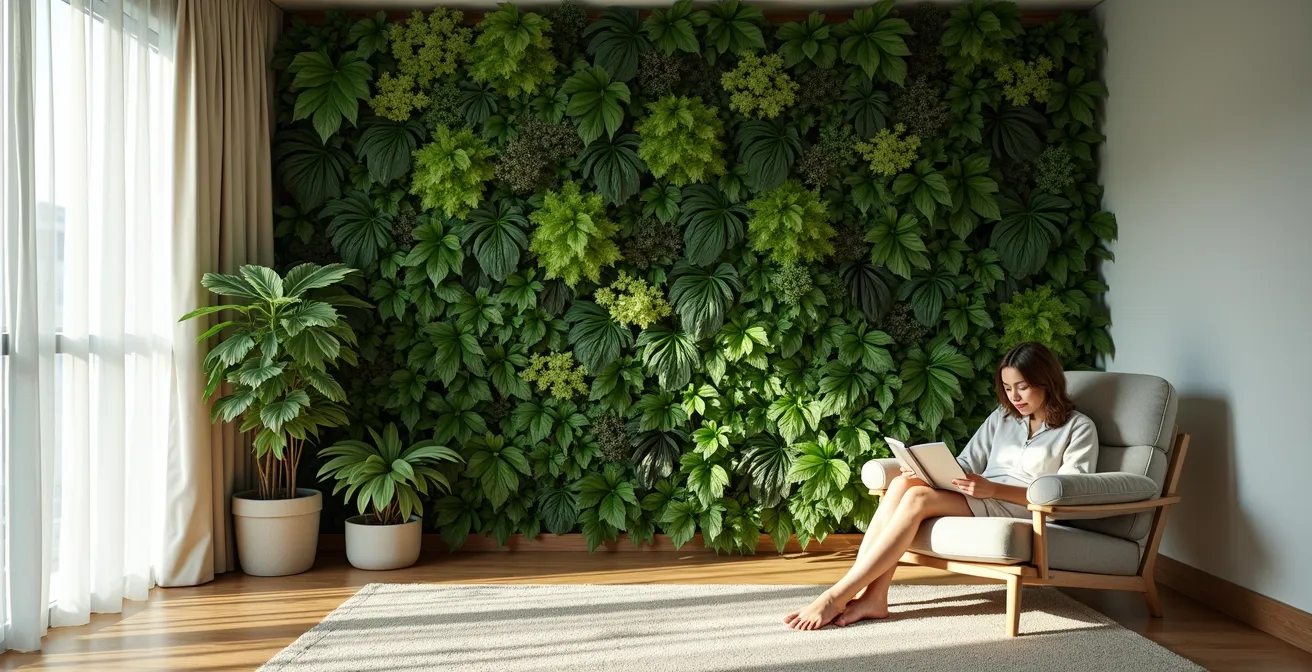
This approach integrates a functional soundproofing solution with a powerful element of biophilic design. It solves a practical problem while simultaneously enhancing the room’s atmosphere, improving air quality, and contributing to the resident’s overall sense of well-being, making it a multi-faceted upgrade for any urban dwelling.
White Roofs vs Green Roofs: Which Is More Effective at Cooling the Top Floor?
When it comes to mitigating summer heat gain on the top floor of a building, two primary strategies emerge: cool roofs (often painted white to reflect solar radiation) and green roofs (covered in vegetation). Both are effective at reducing cooling loads compared to a traditional dark roof, but they operate on different principles and offer vastly different benefits, particularly in a four-season climate like Canada’s. From an ecological architect’s perspective, while a white roof is a good single-purpose solution, a green roof is a superior, multi-functional system.
A white roof’s effectiveness is based on its high albedo, or solar reflectance. It reflects a significant portion of incoming sunlight, preventing the roof structure from absorbing that energy and transferring it as heat into the building below. This is highly effective at reducing air conditioning demand in the summer. However, its benefit is limited almost exclusively to the cooling season. In the winter, this same reflective property can be a slight disadvantage, as it reflects away potential solar heat gain that could have passively warmed the building.
A green roof, by contrast, provides cooling through a different mechanism: evapotranspiration. The plants absorb water and release it into the atmosphere as vapor, a process that actively cools the surrounding air, much like sweat cools the human body. In addition, the layers of soil and vegetation provide a substantial amount of insulation. This is where the green roof’s true superiority in the Canadian context becomes clear. This insulation works year-round.
This critical distinction is highlighted by experts in the field. As the Canadian Green Building Council points out, the benefits of a green roof extend far beyond summer cooling:
A green roof’s insulation properties provide a significant ‘winter dividend’ by reducing heating costs, an advantage a white roof lacks, making it a year-round performer in Canada’s climate.
– Canadian Green Building Council, LEED Canada Reference Guide
Therefore, while a white roof solves one problem (summer heat), a green roof solves two: it reduces summer cooling costs and provides a “winter dividend” by lowering winter heating costs. When you add its other benefits—stormwater management, increased biodiversity, and longer roof membrane lifespan (as it’s protected from UV radiation)—the green roof emerges as the more holistic and high-performance architectural solution.
Key Takeaways
- Living walls are engineered systems, not just decoration; their success depends on technical specifications like plant hardiness, leak-proof irrigation, and structural integration.
- The benefits are quantifiable: they can reduce air conditioning needs by up to 33%, increase productivity by 12%, and offer up to 15dB of sound insulation.
- In Canada, the year-round performance of green infrastructure is key, offering both summer cooling and a “winter dividend” by reducing heating costs, an advantage white roofs lack.
How Urban Heat Islands Increase Your Cooling Costs and What You Can Do About It?
The phenomenon of the urban heat island effect is a defining characteristic of modern cities. Vast surfaces of asphalt, concrete, and dark roofing absorb and retain solar radiation, raising ambient temperatures significantly higher than in surrounding rural areas. This forces building cooling systems to work harder and longer, leading to inflated energy bills and increased strain on the power grid. A living wall directly counters this effect at the building scale, acting as a green, cooling shield that significantly reduces energy consumption.
The primary cooling mechanism is evapotranspiration. As plants on the facade release water vapor, they actively cool the air immediately adjacent to the building’s surface. This process, combined with the direct shading provided by the foliage, can reduce surface temperatures by as much as 10°C to 20°C. This dramatically lessens the amount of heat that penetrates the building envelope, directly impacting the load on air conditioning systems. The result is a substantial and measurable energy saving. In fact, research demonstrates a potential 33% reduction in air conditioning requirements for buildings with green facades.
This direct energy saving forms the core of the financial argument for living walls. Recognizing these benefits, many Canadian municipalities have implemented incentive programs to encourage the adoption of green infrastructure. For developers and homeowners, this can significantly improve the financial viability of an installation. These programs are a tangible acknowledgment of the public good that green buildings provide by mitigating the urban heat island effect.
Navigating these incentives is a key step for anyone considering a green wall project in Canada:
- Toronto: The Eco-Roof Incentive Program offers grants for both green and cool roofs, helping to offset initial installation costs.
- Vancouver: As part of its Greenest City Action Plan, Vancouver offers various grants that can apply to innovative projects like living walls which contribute to the city’s environmental goals.
- Montreal: The city offers credits and programs related to stormwater management, and green infrastructure like living walls and roofs can qualify due to their ability to retain rainwater.
By documenting energy savings, property owners may also be eligible for tax credits. When combined with the increase in property value—especially in competitive markets like the Greater Toronto Area where differentiation is key—the return on investment for a living wall becomes compelling. It is an investment that pays dividends to the owner through lower bills and to the community through a cooler, more resilient urban environment.
The evidence is clear: integrating living systems into our buildings is a strategic move towards more resilient, efficient, and humane cities. To translate these concepts into a successful project, the next step is to evaluate your specific site and goals against the high-performance systems available. Begin today by seeking a professional assessment to understand the full potential for your property.