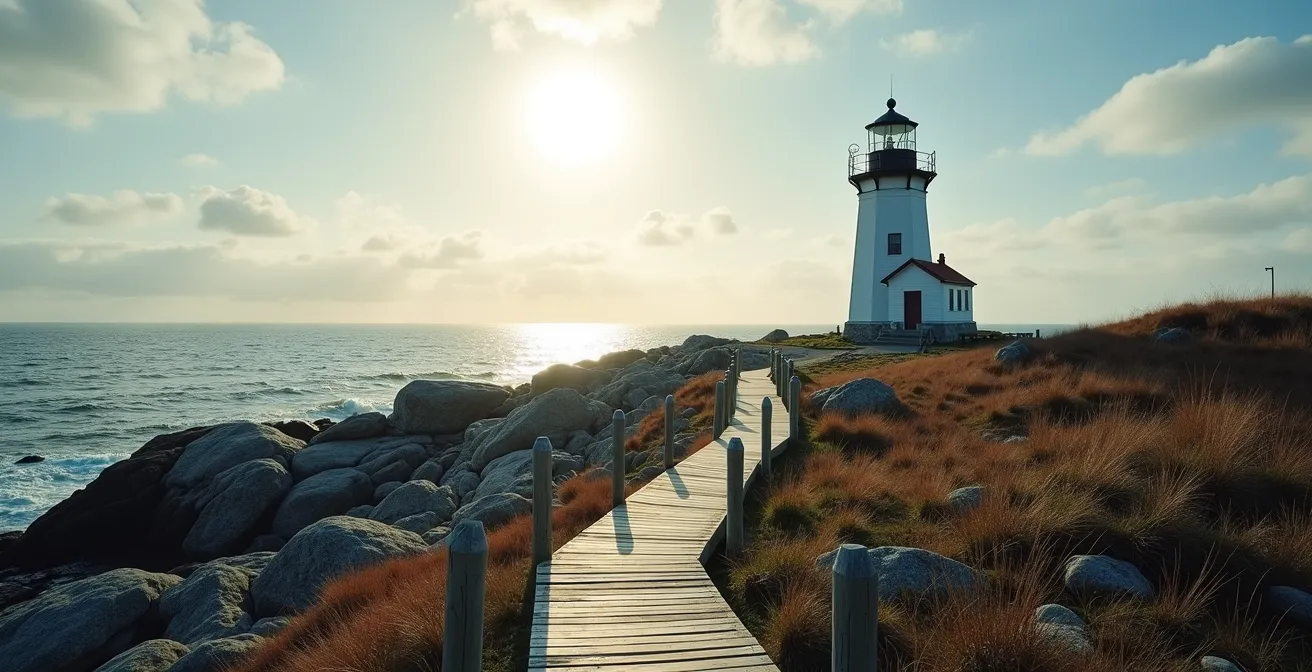
Understanding Canada’s maritime history isn’t about visiting lighthouses; it’s about learning to read them as living documents written on the coastline.
- A lighthouse’s architectural “DNA”—from pepper-shaker to concrete—reveals its specific technological and historical era.
- Their modern survival depends on community stewardship, with many heritage sites now managed by local groups and repurposed as unique accommodations.
- The intangible archives of local crafts and shipwreck lore hold the deepest keys to understanding coastal resilience and identity.
Recommendation: Engage directly with community-run museums and local traditions to experience this history firsthand, moving beyond passive observation to active participation.
The image is iconic: a solitary lighthouse standing sentinel on a rugged Canadian cliff, its beam cutting through the fog. For many, these structures are picturesque landmarks, the subject of countless photographs and postcards. They are seen as stoic, silent relics of a bygone era, their primary purpose of guiding ships now a footnote in history books. This perspective, while romantic, barely scratches the surface of the profound stories these beacons have to tell.
But what if these towers were more than just stone and light? What if they were history books written on the landscape, each one a chapter in Canada’s sprawling maritime narrative? The true lighthouse trail is not a line on a map, but a method of inquiry. It’s about learning to read the structural DNA of a tower, to listen for the echoes of shipwrecks in the surf, and to see living history in the hands of a local artisan. The key to unlocking this past lies not in simply viewing the lighthouses, but in understanding how to interpret them as the epicentres of community, engineering, and survival.
This guide moves beyond the postcard view. It provides a historian’s framework for reading the coastline. We will decode the architectural language of these sentinels, explore how they are being preserved through passionate community efforts, and discover the living traditions that keep their legacy vibrant. By the end, you will see Canada’s lighthouses not as monuments to the past, but as active portals into the nation’s maritime soul.
This article will guide you through the essential steps and perspectives needed to transform a simple coastal visit into a deep historical investigation. The following sections break down how to interpret the physical structures, access their stories, and engage with the culture they continue to shape.
Summary: A Historian’s Journey Along Canada’s Lighthouse Trail
- Pepper-shaker vs Octagonal: identifying the era of lighthouses by their shape
- How to get inside decommissioned lighthouses that are usually locked?
- Mapping the famous shipwrecks visible from the shore at low tide
- Why following old lighthouse paths can be dangerous near the cliff edge
- Which small maritime museums are actually worth the $5 entry fee?
- How to legally run a Bed & Breakfast in a heritage zone?
- Rug hooking and storytelling: why these slow arts survive in a fast world?
- Why participating in local traditions is the key to understanding maritime resilience?
Pepper-shaker vs Octagonal: identifying the era of lighthouses by their shape
A lighthouse’s architecture is its birth certificate. Before reading any plaque, you can begin to place a structure in time by observing its form. The shapes are not arbitrary aesthetic choices; they are the direct result of the technology, materials, and political priorities of their era. Across the vast network of over 750 lighthouses and long-range lights in Canada, a distinct structural DNA emerges, allowing you to read the coastline’s history at a glance.
The most iconic Canadian designs are the wooden, tapered towers often called “pepper-shakers.” These square, pyramidal structures were a hallmark of the post-Confederation period (1867-1900), when the new federal government needed to rapidly deploy standardized, cost-effective navigational aids along its expanding coasts. Spotting one is like seeing a fingerprint of nation-building. Conversely, stout octagonal wooden towers are more typical of the pre-Confederation era in the Maritimes (1830-1850), reflecting the shipbuilding craftsmanship of the time. The late 19th century saw the introduction of prefabricated cast-iron cylindrical towers, which could be shipped to remote locations. Finally, the monumental reinforced concrete towers with heavy buttresses, like the 34-metre-high Cap-des-Rosiers Lighthouse, signify the 20th-century need to support massive, powerful Fresnel lenses.
How to get inside decommissioned lighthouses that are usually locked?
Many of Canada’s historic lighthouses have been decommissioned and stand locked, their interiors a mystery to passing visitors. However, a significant shift in preservation policy has made accessing these sites more possible than ever. The key is not a physical object, but an understanding of community stewardship. Under the Heritage Lighthouse Protection Act, the federal government has actively transferred ownership of these structures to local municipalities, non-profits, and community groups committed to their preservation and public use.
This is where your investigation begins. According to Parks Canada, over 63 heritage lighthouses have been transferred to new owners, who are often passionate local volunteers. To find access, search for a “Lighthouse Society” or “Preservation Committee” associated with the specific lighthouse you wish to visit. These groups frequently organize open days, guided tours during the summer season, or private viewings by appointment. Their websites or local social media pages are the most reliable sources for opening hours and special events. Access is often granted in exchange for a small donation that directly funds the building’s upkeep.
This community-led approach is the heart of modern lighthouse preservation. The entrance to a once-federal building may now be through the efforts of the very community it once served, a testament to their enduring value.

As the Heritage Lighthouse Protection Act itself states, “communities in the areas in which lighthouses are situated have an important role in the conservation and protection of heritage lighthouses.” By connecting with these local stewards, you are not just gaining entry to a building; you are participating in the living heritage of the coast and supporting its future.
Mapping the famous shipwrecks visible from the shore at low tide
Lighthouses stand as symbols of safety, but they are also silent witnesses to maritime tragedy. Their locations were chosen precisely because the surrounding waters were treacherous. To truly connect with the history of a lighthouse, one must also acknowledge the ghosts in the water it guards. Many of Canada’s most infamous shipwrecks lie just offshore from these beacons, and in some cases, their skeletal remains are still visible at low tide, offering a haunting link to the past.
The coastline of the Îles de la Madeleine, for example, is a notorious ship graveyard where the archipelago has witnessed over 700 ships stranded on its shores. Exploring its beaches at low tide can reveal the weathered timbers of long-lost vessels. One of the most poignant sites in Canadian maritime history is near the Pointe-au-Père Lighthouse in Bas-Saint-Laurent. In 1914, the Empress of Ireland sank in just 14 minutes after a collision, claiming 1,012 lives. Climbing the lighthouse today provides a sobering, panoramic view of the very spot where this horrific event unfolded. The adjacent Empress of Ireland Museum further deepens the connection, turning a scenic viewpoint into a profound memorial.
Mapping these sites requires research ahead of your visit. Local maritime museums, historical society archives, and even old nautical charts are invaluable resources. They can help you correlate a specific lighthouse with the shipwrecks in its vicinity. Standing on the shore, knowing the story of the wreck before you, transforms the view from a simple seascape into a powerful and moving historical tableau.
Why following old lighthouse paths can be dangerous near the cliff edge
The allure of a lighthouse often includes the path leading to it—a trail promising dramatic coastal views. However, it is critical to understand that many of these paths are not modern, engineered hiking trails. They are the original, utilitarian supply routes used by lighthouse keepers for a century or more. These routes were designed for function, not for the safety of tourists, and following them blindly can be extremely hazardous.
The primary danger lies in coastal erosion. The same dramatic forces of wind and water that make these locations so picturesque are constantly undermining the cliffs they sit upon. A path that was safe a decade ago may now run perilously close to an unstable edge. This is especially true on coastlines with softer geology, such as the sandstone cliffs of the Gulf of St. Lawrence, which can crumble without warning. As the guide “Historic Canadian Lighthouses” soberly warns, “One point to remember when visiting the site is that it is a hazardous coastline and one should keep to the marked trail to the lighthouse.”
Before setting out, always consult official sources like Parks Canada or provincial park websites for current trail advisories. It’s also vital to distinguish between official, maintained trails and unofficial “social trails” or old keeper’s paths. The latter should be avoided. Never approach a cliff edge, especially during high winds or after heavy rain when the ground is saturated and the risk of collapse is highest. The most breathtaking photograph is not worth the risk.
Which small maritime museums are actually worth the $5 entry fee?
Along any coastal route, you will encounter dozens of small, local museums, often housed in historic buildings and charging a nominal entry fee. While some are genuine treasures, others can be disappointing collections of generic artifacts. As a historian, learning to spot an authentic gem from the roadside is a crucial skill. The goal is to find a museum that serves as an “intangible archive,” one that prioritizes deep, local stories over broad, shallow overviews.
An authentic small maritime museum is not defined by the size of its collection, but by its connection to the community. Look for passionate local volunteers or staff; their firsthand stories and deep knowledge are often more valuable than any display case. The most compelling exhibits feature personal artifacts from local fishing and lighthouse-keeping families—a worn-out diary, a set of mending tools, a child’s toy. These objects tell a human story that a generic ship’s wheel cannot. The best museums are often located in authentic heritage buildings, such as a former keeper’s quarters or a cannery, where the building itself is part of the exhibit.
This pursuit of authenticity is about finding the soul of the community’s maritime experience. It’s the difference between seeing a model of a dory and hearing a story from someone whose grandfather built them.
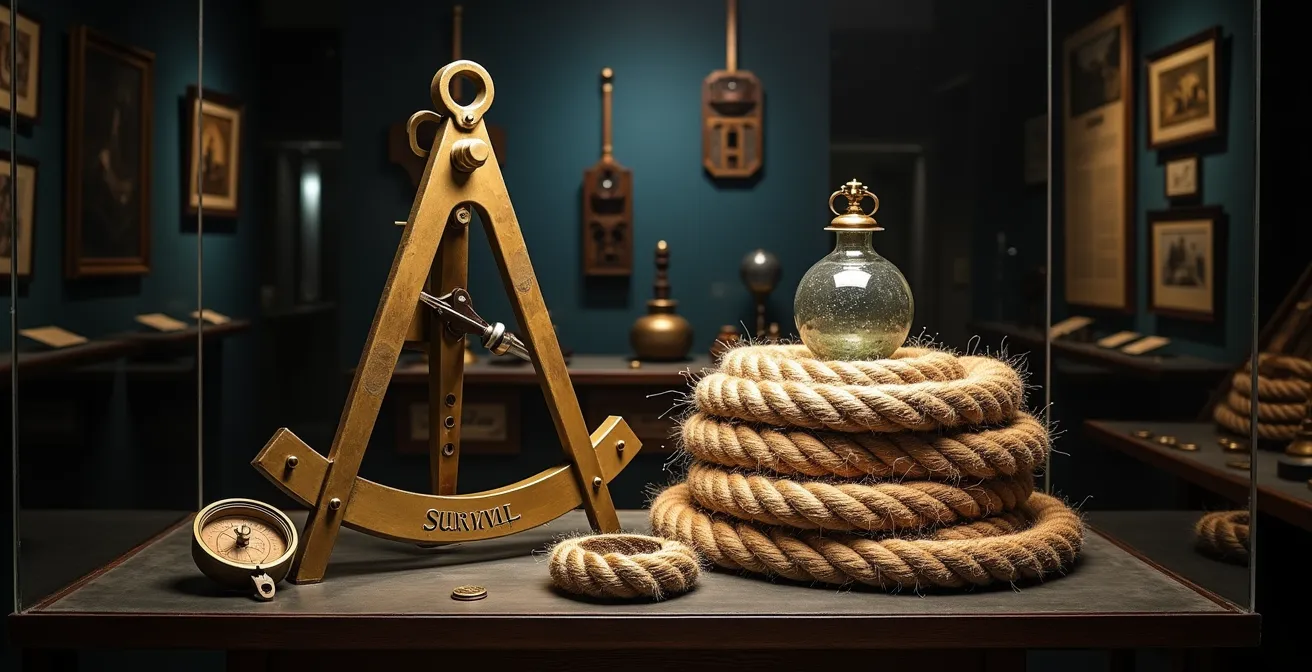
To help you discern quality from quantity, use a methodical approach when deciding which museums to visit. The following checklist can guide your choices and ensure your time and money are well spent.
Your Checklist for Identifying Authentic Maritime Museums
- Check for Personal Artifacts: Look for items explicitly linked to local families, such as letters, tools, or clothing from lighthouse keepers or fishermen.
- Engage the Staff: Ask if the guides are local volunteers. Their passion and personal anecdotes are a sign of a deeply rooted institution.
- Verify the Narrative Focus: Does the museum tell one deep, specific local story (e.g., a single industry, a specific shipwreck) or a generic overview of “maritime history”? Depth is better than breadth.
- Seek Authentic Settings: Prioritize museums housed in relevant heritage buildings, like a former keeper’s house, net loft, or post office, which adds context.
- Look for Intangible Heritage: Does the museum preserve oral histories, host craft demonstrations (like net mending or rug hooking), or feature recordings of local storytellers?
How to legally run a Bed & Breakfast in a heritage zone?
The preservation of Canada’s lighthouses is increasingly tied to their economic viability. One of the most successful models for this is the conversion of keeper’s quarters, or even the towers themselves, into unique accommodations like Bed & Breakfasts. This not only generates revenue for maintenance but also offers the public an unparalleled immersive experience. However, operating a business within a designated heritage site involves navigating a complex web of regulations designed to protect the structure’s historical integrity.
As of 2024, Canada has designated 112 lighthouses for protection under the Heritage Lighthouse Protection Act. Any commercial activity within these sites requires strict adherence to heritage conservation standards. The process typically involves submitting a detailed business plan to the authority that owns or oversees the lighthouse (often a local non-profit or Parks Canada). This plan must demonstrate that the proposed commercial use will not compromise the building’s key heritage features. This can include restrictions on structural modifications, signage, and even the type of furniture used. Furthermore, operators must comply with all standard municipal and provincial business licensing, zoning laws, and health and safety regulations for hospitality businesses.
Case Study: West Point Lighthouse Inn, PEI
A pioneering example of this model is the West Point Lighthouse on Prince Edward Island. It holds the distinction of being Canada’s first active lighthouse to also operate as an inn. The successful conversion of its keeper’s quarters into 13 guest rooms, all while the light remains a functioning navigational aid, demonstrates a perfect synergy between heritage preservation and sustainable tourism. This project proves that with careful planning and respect for heritage guidelines, these historic structures can have a vibrant and commercially successful future, offering guests awe-inspiring views of the Northumberland Strait and a deep connection to maritime life.
Rug hooking and storytelling: why these slow arts survive in a fast world?
The history of a maritime region is not only written in logs and ledgers; it is also woven into the fabric of its traditional crafts. In Atlantic Canada, few arts are as deeply connected to the lighthouse story as rug hooking. In a fast-paced, digital world, the survival of this “slow art” is a powerful testament to its role as a vessel for storytelling, resourcefulness, and community identity. These crafts are not mere decoration; they are tangible archives of maritime life.
Originally, rug hooking was an act of profound practicality. In isolated coastal communities, women created floor coverings from whatever materials were available. This often included scraps of old clothing, feed sacks, and, significantly, pieces of worn-out sailcloth or even old lighthouse keeper uniforms. The designs they hooked were a reflection of their world: the local lighthouse, the ships in the harbour, the surrounding sea life. Each rug became a document of a specific time and place, a personal expression of a shared environment.
Case Study: Maritime Crafts as Economic and Cultural Resilience
The tradition of rug hooking in communities from Cape Breton to the shores of Québec served a dual purpose. It was a practical way to insulate drafty floors and a crucial source of supplemental income, especially when the fishing was poor. Women would sell or trade their rugs, creating a micro-economy based on their artistry and resourcefulness. Today, this tradition has evolved into a cornerstone of Atlantic Canada’s cultural tourism. Studios and cooperatives continue to practice and teach the art, preserving the techniques while creating new works that tell both old and new stories. It is a living link to a past defined by making do and making beautiful.
These crafts survive because they are imbued with meaning. They represent a connection to place and a history of resilience. To hold a hooked rug depicting a local lighthouse is to hold a story, making these slow arts an essential part of understanding the region’s soul.
Key takeaways
- Lighthouse architecture is a historical code: its shape and material reveal the era and purpose of its construction.
- Access to many historic lighthouses is now managed by passionate local community groups, making them key contacts for visitors.
- True maritime history involves acknowledging the dangers of the coast, including shipwrecks and treacherous keeper’s paths.
Why participating in local traditions is the key to understanding maritime resilience?
To stand before a lighthouse is to see a symbol. To participate in the traditions of the community that lives in its shadow is to understand its substance. The ultimate step in following the lighthouse trail is to move from a passive observer to an active participant. The resilience of Canada’s maritime people—their ability to withstand economic hardship, geographic isolation, and the unforgiving sea—is not an abstract concept found in a museum display. It is a living quality embedded in their traditions, skills, and daily interactions.
Engaging with these traditions offers a dimension of understanding that no book can provide. Joining a community dory building workshop in Lunenburg, for instance, teaches you more about the region’s shipbuilding heritage than simply looking at a finished boat. Volunteering for a shoreline cleanup connects you to the modern community’s commitment to protecting the very coast their ancestors depended on. Staying overnight in a converted lighthouse keeper’s inn provides a small but powerful taste of the isolation and immense responsibility that defined a keeper’s life. These immersive experiences are where history ceases to be a subject and becomes a felt reality.
lighthouses form an integral part of Canada’s identity, culture and heritage, and are of historic and aesthetic interest and significance to our communities and our nation
– Heritage Lighthouse Protection Act, Parliament of Canada preamble
This “integral part” of Canadian identity is most profoundly felt through participation. It is in the sharing of a story, the learning of a skill, or the simple act of supporting a local enterprise that the spirit of maritime resilience is truly revealed. This is the final and most important destination on the historian’s lighthouse trail.
Your journey to understanding Canada’s maritime soul starts now. Move beyond the scenic viewpoint and seek out the community-run museums, the artisan studios, and the immersive heritage experiences that bring this rich history to life.