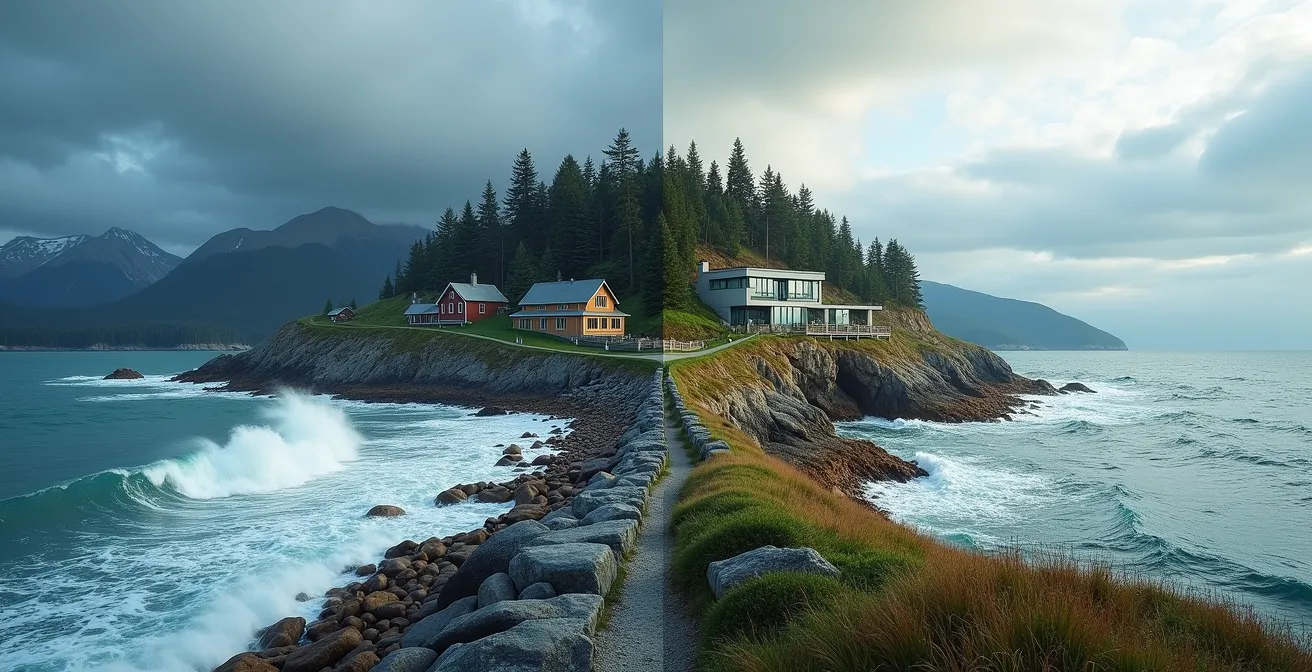
Investing in Canadian oceanfront property is no longer about securing a view; it’s about mastering a complex portfolio of escalating physical, legal, and material risks.
- Provincial differences in land rights (BC’s Torrens vs. Atlantic’s Registry systems) create vastly different liability and title fraud exposures.
- Accelerated material decay from salt spray and shifting government flood maps can render a property uninsurable within a decade, regardless of its current state.
Recommendation: Conduct a forward-looking risk assessment that models future sea-level rise and long-term material lifecycle costs, not just current conditions, before any purchase.
For high-net-worth investors, the allure of an oceanfront property in Canada—whether on the rugged coast of British Columbia or the dramatic shores of the Atlantic provinces—is undeniable. It represents a dream lifestyle and a significant portfolio asset. However, the traditional approach to due diligence, focused on views and structural inspections, is now dangerously obsolete. The converging forces of climate change, evolving legal precedents, and insurer risk aversion have created a new landscape of hidden liabilities. Simply asking “Is it in a flood zone?” is no longer sufficient.
Most buyers focus on standard property insurance, perhaps with a flood rider. They might consider the obvious threat of a storm surge. But the most significant risks—the ones that can erode value and lead to uninsurability—are far more subtle. These include the long-term, corrosive effects of salt spray on building materials, misunderstood property boundaries at the high-tide line, and the profound differences in land title systems between Eastern and Western Canada. Failing to understand these nuances is the difference between acquiring a legacy asset and a financial black hole.
This analysis moves beyond the platitudes. We will not simply tell you to check a flood map. Instead, we will dissect the specific, forward-looking challenges that sophisticated buyers must navigate. The key to a secure coastal investment is not just buying insurance; it is about implementing a strategy of engineered resilience that ensures the property remains valuable, protectable, and insurable for the decades to come. This is a consultant’s-eye view of the risks that matter most.
This guide provides a detailed breakdown of the critical risk factors you must consider. Explore the sections below to understand the specific physical, legal, and financial challenges inherent to coastal properties in Canada today.
Summary: Navigating the Insurance Minefield of Canadian Coastal Properties
- Why a setback of 50 feet might not be enough for the next 20 years
- Do you own the beach? Understanding foreshore rights and public access
- Salt spray vs Metal: why your stainless steel BBQ rusts in 6 months on the coast
- The flood zone map update that could make your dream home uninsurable
- When is a $50k retaining wall a good investment for property value?
- How to lower insurance premiums by 20% when living 15km from a fire station?
- Why walking on wet rocks can be fatal on the Pacific coast
- How to protect your property title against ID theft and fraudulent mortgages?
Why a setback of 50 feet might not be enough for the next 20 years
Municipal bylaws often mandate a minimum setback from the coastline, a distance historically seen as an adequate buffer against erosion and storm surges. For years, a 50-foot (or 15-metre) setback was a common standard. This is no longer a reliable metric for long-term asset protection. The accelerating pace of climate change means that historical data is a poor predictor of future risk. What was safe yesterday is becoming vulnerable tomorrow.
The primary drivers are sea-level rise and increased storm intensity. Projections are no longer abstract academic exercises; they are concrete data points that insurers are beginning to incorporate into their risk models. For example, recent projections from a MyChoice study show an average sea-level rise of 159.3 cm by 2100 in Nova Scotia. This baseline rise doesn’t even account for the amplifying effect of storm surges, where higher sea levels allow storm waves to reach further inland with more destructive energy. A property that is 50 feet from the current high-water mark could see that buffer disappear within the term of a 25-year mortgage.
As a sophisticated investor, you must think like an underwriter. An insurer’s primary concern is the probability of a future loss. A property built to today’s minimum code on a vulnerable coastline represents a rapidly escalating risk. This “insurability delta”—the gap between current standards and future reality—is where property value can be lost. Proactive assessment is the only defence.
Your Action Plan: Coastal Setback and Hazard Assessment
- Request a Coastal Hazard Assessment Report for your specific property location from provincial authorities or a qualified coastal engineer.
- Review updated sea-level rise projections for both 2050 and 2100 scenarios to understand the long-term trajectory.
- Consult with provincial coastal navigators, such as those in Nova Scotia available at 1-888-570-4240, for help interpreting technical reports.
- Compare municipal zoning bylaws with provincial coastal protection strategies, as they may not be aligned.
- Factor in storm surge amplification and wave run-up, which can add several metres of vertical hazard on top of the base sea-level rise.
Do you own the beach? Understanding foreshore rights and public access
One of the most common and costly misunderstandings for coastal property buyers is the assumption that their ownership extends to the water’s edge. In Canada, the legal framework governing the “foreshore”—the land between the high-water and low-water marks—is complex and varies significantly, particularly between British Columbia and the Atlantic provinces. This isn’t just about public access; it’s about boundary uncertainty and liability.
In British Columbia, the vast majority of the foreshore is considered provincial Crown land. Your property line typically ends at the “natural boundary” or high-water mark. You do not own the beach in front of your house; you are merely an upland owner. This has major implications for building docks, stairs, or erosion protection, all of which require leases or permits from the province. In Atlantic Canada, the situation can be even more ambiguous, rooted in centuries-old land grants that may or may not have included the foreshore. Determining the precise boundary often requires extensive historical and legal research.
This ambiguity creates risk. If a member of the public is injured on the foreshore adjacent to your property, are you liable? What if the erosion control measures you place on what you believe is your land are actually on public land? Resolving these questions after the fact is expensive. For an investor, clarity on boundaries is not a luxury; it is a fundamental component of risk management.
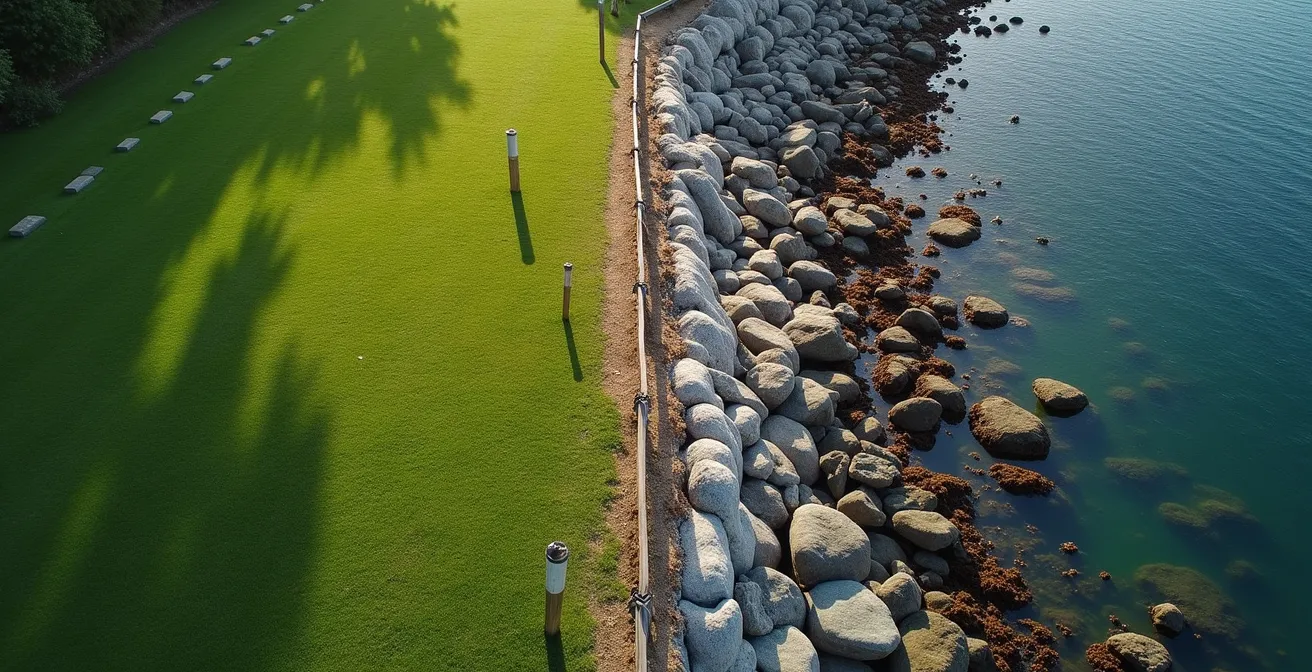
As the image above illustrates, the demarcation between manicured private land and the natural public foreshore is a critical legal line. An accurate survey that clearly defines this natural boundary is one of the most important pieces of due diligence you can undertake. It is the foundation upon which your property rights, and limitations, are built.
Salt spray vs Metal: why your stainless steel BBQ rusts in 6 months on the coast
The gentle sea breeze that makes coastal living so appealing is also a relentless corrosive agent. Airborne salt particles, or salt spray, settle on every exterior surface of a home, from window frames and fasteners to HVAC units and vehicles. This creates a “material degradation curve” that is far steeper than in any inland environment. Standard building materials, even those marketed as “durable” like 304-grade stainless steel, can fail in a fraction of their expected lifespan, leading to staggering and often uninsured maintenance costs.
The issue is the chloride ions in salt, which aggressively attack the protective chromium oxide layer on stainless steel, causing pitting and rust. For an oceanfront property, specifying marine-grade materials, such as 316-grade stainless steel, marine-grade aluminum, and hot-dip galvanized steel, is not an upgrade; it is a baseline necessity. The initial cost premium is significant, but it pales in comparison to the cost of replacing a failed component every few years. This must be factored into the total cost of ownership from day one.
Case Study: The “Coastal Maintenance Affidavit”
Insurers are becoming acutely aware of this risk. In high-salt-fog areas like parts of Newfoundland, some insurers are now requiring homeowners to sign ‘coastal maintenance affidavits’ as a condition of policy renewal. This document legally requires the owner to attest to performing regular freshwater washing of exterior surfaces, checking sacrificial anodes on metal structures, and inspecting sealants to maintain coverage for claims related to corrosion. This practice, detailed by leading coastal insurance experts, signals a major shift: the onus of proving proactive maintenance is now falling squarely on the property owner.
The following table starkly illustrates the difference in performance and cost. A decision to save money on fasteners or window frames during construction can trigger a cascade of costly repairs long before they would be expected inland.
| Material Type | Standard Grade Lifespan | Marine Grade Lifespan | Cost Premium |
|---|---|---|---|
| Stainless Steel Fasteners | 6-12 months | 5-7 years | +300% |
| Aluminum Window Frames | 2-3 years | 10-15 years | +150% |
| Composite Decking | 5-7 years | 15-20 years | +80% |
| HVAC Units | 3-5 years | 10-12 years | +200% |
The flood zone map update that could make your dream home uninsurable
Flood zone maps are not static documents. As climate data improves and sea-level rise accelerates, federal and provincial governments are constantly updating their coastal hazard maps. A property that is currently outside a designated high-risk flood zone could find itself reclassified in the next update. This single administrative change can have devastating financial consequences, instantly impacting property value, development potential, and, most critically, the availability and cost of insurance.
Lenders and insurers rely heavily on these official designations. If a property is re-mapped into a high-risk zone, a lender may suddenly require mandatory, and often prohibitively expensive, flood insurance as a condition of the mortgage. In the most extreme cases, private insurers may simply decline to offer coverage at all, a practice known as “redlining.” This leaves the owner reliant on limited, high-deductible government disaster assistance programs. The number of properties facing this threat is not trivial; a recent flood risk analysis identified thousands of vulnerable dwellings, including 3,190 in British Columbia and 2,231 in Nova Scotia situated at just one metre of elevation.
An investor must therefore look beyond the current map and investigate the likelihood of future re-mapping. This involves checking for draft maps, reviewing municipal or provincial climate adaptation plans, and understanding the “grandfathering” clauses in existing insurance policies. Some policies may not honour a lower rate if the property is re-designated. Waiting for the official map update is too late; the strategic move is to anticipate the change and assess the risk before it becomes an established fact.
When is a $50k retaining wall a good investment for property value?
Faced with an eroding coastline, the instinctive reaction for many property owners is to build a wall—a concrete or rock seawall designed to hold back the ocean. While seemingly robust, these “hard armoring” solutions are increasingly viewed as a poor long-term investment by coastal engineers and regulators. They can be incredibly expensive, require extensive permitting, and often fail catastrophically by causing scour—increased erosion—at the base of the wall and on adjacent properties.
A $50,000 investment in a traditional seawall might temporarily protect your property, but it could also accelerate the loss of the beach in front of it and be denied a permit for future repairs. This is where the concept of engineered resilience and “living shorelines” becomes a superior investment strategy. A living shoreline uses natural materials like native plants, sand, and strategically placed rock to stabilize the coast, absorb wave energy, and maintain the natural beach ecosystem. While the upfront cost can be comparable to a small seawall, the benefits are far greater.

Regulators and insurers are beginning to favour these nature-based solutions. A property protected by a well-designed living shoreline, as depicted above, is often seen as a lower long-term risk than one defended by a failing concrete wall. It is more likely to receive regulatory approval and may even qualify for preferential insurance treatment. Therefore, a $50k investment in a living shoreline that is sustainable and permittable is a far better contributor to long-term property value than a wall that creates future legal and environmental problems.
How to lower insurance premiums by 20% when living 15km from a fire station?
Many desirable coastal properties, particularly in areas like BC’s Gulf Islands or along Nova Scotia’s South Shore, are located far from municipal services. A key factor in determining homeowner’s insurance premiums is the Fire Underwriters Survey (FUS) rating, which grades a property’s proximity to a fire station and a pressurized hydrant. A property more than 8km from a station or 300m from a hydrant is often given a poor rating, leading to dramatically higher premiums or even denial of coverage for fire.
However, you are not powerless in this situation. Insurers are increasingly willing to recognize private, on-site fire suppression measures that demonstrate a proactive approach to risk mitigation. By investing in specific infrastructure, you can provide underwriters with the evidence they need to justify a lower premium, effectively overriding a poor FUS rating. This is a clear example of how a capital investment can generate a direct return through reduced insurance costs.
The key is to document these improvements professionally and present them to your insurer during renewal negotiations. A prime example comes from British Columbia, where properties in BC’s Gulf Islands with FireSmart Canada assessments and private water storage have successfully negotiated significant premium reductions. They proved their enhanced capabilities, and insurers responded. The essential elements include installing a large-capacity water tank (minimum 10,000 gallons) with a fire department-compatible connection, and completing a FireSmart Canada assessment to reduce flammable vegetation around the home. This documented, proactive approach can directly lead to premium discounts of 20% or more.
Why walking on wet rocks can be fatal on the Pacific coast
The physical risks to a coastal property are clear, but a significant and often overlooked risk is legal liability. The dramatic, rocky shorelines of the Pacific coast, in particular, present unique dangers. Slick, algae-covered rocks combined with the unpredictable nature of rogue waves create a hazardous environment, not just for the homeowner but for guests and even uninvited visitors.
This is where a legal principle known as the “attractive nuisance” doctrine can come into play. This doctrine holds that a property owner may be liable for injuries sustained by trespassers, particularly children, if the injury is caused by a hazardous condition or object on the property that is likely to attract them. A seemingly private and beautiful stretch of rocky coastline could be deemed an attractive nuisance, exposing the owner to significant liability if someone is swept off the rocks by a wave.
This risk is not theoretical. A lawsuit resulting from such an incident could be financially ruinous, and a standard homeowner’s policy may have limitations on this type of liability coverage. This highlights the importance of having a comprehensive personal liability umbrella policy in addition to your standard homeowner’s insurance. It also reinforces the need for clear, physical demarcation of property boundaries and appropriate signage where possible.
The ‘attractive nuisance’ doctrine applies to coastal properties where guests or even trespassers can be injured by rogue waves, creating significant liability exposure for property owners.
– Coastal Insurance Solutions, 8 Essential Oceanfront Property Insurance For Luxury Homes
Key Takeaways
- Future-dated climate projections, not just current municipal bylaws, must guide decisions on coastal setbacks.
- Understanding the specific provincial land title system (BC’s Torrens vs. Atlantic’s Registry) is critical for managing liability and title fraud risk.
- Investing in marine-grade materials and engineered “living shorelines” is a long-term value strategy that enhances insurability.
How to protect your property title against ID theft and fraudulent mortgages?
While you are focused on protecting your physical property from the ocean, a less visible but equally potent threat is title fraud. This occurs when a criminal uses stolen identity to impersonate a homeowner, place a new mortgage on the property, and disappear with the funds, leaving the legitimate owner with a massive debt secured against their home. This risk is not uniform across Canada; it is profoundly influenced by the type of land registration system used by the province.
This is one of the most critical distinctions between investing in British Columbia versus the Atlantic provinces. BC uses a Land Title (or Torrens) system, which provides a government guarantee of title. The government registry is the definitive record of ownership, making it very difficult for fraudulent transfers to be registered and providing a level of state-backed assurance.
In contrast, the Atlantic provinces (Nova Scotia, New Brunswick, PEI) primarily use a Registry System. In this system, the government registry simply records documents; it does not guarantee their validity. A historical chain of deeds is what proves ownership. This system is more vulnerable to fraud and errors in the historical record. For this reason, title insurance is not just recommended in Atlantic Canada; it is an absolutely essential line of defence for any prudent investor. It protects you from financial loss due to title defects, liens, and, crucially, title fraud.
The choice of province dictates the level of inherent risk and the essential tools for mitigation. As the comparative analysis below shows, relying solely on the government system for protection is a safe bet in one part of the country and a high-risk gamble in another.
| Province | System Type | Government Protection | Title Insurance Priority |
|---|---|---|---|
| British Columbia | Land Title (Torrens) | Government guarantee | Recommended |
| Nova Scotia | Registry System | No guarantee | Essential |
| New Brunswick | Registry System | No guarantee | Essential |
| PEI | Registry System | No guarantee | Essential |
Ultimately, securing a high-value coastal property requires a holistic risk management strategy that extends far beyond a standard insurance policy. By analyzing setbacks with future climate data, clarifying legal boundaries, investing in resilient materials, and understanding provincial title risks, you transform a potentially volatile purchase into a secure, defensible, and truly valuable legacy asset. To put these insights into action, the next logical step is to commission a comprehensive, location-specific coastal risk assessment.