
The price premium for a top school isn’t just a cost—it’s an investment in equity that private school tuition can’t offer.
- Boundary volatility is a significant risk, and a desirable address is no guarantee of a spot in an overfilled school.
- The daily commute to a distant school represents a real “lifestyle tax” that can erode savings and family well-being.
Recommendation: Conduct a full “Lifestyle Ledger” analysis, weighing commute times, neighbourhood walkability, and future boundary changes before focusing solely on the house price.
For many Ontario families, the search for a new home is really a search for a better future for their children. The dream is simple: a safe street, a welcoming community, and a spot in a great public school. It’s an ambition that often leads parents to scrutinize school rankings from sources like the Fraser Institute, believing a high score is a golden ticket. The conventional wisdom is clear: homes in top-rated school districts come with a hefty price tag, and you must be prepared to pay for it.
But this focus on the initial purchase price is a dangerously incomplete picture. The decision is far more complex than simply paying more for a desirable postal code. What if the real key wasn’t just about affording the mortgage premium, but understanding the entire “Lifestyle Ledger”—the hidden balance sheet of non-financial costs and benefits that will define your family’s daily existence for years to come? The true cost of that top-ranked school is measured in commute times, community access, and long-term stability.
This guide moves beyond the sticker price to offer a strategic analysis for parents. We will dissect the numbers behind the real estate premium versus private school tuition, expose the hidden traps of school boundaries and waitlists, and quantify the real impact of a long school run on your family’s happiness. It’s time to look past the rankings and calculate the true, all-in cost of your family’s educational investment.
To help you navigate this complex decision, this article breaks down the key factors you need to consider. From the financial implications to the day-to-day lifestyle realities, the following sections will provide a clear roadmap for your analysis.
Summary: The True Cost of Buying in a Top Ontario School District
- Why Fraser Institute rankings matter for resale value even if you don’t agree with them
- How to check if a school boundary review is planned that could exclude your street?
- Private school tuition vs Mortgage premium: which costs less over 12 years?
- The “holding school” trap: why living across the street doesn’t guarantee a spot in overfilled schools
- How a 45-minute school run impacts family happiness and marriage stability?
- Why does crossing one street in Queen West change property value by $50k?
- Are the sidewalks wide enough and are there curb cuts for families?
- Why moving to the edge of the Golden Horseshoe for cheaper housing might cost you more in lifestyle?
Why Fraser Institute Rankings Matter for Resale Value Even if You Don’t Agree with Them
Whether you see them as a valuable tool or an oversimplification of education, Fraser Institute rankings have an undeniable and powerful impact on the Ontario real estate market. For many buyers, these scores are a primary filter, creating a direct correlation between a school’s perceived quality and the value of the homes in its catchment area. This isn’t just a feeling; it’s a financial reality. An analysis of Ottawa’s market, for instance, shows that homes near better-performing schools command a significant premium. Research reveals that homes near top schools are priced 20% to 36% higher than properties in areas with lower-ranked schools.
This premium can be even more pronounced in competitive markets like the Greater Toronto Area. While outlier properties can command staggering differences, the consistent trend is that a top-tier school acts as a powerful anchor for property values. The reason extends beyond the immediate benefit of a good education. As Zoocasa Realty Broker of Record Chantel Crisp notes, “Parents are motivated to get their children into great school districts even during economic downturns.” This consistent demand makes properties in these zones a more resilient investment.
Think of the school ranking not as a judgment on your child’s education, but as a market signal that influences a large pool of buyers. Even if you personally value other aspects of a school more, its high ranking provides a layer of protection for your investment. When it comes time to sell, you will be marketing your home to a new wave of parents using the very same filters. This ensures a larger, more motivated buyer pool, which helps to sustain and often grow that initial premium you paid, turning a portion of your housing cost into education equity.
How to Check if a School Boundary Review is Planned That Could Exclude Your Street?
Paying a premium for a home in a top school district can feel like a secure investment, but it comes with a hidden risk: boundary volatility. School catchment areas are not set in stone. As populations shift, new developments rise, and schools become over-crowded, school boards must periodically review and redraw their boundaries. The nightmare scenario for any family is buying their dream home, only to discover a year later that their street has been rezoned to a different, less desirable school.
This makes proactive due diligence absolutely critical. Relying solely on a real estate agent’s information or a current school finder tool is not enough. You must become an investigator, looking for signs of future changes. The most important place to look is directly at the source: your local school board’s website. Search for documents related to “Capital Planning,” “Pupil Accommodation Review,” or “Boundary Studies.” These reports often contain long-term enrolment projections and discussions about capacity issues that can be early warning signs of a pending review.

Another key strategy is to monitor the school board’s trustee meetings. The minutes and agendas, usually available online, are where initial discussions about boundary changes often first appear. Paying attention to these conversations can give you months of advance warning that your target area is under review. Never assume that proximity guarantees inclusion; the final boundary lines can be drawn in ways that defy simple logic.
Private School Tuition vs Mortgage Premium: Which Costs Less Over 12 Years?
For families weighing their options in Ontario, the central financial question often boils down to a major trade-off: is it smarter to pay a significant premium for a home in a top public school district or to buy a more affordable home and allocate the savings to private school tuition? At first glance, avoiding a higher mortgage seems prudent. However, a 12-year analysis (covering Grade 1 through 12) reveals a more complex financial picture.
The cost of private education is a substantial and recurring expense. In major Ontario cities, it’s not uncommon for annual tuition to range from $30,000 to $50,000 per child. Over 12 years, this amounts to a staggering $360,000 to $600,000 for just one child—a figure that doubles or triples with more children. This is a sunk cost; the money is spent and gone. In contrast, the “school premium” paid for a house is an investment in an asset. While you pay more upfront, that value is often retained and can even appreciate over time, effectively building your family’s net worth.
This comparative table clearly illustrates the long-term financial implications. It highlights that while the upfront cost of the house is higher, the premium paid is a one-time investment that serves all children in the family and can be recovered or grown upon resale.
| Cost Factor | Private School Route | Premium Home Route |
|---|---|---|
| Base Cost (12 years) | $30,000-50,000/year × 12 = $360,000-600,000 | $200,000-400,000 mortgage premium |
| Per Additional Child | Multiplies total cost | No additional cost |
| Tax Benefits | Limited childcare expense claims | None |
| Resale Value | $0 recovered | Premium often retained or increased |
| Additional Costs | Uniforms, donations, transport | Higher property taxes |
Furthermore, owning a more expensive home means paying higher annual property taxes, which is a key factor to include in your calculations. However, this is typically a far smaller outlay than private tuition. When viewed through the lens of building long-term family equity, investing in a home in a top public school district often emerges as the more financially sound strategy over the long run, especially for families with more than one child.
The “Holding School” Trap: Why Living Across the Street Doesn’t Guarantee a Spot in Overfilled Schools
You’ve found it: a house for sale directly across the street from your dream school. It seems like a foolproof plan, but this is where many Ontario families fall into the “holding school” trap. The assumption that living within a school’s boundary—let alone in its shadow—guarantees your child a spot can be a costly mistake. In many high-demand urban areas, the designated neighbourhood school may be at or over capacity.
When this happens, school boards often designate a “holding school” for new residents. This means your child will be bussed to another, often more distant and less-desirable, school until space becomes available at your local one. This “temporary” arrangement can sometimes last for years. As Zoocasa CEO Lauren Haw points out, “Homes across the street from each other may be in different catchment areas. Understanding where your home is within a certain boundary can help with long-term transition planning and reduce unnecessary moves.” This applies not just to boundaries, but to enrolment status within them.
Case Study: The Ontario French Immersion Lottery System
A prime example of this trap is the French Immersion (FI) program in popular Ontario school boards like the TDSB and OCDSB. Many parents move specifically for these programs, only to find that living in the zone doesn’t guarantee a spot. Instead, it merely grants them a ballot in a lottery. According to analysis of school district policies, new in-boundary residents often have a lower priority than children who already have siblings in the program or those transferring from designated feeder schools. Consequently, families can make a massive financial and life decision to move into a specific area and still end up on a waitlist, their child’s educational path uncertain.
Before you make an offer, it is absolutely essential to call the school directly and inquire about its enrolment status. Ask pointed questions: “Is the school currently accepting new in-boundary students for my child’s grade level?” and “Is there a holding school in effect for this address?” Do not rely on third-party information. Getting a direct confirmation from the school administration is the only way to be certain you are not just buying a house, but also a desk in the classroom you want.
How a 45-Minute School Run Impacts Family Happiness and Marriage Stability?
In the quest for the right school, some families accept a compromise: a great school that requires a significant daily commute. A 45-minute drive each way might seem manageable at first, but this “Commute Tax” has a steep and compounding cost on your family’s most valuable resource: time. Over a 194-day Ontario school year, a 90-minute daily round trip adds up. In fact, you’re sacrificing a staggering 291 hours per year to the school run—equivalent to more than seven 40-hour work weeks.
This lost time bleeds into every corner of family life. It means less time for homework help, shared dinners, or simply relaxing together. It often forces one parent—disproportionately the mother—to make career sacrifices, limiting their work hours or opportunities to accommodate the rigid pickup and drop-off schedule. The financial cost of before-and-after-school care, necessary to bridge the gap between school and work hours, can quickly add up, eroding the savings from a cheaper house.
Beyond the logistics, this daily grind takes a significant emotional toll. The stress of navigating traffic, the constant clock-watching, and the logistical juggle can increase tension between partners. The “default parent” responsible for the commute can feel isolated and resentful, impacting marriage stability. Furthermore, children with long commutes have less opportunity for spontaneous playdates, after-school activities, or the simple joy of walking home with friends, which are all crucial parts of building a community and a sense of belonging. The Lifestyle Ledger must account for these very real, though non-financial, costs.
Why Does Crossing One Street in Queen West Change Property Value by $50k?
The impact of school boundaries on property values is never more apparent than at the micro-level of a single neighbourhood. In areas like Toronto’s Queen West, it’s not uncommon to see two nearly identical homes, separated only by a single street, with vastly different price tags. The reason is almost always an invisible line: the school catchment boundary. This phenomenon demonstrates that the premium isn’t just a city-wide average; it operates with surgical precision at the street level.
This stark difference is driven by the simple mechanics of supply and demand. The number of homes within the boundaries of a highly sought-after school like a top-rated public school or a French Immersion centre is finite. When a large pool of motivated families competes for this limited inventory, prices are inevitably driven up on one side of the street while remaining standard on the other. This creates sharp, localized price cliffs that can seem baffling without the context of the school map.
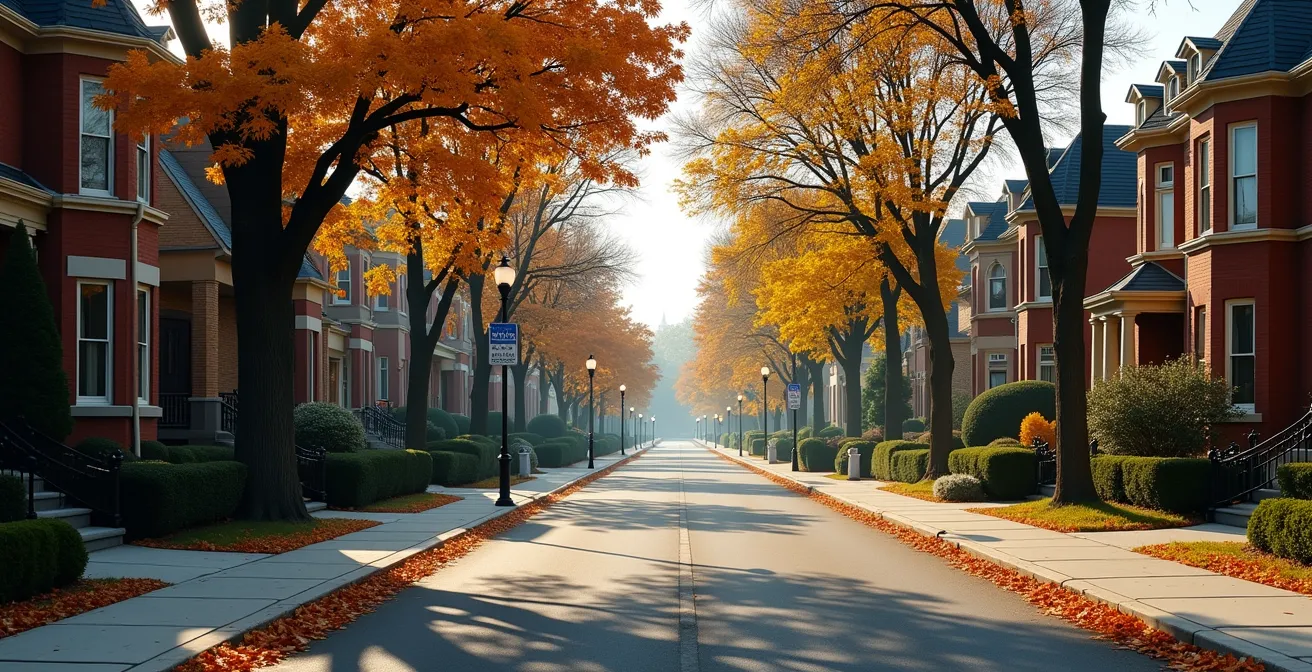
The financial stakes are significant. Analysis across the GTA has consistently shown that being on the “right” side of the boundary can add a 20 to 36 percent premium to a home’s value. For a median-priced home, this can easily translate to a difference of $50,000, $100,000, or even more. This is why savvy buyers and their agents pore over boundary maps with the intensity of treasure hunters—they know that a few meters in one direction can represent a massive swing in both purchase price and future resale potential.
This reality underscores the importance of verifying the exact school zoning for any property you are seriously considering. Never assume based on proximity. A home may be geographically closer to one school but officially zoned for another, and that small detail carries enormous financial weight.
Are the Sidewalks Wide Enough and Are There Curb Cuts for Families?
After analyzing school rankings and boundary maps, it’s time to zoom in on the most immediate aspect of your family’s future life: the walk to school. A neighbourhood’s “walkability” is a critical but often overlooked component of the Lifestyle Ledger. It’s not just about whether a school is technically within walking distance; it’s about whether that walk is safe, practical, and pleasant for a family with young children. A key part of your house-hunting process should include a hands-on Walkability Audit.
Start with the basics: are there even sidewalks on both sides of the street? Are they wide enough (a minimum of 1.5 meters is needed to comfortably pass another stroller)? Look at the intersections. Are there clearly marked crosswalks, traffic-calming measures like speed bumps, and, most importantly, curb cuts at every corner? A missing curb cut can turn a simple walk with a stroller or wagon into a frustrating and dangerous daily obstacle.
Beyond safety infrastructure, consider the quality of the environment. Is there a mature tree canopy providing shade on hot days? Are the routes to local parks direct and safe, without forcing you to cross major arterial roads? These small details contribute immensely to a family’s quality of life and encourage an active, community-oriented lifestyle. Some Ontario municipalities like Toronto and Mississauga are actively implementing policies like “Complete Streets” and “Vision Zero” to prioritize pedestrian safety. Searching for these terms in a municipality’s Official Plan can give you insight into its commitment to creating family-friendly infrastructure, which in turn supports long-term property values.
Your Family Walkability Audit Checklist
- Sidewalks: Verify their presence on all streets and ensure they are at least 1.5m wide for easy stroller navigation.
- Crossings: Count the number of marked crosswalks and traffic-calming measures (e.g., speed bumps, bump-outs) on the route to school.
- Shade and Greenery: Assess the mature tree canopy for summer shade and the proximity to safe park entrances.
- Accessibility: Confirm that curb cuts are present at all intersections to allow for easy passage of strollers, wagons, or wheelchairs.
- Municipal Commitment: Check the local municipality’s Official Plan for “Complete Streets” or “Vision Zero” initiatives that signal future improvements.
Key Takeaways
- The school premium is better viewed as an investment in a recoverable asset (home equity) rather than a sunk cost like tuition.
- School boundaries are not static; proactive research into potential reviews is essential to protect your investment and avoid being rezoned.
- The “Commute Tax” is a real cost measured in hundreds of hours of lost family time and increased stress, which must be weighed against a lower house price.
Why Moving to the Edge of the Golden Horseshoe for Cheaper Housing Might Cost You More in Lifestyle?
The “drive until you qualify” strategy is a well-trodden path for many Ontario families seeking affordability. Moving to the outer edges of the Golden Horseshoe can dramatically lower your purchase price, seemingly solving the affordability crisis. However, this decision often trades one set of costs for another, many of which are hidden. A lower mortgage payment can be quickly offset by a steep increase in transportation expenses and a significant deficit in your family’s time and lifestyle budget.
The most immediate new expense is the commute. A daily 1.5 to 2-hour journey each way into a major employment hub like Toronto is common. This necessitates a reliable GO Train pass, which can cost hundreds of dollars monthly, plus the cost of parking at the station. For many families, a second car becomes mandatory, adding thousands per year in insurance, gas, and maintenance. These direct transportation costs can easily eat up a significant portion of what you save on your mortgage.
The following table provides a clear comparison of the true costs, revealing that the financial savings of moving further out are not as straightforward as they appear.
This decision goes beyond finances, as this true cost comparison illustrates. What is the value of an extra 15-20 hours per week spent commuting instead of with your family?
| Cost Category | Urban Location | Golden Horseshoe Edge |
|---|---|---|
| Housing Cost | Higher purchase price | 30-40% lower |
| Daily Commute | 30-45 minutes | 1.5-2 hours each way |
| GO Train Monthly | $0-200 | $400-600 |
| Second Car Need | Optional | Mandatory ($8,000/year) |
| Station Parking | N/A | $5-7/day |
| Community Amenities | Established | 5-10 years away |
Moreover, these newer, fast-growing communities often lag in amenities. The promised parks, community centres, and libraries may be years away from completion, leaving families in a “service desert.” This forces you to drive further for groceries, activities, and healthcare, adding another layer to the Commute Tax. While the allure of a larger, more affordable home is powerful, a comprehensive analysis often shows that the true, all-in cost of living on the edge is far higher than the mortgage payment suggests.
Ultimately, choosing a home is about finding the right balance for your family’s unique circumstances. By looking beyond the sale price and creating your own “Lifestyle Ledger” that accounts for finances, commute times, and community access, you can make a strategic decision that truly invests in your family’s long-term happiness and well-being. To put these concepts into practice, the next logical step is to begin your own personalized analysis of target neighbourhoods.