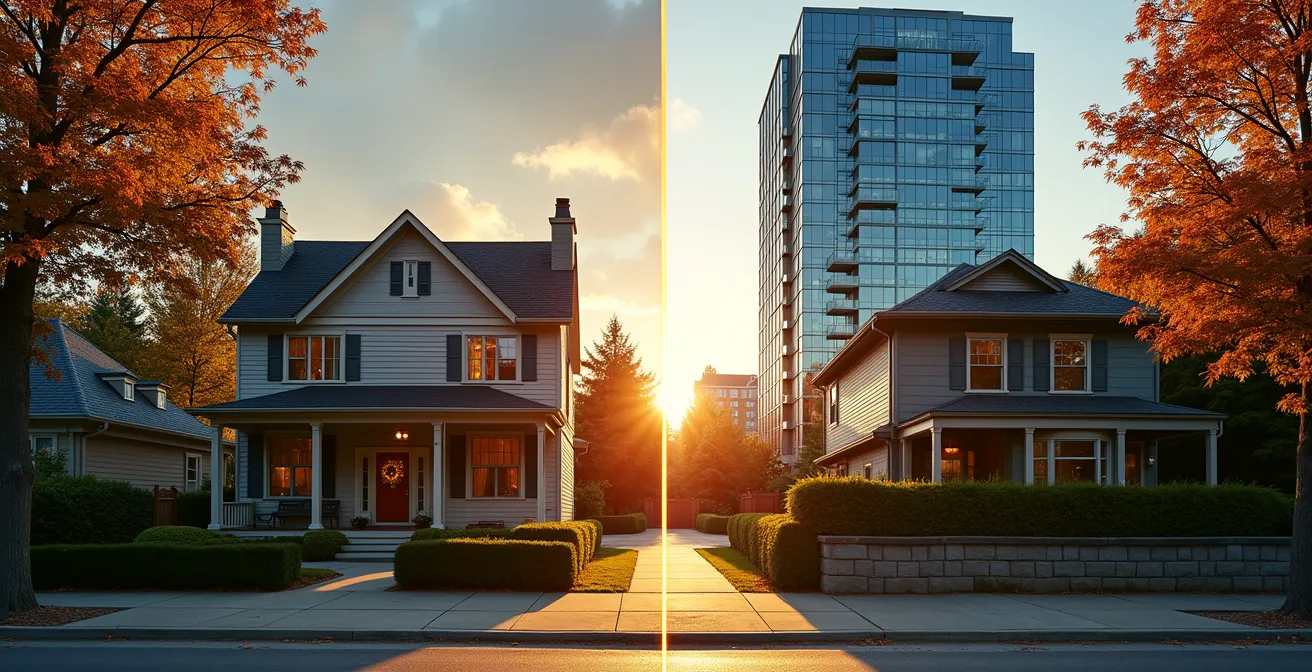
The significant appreciation gap between detached homes and condos is not luck; it’s a predictable outcome of owning a scarce, controllable asset: land.
- The land-to-structure ratio, not the building itself, is the primary driver of long-term property value growth.
- Freehold ownership unlocks the ability to force appreciation through strategic improvements and capitalize on neighbourhood infrastructure development.
Recommendation: To build generational wealth, shift your focus from the square footage of the home to the quality, control, and future potential of the land it occupies.
For many Canadians, homeownership is more than just having a place to live; it’s the cornerstone of their long-term financial strategy and retirement plan. The persistent debate often centres on the convenience and amenities of a condominium versus the freedom and space of a detached house. This conversation typically revolves around lifestyle choices, maintenance fees, and the appeal of a private backyard. While these factors are important, they obscure the fundamental economic principle that truly separates these two asset classes.
The conventional wisdom focuses on what you can see: the modern finishes of a condo or the larger footprint of a house. But the most significant factor driving a two-fold difference in historical appreciation is invisible: the ownership and control of the land itself. The outperformance of detached homes is not a market anomaly but a direct result of structural economic forces, primarily land scarcity and the owner’s absolute control over that asset. Condos, by their nature, offer a fractional, restricted share in this core value driver.
This analysis moves beyond the surface-level discussion. We will deconstruct the historical performance of Canadian real estate to reveal why owning the dirt under your feet has been the single most powerful wealth-building tool for homeowners. By understanding these underlying mechanics—from land-to-structure ratios to the impact of urban development—you can make investment decisions that are not just about finding a home, but about securing your financial future.
To provide a clear framework for this analysis, this guide explores the key structural factors that explain this historical performance gap. We will examine the core concepts that empower detached homeowners and the strategic mistakes to avoid on your wealth-building journey.
Summary: Understanding the Structural Advantages of Detached Home Ownership
- Why the land-to-structure ratio is the #1 predictor of 20-year appreciation
- How to add $40k of value to a property through strategic cosmetic improvements?
- Freehold townhome or Condo townhome: which appreciates better once fees are factored in?
- The “best house on the block” mistake that caps your appreciation potential
- When to downsize: selling at the market peak vs waiting for retirement?
- Why properties within 800m of a new LRT station historically gain 20% more value
- Why building it right the first time is the ultimate carbon strategy?
- What actually happens on closing day and why do you need funds 24h in advance?
Why the land-to-structure ratio is the #1 predictor of 20-year appreciation
As a real estate historian, the most crucial lesson is this: you buy a house, but you invest in land. The structure itself is a depreciating asset. Like any physical object, it wears down, requires maintenance, and becomes dated over time. The land it sits on, however, is a finite resource, especially in desirable urban and suburban areas across Canada. This simple truth is the engine behind the long-term wealth creation of detached properties. The core metric to understand this is the land-to-structure ratio.
This ratio represents the proportional value of the land relative to the value of the building on it. In a high-demand city, a small, older bungalow on a standard lot might have an 80/20 land-to-structure ratio; 80% of the property’s total value is in the land. Conversely, a brand-new condo unit’s value is almost entirely in the structure, with only a tiny, shared fraction attributed to the land beneath the building. This is why historical data shows detached properties consistently outperform, with annual appreciation often in the 7-10% range compared to 5-7% for condos.
A detached home is essentially a vehicle for owning a significant, appreciating asset (land) with a functional, depreciating asset (the house) on top. A condo is the opposite. Over a 20-year horizon, the force of land appreciation will almost always overwhelm the depreciation of the building, leading to substantial net gains. An investor focused on long-term wealth understands they are acquiring a piece of a permanently scarce commodity, not just square footage. In Toronto, for example, even in a volatile year, detached homes saw an appreciation of around 23%, slightly outpacing the 21.5% for condos, underscoring this resilient underlying value.
How to add $40k of value to a property through strategic cosmetic improvements?
The second major advantage of freehold ownership is asset control. Unlike a condo owner, who is bound by the decisions of a corporation and the shared nature of the property, a detached homeowner has the unilateral power to “force appreciation.” This means making targeted investments that directly increase the market value of the property, independent of general market trends. While large-scale structural additions are one path, strategic cosmetic improvements often yield the highest and fastest return on investment.
The key is to focus on the areas that have the greatest impact on a buyer’s perception of value and livability: kitchens and bathrooms. These are the emotional centres of a home. An outdated kitchen can make an entire property feel old, while a modern, functional one can lift the appeal of the whole house. This is not just anecdotal; the numbers bear it out. According to the Appraisal Institute of Canada, a kitchen renovation is one of the highest-ROI projects a homeowner can undertake. A typical investment can see a return of 75% to 100% at resale.
Consider an average investment of around $30,000 to update a dated kitchen—new countertops, modernizing cabinets, new appliances, and improved lighting. If this renovation generates an 80% ROI, that’s $24,000 in immediate equity created. Add a smaller, $10,000 bathroom refresh with a similar ROI, and you can realistically add over $30,000 in tangible value. The goal isn’t to over-spend on luxury finishes but to elevate the home to meet modern buyer expectations, transforming a functional space into a desirable one.

As this visual transformation shows, the change is about more than just aesthetics; it’s about converting a liability (a dated, unappealing space) into a primary asset. This level of value creation is an opportunity exclusive to freehold owners, who can directly control and capitalize on their investment in a way condo owners simply cannot.
Freehold townhome or Condo townhome: which appreciates better once fees are factored in?
The townhouse market presents a fascinating middle ground, but it’s split into two distinct legal and financial structures: freehold and condominium. While they may look identical from the street, their long-term performance as investments is vastly different, once again circling back to the principles of land ownership and asset control. A freehold townhouse, like a detached home, gives you ownership of the building and the land it sits on. A condo townhouse gives you ownership of the interior space, with the land and exterior structure being common elements managed by a condo corporation.
This distinction is critical. With a freehold property, you have no monthly maintenance fees and are solely responsible for all upkeep. With a condo townhouse, you pay monthly fees that cover shared expenses like landscaping, roof repairs, and snow removal. While this may seem convenient, these fees are a permanent and inflating drag on your cash flow and total return. Furthermore, condo boards can levy “special assessments”—sometimes costing tens of thousands of dollars—for unexpected major repairs, a risk that doesn’t exist with freehold ownership.
As the Precondo.ca analysis highlights, this difference in ownership structure has a direct impact on appreciation. In their report, they state:
Houses require higher initial investment and full responsibility for maintenance and repairs, but offer complete customization freedom, greater privacy, and historically faster appreciation rates due to land ownership.
– Precondo.ca Analysis, in a Canada Real Estate Market Report 2024
The following table, based on data comparing these ownership models, breaks down the key financial differences that contribute to the superior long-term performance of freehold properties.
| Factor | Freehold Townhome | Condo Townhome |
|---|---|---|
| Monthly Fees | $0 (self-managed) | $200-$1,000 |
| Maintenance Control | Full control | HOA managed |
| Special Assessments Risk | None | $20,000+ potential |
| Appreciation Rate | Higher (land ownership) | Lower (shared land) |
| 15-Year ROI | Typically 10-15% higher | Affected by fee inflation |
Ultimately, the slightly lower initial convenience of a freehold townhouse is more than offset by the absence of fees, complete asset control, and, most importantly, the superior appreciation that comes from owning the land outright. For a long-term investor, the choice is clear.
The “best house on the block” mistake that caps your appreciation potential
While asset control allows for forcing appreciation, it also introduces the risk of a critical strategic error: over-improvement. The goal of a renovation in a wealth-building context is not to create your dream home in a vacuum, but to maximize its value within its specific market. Becoming the “best house on the block” by a wide margin is often a losing proposition because it runs into the economic principle of a “value ceiling.” A property’s value is heavily influenced by the comparable properties surrounding it. You cannot sell a $1 million home in a $500,000 neighbourhood, no matter how luxurious its finishes are.
This is where disciplined, strategic investment is crucial. A guiding principle for maintaining a strong return on investment is the 5-15% rule. As renovation experts point out, you should aim to spend no more than 5-15% of your home’s total current value on any single renovation project. For example, installing a $150,000 gourmet kitchen in a home worth $400,000 is a classic over-improvement; you will never recoup that cost. The market simply won’t support such a high valuation. According to a guide on maximizing ROI, this discipline is essential to avoid “improving your home beyond the block’s threshold,” as highlighted by a case study on the Ontario over-improvement value ceiling effect.
The savvy investor renovates with an eye on the neighbourhood standard, aiming to be slightly above average, not an outlier. The goal is to meet or slightly exceed the expectations of the target buyer for that specific area. This might mean choosing high-quality but not ultra-luxury appliances, or durable quartz countertops instead of exotic imported marble. While a January 2024 survey showed that 44% of Canadians expect neighbourhood values to increase, this appreciation lifts all boats; it does not justify a single property vastly exceeding its peers. True strategic improvement is about intelligent alignment with the market, not unconstrained spending.
When to downsize: selling at the market peak vs waiting for retirement?
For many Canadian families, their home is their largest asset, often representing the bulk of their retirement savings. This is a powerful wealth-building engine, but it also concentrates significant financial risk in a single asset class. Data shows that for the average Canadian household, real estate makes up a staggering 52% of their total net worth. This reality makes the decision of when to sell—or “downsize”—one of the most critical financial choices they will ever make. The core dilemma is often framed as selling at a perceived market peak versus holding until the planned retirement date.
From a historical market perspective, attempting to time the absolute peak is a fool’s errand. Markets are unpredictable in the short term. A more prudent strategy is to align the decision with personal financial goals and life stages, while keeping an eye on medium-term market cycles. Waiting until a fixed retirement date can be risky; if that date coincides with a market downturn, a significant portion of your nest egg could be wiped out right when you need it most. Conversely, selling too early during a strong upswing means leaving significant tax-free gains (on a principal residence) on the table.

A balanced approach involves creating a “window of opportunity” for downsizing, perhaps a 3-5 year period leading up to retirement. During this window, you can monitor the market without being forced to sell at an inopportune moment. For example, if the market experiences a strong run-up two years before your planned retirement, that may be the optimal time to crystallize your gains, sell the large family home, and move the capital into a more diversified and liquid portfolio. Forecasts from major institutions like Royal LePage can provide context; for instance, their 2025 forecast projects a return to more normal appreciation rates, which could signal a stable period to execute such a plan. The decision should be less about hitting the absolute top and more about achieving financial security on your own terms.
Why properties within 800m of a new LRT station historically gain 20% more value
If land is the primary driver of value, then factors that make specific parcels of land more desirable create a powerful, long-term economic moat for a property. Nothing exemplifies this more than proximity to major public transit infrastructure. In growing Canadian cities, the development of a new Light Rail Transit (LRT) line is a transformative event for a neighbourhood. It fundamentally alters the accessibility and convenience of a location, reducing commute times and connecting residents to employment hubs, entertainment, and services. This increased utility is directly capitalized into the value of nearby land.
The effect is not marginal. Numerous studies have quantified this “transit uplift.” A landmark CMHC study, often cited in real estate analyses, found that properties located within 800 metres of a rapid transit station tend to appreciate significantly faster than those farther away. This isn’t a one-time jump; it’s a sustained period of outperformance. For instance, the launch of Ottawa’s Confederation Line triggered an appreciation increase of 10–15% in station-adjacent neighbourhoods over just a two-to-three-year period, on top of general market growth.
This creates a clear strategy for the long-term investor: “buy the rumour, sell the news.” Investing in a detached home in a neighbourhood slated for a future LRT station, even years in advance, allows you to acquire the land before the full value of the transit line is priced in. As the project moves from planning to construction to operation, the value of your property benefits from compounding waves of appreciation. This is a powerful, passive way to force appreciation. A broader City of Ottawa economic impact study confirms this, showing a wide property value increase range from 10% up to 50% in some cases, depending on the specific location and property type. For detached homes with their significant land component, the effect is often at the higher end of that range.
Key Takeaways
- Land is the appreciating asset; the structure depreciates. A high land-to-structure ratio is the foundation of long-term wealth building in real estate.
- Freehold ownership provides absolute asset control, enabling strategic “forced appreciation” through high-ROI improvements that condo ownership prohibits.
- Avoid the “best house on the block” trap by adhering to the 5-15% rule, ensuring renovation costs are proportional to neighbourhood values to prevent a capped ROI.
Why building it right the first time is the ultimate carbon strategy?
In the 21st century, another critical factor has emerged that affects the long-term value of a property: energy efficiency. Historically, this was a minor consideration, but with rising carbon taxes, tightening building codes, and growing environmental awareness, it has become a major component of a home’s financial viability. “Building it right the first time”—or renovating to a high standard of efficiency—is no longer just an environmental choice; it’s a crucial defensive strategy against what is known as functional obsolescence. A home that is expensive to heat and cool is at risk of becoming undesirable, leading to a “brown discount” at resale.
As one Ontario renovation expert notes, this is a growing financial risk. In their analysis, they state:
Energy-efficient homes are becoming increasingly valuable as carbon taxes rise and building codes tighten. Properties without efficiency upgrades risk becoming functionally obsolete, leading to a ‘brown discount’ at resale.
– Energy Kingston Exteriors, in the Ontario Home Renovation ROI Guide 2024
For a freehold homeowner, this presents another opportunity for strategic investment. Upgrading insulation, sealing windows, and installing high-efficiency HVAC systems not only reduces monthly utility bills but also protects the property’s future market value. It builds a different kind of economic moat—one based on performance and low operating costs. Many provincial and municipal governments in Canada offer rebates and incentives to encourage these upgrades, reducing the upfront cost and accelerating the return on investment.
Action Plan: Leveraging Green Building Rebates in Canada
- Schedule Audits: Book pre- and post-renovation energy audits to get a baseline and verify the efficiency improvements made.
- Qualify for Rebates: Ensure your project includes at least two qualifying updates to achieve the necessary efficiency increase (e.g., 15%) for major rebate programs.
- Access Incentives: Investigate and apply for available programs, such as Enbridge’s Smart Savings incentives which can offer up to $1,600.
- Protect Your Home: For homes built before 2004, look into protective plumbing rebates like the RPPP to mitigate flood risks while upgrading.
- Document Everything: Keep detailed records of all improvements, audits, and certifications to clearly demonstrate the home’s enhanced value and efficiency to future buyers.
By investing in efficiency, you are future-proofing your asset against rising energy costs and evolving buyer expectations, ensuring it remains a premium, desirable property for decades to come.
What actually happens on closing day and why do you need funds 24h in advance?
After navigating the strategic decisions of property selection and financing, the final step in securing your asset is the closing day. For many buyers, this process can seem like an opaque, stressful formality. However, understanding the mechanics of what happens behind the scenes is crucial for a smooth transaction. Closing day is the culmination of legal and financial processes where ownership is officially transferred. In Canada, this is not an instantaneous event; it’s a carefully orchestrated sequence involving lawyers for both the buyer and seller, and the provincial land registry system.
One of the most common points of confusion and stress is the requirement to have your closing funds—the down payment balance plus all closing costs—delivered to your lawyer’s trust account at least 24 to 48 hours in advance of the closing date. This is not an arbitrary deadline. Your lawyer needs this time to perform several critical tasks. They must verify the funds, draw a certified cheque or wire transfer payable to the seller’s lawyer, and coordinate with the electronic land registry system (like Teranet in Ontario) to register the change in ownership and the new mortgage against the property title.
These steps cannot be rushed. The entire transaction hinges on the seller’s lawyer receiving cleared funds before they will release the keys to the property. If your funds arrive late on the closing day, it can create a chain reaction of delays that could, in a worst-case scenario, cause the entire deal to collapse. This would put you in breach of contract, potentially leading to the forfeiture of your deposit and legal action from the seller. Properly preparing for the logistics of closing day is the final, non-negotiable step in taking possession of the asset you have worked so hard to acquire.
To build a truly effective long-term wealth strategy, the next logical step is to analyze potential properties not just as homes, but as assets with a specific land-to-structure value and strategic potential.
Frequently Asked Questions about the Canadian Real Estate Closing Process
Why must funds arrive 24 hours before closing?
Canadian lawyers need time to verify funds, prepare certified cheques, and coordinate with land registry systems like Ontario’s Teranet before the closing deadline. This buffer ensures all legal and financial checks are completed for a smooth transfer of ownership.
What happens if funds arrive late on closing day?
Late funds can cause the transaction to fail, potentially resulting in a breach of contract, the loss of your deposit, and the possibility of legal action from the seller for any damages they incur due to the delay.
What closing costs beyond the down payment should I prepare for?
You must be prepared for several additional costs, including Land Transfer Tax (which varies significantly by province and municipality), legal fees (typically $1,500-$3,000), title insurance ($300-$600), and adjustments for prepaid property taxes or utilities.