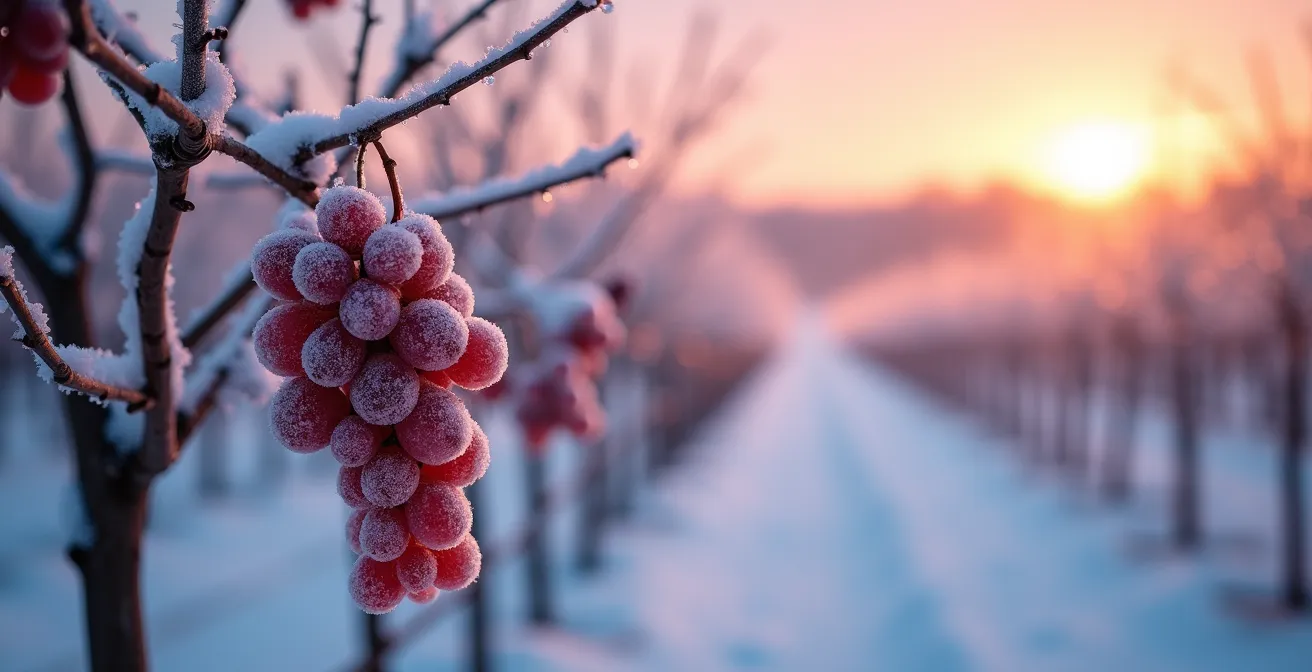
The high price of Canadian Icewine isn’t just about frozen grapes; it’s a direct reflection of a rigorously enforced “liquid gold standard” of quality and authenticity unique to Canada.
- Production is legally mandated to occur only when grapes are naturally frozen on the vine at or below -8°C, a process of calculated scarcity that drastically reduces yield.
- Authenticity is guaranteed by the VQA (Vintners Quality Alliance) system, which protects consumers from fakes and justifies a premium for certified terroir and varietals.
Recommendation: Look for the VQA logo and the single-word “Icewine” spelling on the label to ensure you’re investing in an authentic bottle, not a cheap imitation.
When faced with a slender 375ml bottle of Canadian Icewine carrying a price tag that rivals fine Scotch or Champagne, the question is inevitable: why is this liquid gold so expensive? Many will offer simple explanations like “it’s risky to make” or “the yield is low.” While true, these are just surface-level observations. They miss the intricate system of regulation, terroir, and craftsmanship that deliberately transforms agricultural risk into a globally recognized luxury product. This isn’t just a dessert wine; it’s a testament to a national commitment to quality.
The true value of Icewine is not an accident of a cold climate. It is the result of a concept we can call “codified risk.” Unlike anywhere else in the world, Canadian vintners operate under a strict legal framework that dictates the exact conditions for its creation. This framework, enforced by organizations like VQA Ontario, is the foundation of its price. It guarantees that every certified bottle is the product of a perilous, labour-intensive process that simply cannot be replicated artificially or scaled up easily.
This guide moves beyond the platitudes to uncover the real drivers behind Icewine’s cost. We will explore the non-negotiable -8°C rule, demystify the art of pairing, and examine how terroir and authenticity are as crucial to the final price as the grapes themselves. By understanding this complex value chain, you’ll no longer see just a high price, but the story of a national treasure meticulously crafted from vine to glass.
This article explores the specific factors that contribute to the prestige and cost of authentic Canadian Icewine. Follow along as we break down the regulations, production methods, and tasting experiences that define this unique luxury.
Summary: The True Value of Canada’s Liquid Gold
- The -8°C rule: why artificial freezing is forbidden for authentic Icewine
- Blue cheese or Foie Gras: what actually pairs with sweet Vidal Icewine?
- Does Icewine improve with age or should you drink it fresh?
- How to enjoy dessert wine without the hangover the next day?
- Vidal vs Cabernet Franc: which grape variety makes the best gift for a novice?
- Bench vs Lakeshore: how soil location changes the taste of Niagara Riesling?
- How to distinguish authentic Canadian Icewine from imported fakes?
- Why the Niagara benchlands offer a more authentic experience than Clifton Hill?
The -8°C rule: why artificial freezing is forbidden for authentic Icewine
The fundamental reason for Icewine’s high price lies in a simple, unyielding number: -8°C. For a bottle to be labelled as authentic VQA Icewine in Canada, the grapes must be naturally frozen on the vine and harvested while the air temperature is at or below this critical threshold. This isn’t a guideline; it’s a strictly enforced law of production. As the VQA Ontario system mandates, production is monitored by appointed agents who will halt the harvest if the temperature rises above -8°C. This process of codified risk ensures that the water in the grapes freezes, but the sugars and dissolved solids do not, creating a highly concentrated must when pressed.
This paragraph introduces the rigorous certification process. For a better understanding, the illustration below captures a VQA inspector verifying conditions in the field, a crucial step in creating the liquid gold standard.
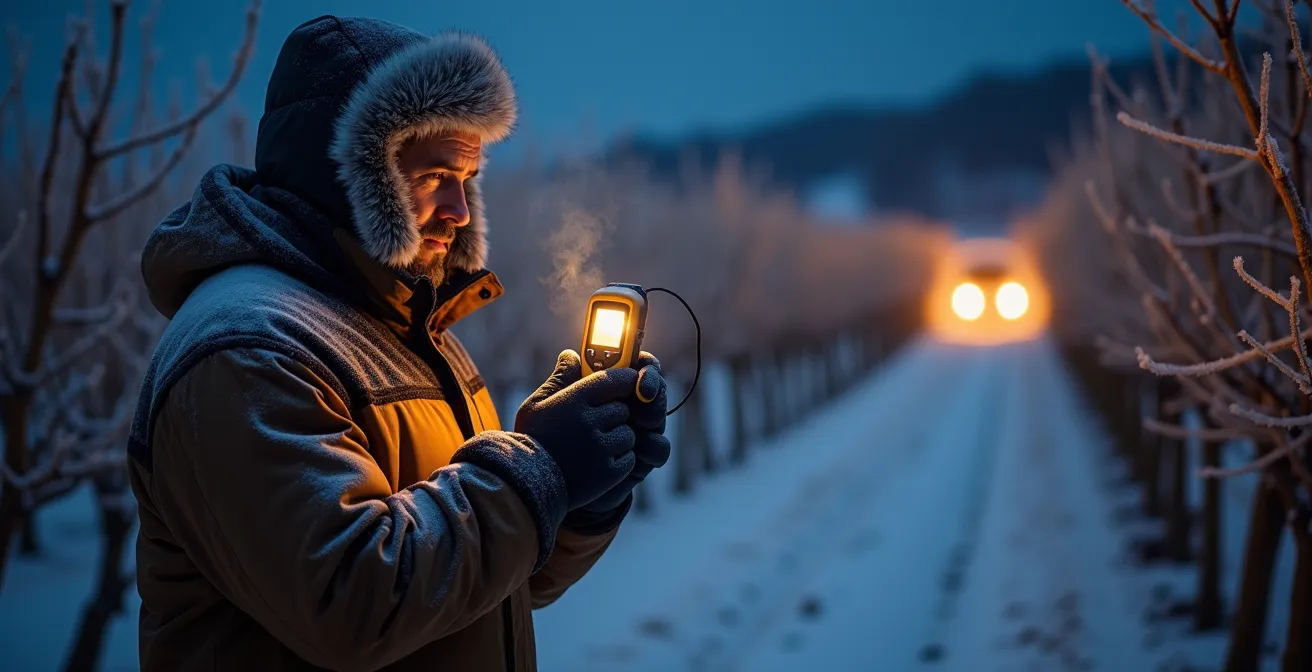
As this image suggests, the process is one of precision and endurance. Wineries must register their intended Icewine vineyards before the season, and the entire harvest must occur in a continuous process under these freezing conditions. The resulting grape must is required to have a minimum sugar level of 35° Brix, a concentration far higher than German Eiswein standards, leading to the wine’s characteristic sweetness and viscosity. This natural gamble is extremely volatile; a recent harvest report noted that a staggering 4,100 tonnes of grapes were harvested for icewine in 2024, a massive 5.4 times more than the paltry 765 tonnes from the previous year, highlighting the immense financial risk producers take on each season.
Ultimately, this rule of nature, enforced by law, creates a “calculated scarcity.” It takes roughly 3.5 kilograms (8 pounds) of grapes to produce a single 375ml half-bottle of Icewine, a yield about ten times smaller than for a typical table wine. The price directly reflects this painstaking, high-risk concentration of flavour.
Blue cheese or Foie Gras: what actually pairs with sweet Vidal Icewine?
The intense sweetness and rich texture of Icewine, particularly the popular Vidal variety, can seem intimidating to pair. While it’s often relegated to the end of a meal as a standalone “liquid dessert,” its true potential is unlocked when matched with savoury, fatty, or salty foods. The key is to find pairings that provide a contrast, allowing the wine’s acidity to cut through richness and its sweetness to balance saltiness. This turns a simple tasting into a sophisticated gastronomic experience, further enhancing its value proposition.
Exploring pairings based on Canadian terroir creates a uniquely patriotic tasting journey. The honeyed, apricot notes of a Niagara Vidal, for instance, create a stunning counterpoint to the sharp, crystalline texture of an aged cheddar from Quebec. Likewise, the opulence of foie gras or duck rillettes from Lac Brome is beautifully sliced through by the wine’s vibrant acidity. For a truly memorable experience, a cross-Canada flight featuring Ontario Vidal with British Columbia smoked salmon and Nova Scotia wild blueberry tarts showcases the versatility of this national treasure.
The following table, based on expert analysis, breaks down the ideal pairings for Canada’s primary Icewine varietals, offering a clear guide for gourmands and gift-buyers alike.
| Icewine Varietal | Flavor Profile | Best Canadian Pairings | Serving Notes |
|---|---|---|---|
| Vidal (white) | Honey, apricot, tropical fruit | Quebec aged cheddar, maple-glazed nuts | Most approachable for novices |
| Riesling (white) | Citrus, mineral, high acidity | Atlantic lobster, fruit-based desserts | Ages well 10-20 years |
| Cabernet Franc (red) | Strawberry jam, spice, unique | Dark chocolate, berry tarts | Rare Canadian specialty |
| Sparkling Icewine | Lighter sweetness perception | Fresh fruit, soft cheeses, nuts | Effervescence reduces sweetness |
For optimal enjoyment, serving temperature is critical. Chilling the bottle in an ice bucket for 15 minutes or refrigerating it for two hours brings it to the perfect temperature to temper its sweetness and highlight its complex aromatics. A standard pour of 1.5 ounces per person in a white wine glass is all that’s needed to appreciate its concentrated power.
Does Icewine improve with age or should you drink it fresh?
A common misconception about Icewine is that its sweetness makes it a drink to be consumed young and fresh. While a young Icewine is certainly a vibrant and delicious experience, its high sugar content and acidity act as natural preservatives, giving it remarkable aging potential. Much like a fine Sauternes, a well-cellared Canadian Icewine can evolve for decades, transforming its bright fruit flavours into complex notes of marmalade, dried apricot, caramel, and nuts. This capacity for aging significantly contributes to its status and price as a collector’s item.
A Landmark Vintage: Inniskillin’s 1989 Vidal Icewine
The moment that established Canadian Icewine on the world stage was when Inniskillin’s 1989 Vidal Icewine won the prestigious Grand Prix d’Honneur at Vinexpo 1991 in Bordeaux. This victory was particularly remarkable as the wine was technically an illegal import into the EU at the time, yet its quality was undeniable. This event not only showcased the exceptional aging potential of the vintage, which remains a collector’s item, but also paved the way for official EU recognition of Canadian Icewine standards in 2001, cementing its place as a global luxury good.
This international recognition was a pivotal moment. As co-founder Donald Ziraldo recalled in The Canadian Encyclopedia, this win was the catalyst for the brand’s luxury status:
Looking back, when nobody had heard of Canadian wine before, that gold medal was the stepping stone to the world stage. Inniskillin icewine became a luxury brand.
– Donald Ziraldo, The Canadian Encyclopedia – Icewine article
The market has since validated this aging potential with staggering auction results. As a testament to its investment value, Canadian wine expert Natalie MacLean reported that a half-bottle of Royal DeMaria 2006 Chardonnay Icewine sold for $30,000, a price that firmly places it in the realm of the world’s most elite and collectible wines. While most Icewines are enjoyed within 5-10 years, Riesling-based varieties can often age for 20 years or more. Once opened, a bottle will keep for a week or two in the refrigerator, but its peak is best enjoyed upon uncorking.
For gift-buyers and connoisseurs, this dual nature is a key part of the appeal. A bottle can be a delightful immediate pleasure or a long-term cellar treasure, an investment in future enjoyment that justifies its initial cost.
How to enjoy dessert wine without the hangover the next day?
The term “dessert wine” can conjure images of cloying sweetness and a subsequent sugar-and-alcohol headache. However, enjoying Canadian Icewine responsibly is surprisingly easy, thanks to its unique chemical composition and established tasting protocols. The first key factor is its alcohol content. Unlike fortified dessert wines like Port, which can reach 19-20% alcohol by volume (ABV), a guide by Travel Awaits notes that Canadian Icewine typically contains 9-11% ABV. This significantly lower alcohol level, combined with smaller serving sizes, is the first line of defense against overindulgence.
The second factor is adopting the professional practices used in Niagara’s winery tasting rooms. The goal is to savour, not to consume in large quantities. Pairing the wine with fatty or savoury foods like aged cheese or nuts is not just for flavour; it also slows the body’s absorption of sugar and alcohol. Remember, it takes an entire vine’s worth of grapes to produce a single bottle, making each sip a precious commodity to be respected and enjoyed slowly. Using the correct glassware, such as tulip-shaped glasses, enhances the aromatics and encourages smaller, more deliberate sips.
To ensure a pleasant experience from start to finish, following a clear set of steps is the best approach. This checklist outlines the professional protocol for savouring Icewine responsibly.
Your Practical Guide: Savouring Icewine Responsibly
- Control Temperature: Start with the proper serving temperature by chilling the bottle to around 10°C (50°F) for optimal enjoyment and to naturally slow consumption.
- Use Appropriate Glassware: Pour a small 1.5 oz (45 ml) serving into a tulip-shaped icewine glass or a standard white wine glass to concentrate the aromas.
- Practice Winery Protocol: If sampling multiple wines, as on a tour, make use of the provided spittoons. This is the professional way to taste without the full effects of alcohol.
- Pair Strategically: Always serve Icewine with fatty or savoury foods, such as Canadian aged cheese or nuts, to slow sugar absorption and create a balanced tasting experience.
- Appreciate the Concentration: Remember the production ratio—it takes about 8 pounds of grapes for one half-bottle. This mental note encourages you to treat each sip as precious and savour it slowly.
By treating Icewine not as a standard beverage but as a concentrated essence of the grape, you can fully appreciate its complexity without any negative after-effects. It’s about quality and intensity, not quantity.
Vidal vs Cabernet Franc: which grape variety makes the best gift for a novice?
Choosing the right Icewine as a gift can be daunting, but the decision often boils down to two flagship Canadian varieties: the golden Vidal and the rare, ruby-hued Cabernet Franc. The choice depends entirely on the recipient. Vidal, a hardy hybrid grape often called “The Hardy Canadian Survivor,” is the workhorse of the industry. It produces a luscious, approachable Icewine with forward notes of tropical fruit, honey, and apricot. Its reliable performance in Canada’s climate makes it the most widely produced and affordable Icewine, positioning it as the perfect entry point for a novice.
This visual comparison highlights the striking difference between the two grapes before they are transformed into liquid gold. On the right, the deep purple Cabernet Franc, and on the left, the translucent golden Vidal.
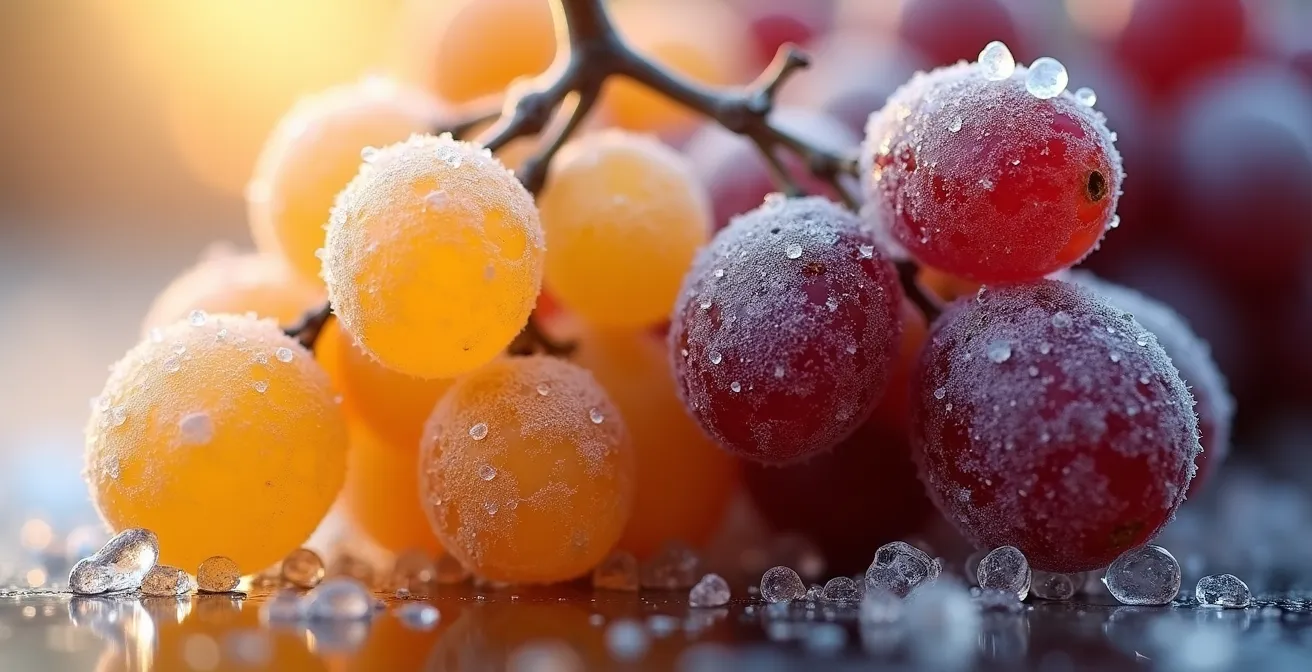
In contrast, Cabernet Franc Icewine is a rare specialty, often considered Niagara’s risky crown jewel. As a red grape, it produces a wine with a completely different profile: notes of strawberry jam, rhubarb, and a hint of spice. Its production is far more limited and commands a significantly higher price, making it an exceptional gift for a seasoned red wine enthusiast or an adventurous collector. Pillitteri Estates, the world’s largest estate Icewine producer, exemplifies this strategy by offering 13 different varietals, using Vidal for volume and accessibility while positioning rare grapes like Cabernet Franc as premium collector’s items.
This table provides a clear decision-making framework for any gift-giver, directly comparing the two varietals across key purchasing factors.
| Aspect | Vidal Icewine | Cabernet Franc Icewine |
|---|---|---|
| Ideal recipient | First-time icewine drinkers, dessert lovers | Red wine enthusiasts, adventurous collectors |
| Production volume | Most common Canadian icewine | Rare, limited production |
| Price range (375ml) | CAD $40-80 | CAD $80-150+ |
| Flavor profile | Tropical fruit, honey, apricot | Strawberry jam, spice, unique complexity |
| Canadian story | Hardy hybrid survivor of Canadian winters | Niagara’s risky crown jewel |
| Gift package idea | Pair with Canadian icewine glasses | Include Niagara wine region book or tour voucher |
Ultimately, for a first-time experience, the welcoming and classic profile of a Vidal Icewine is the superior choice. For the connoisseur who has “tried everything,” the unique and complex character of a Cabernet Franc Icewine offers an unforgettable and highly valued surprise.
Bench vs Lakeshore: how soil location changes the taste of Niagara Riesling?
While the -8°C rule sets the baseline for Icewine, its ultimate character—and a significant portion of its price—is determined by terroir. In the Niagara Peninsula, where industry statistics show that 90% of Canadian icewine comes from Ontario, the most crucial geographical distinction is between the “Bench” and the “Lakeshore.” This concept of terroir value is paramount, especially for expressive grapes like Riesling. The Niagara Escarpment, a limestone ridge, creates a series of sub-appellations known as the Benches (such as Beamsville Bench and St. David’s Bench) with unique microclimates.
Vineyards located on the Benches are prized for their limestone-rich soils and superior air drainage. This environment produces Riesling Icewines that are distinctly mineral-driven, with high acidity, crisp citrus notes, and incredible aging potential. The terroir imparts a structure and elegance that connoisseurs actively seek out. These are wines of precision and finesse, reflecting the challenging, well-drained soils they grow in.
In contrast, vineyards on the flat lands closer to Lake Ontario (the Lakeshore) experience more humidity and a moderating lake effect. The soils here are typically heavier with clay and loam. This results in Riesling Icewines that are often richer, more voluptuous, and dominated by honeyed, ripe-fruit profiles. While still excellent, they present a different expression of the grape—one of opulence rather than minerality. This clear differentiation in taste profile, stemming directly from the soil and location, translates directly to the final bottle price. VQA-designated Icewines from specific Bench sub-appellations regularly command 20-30% price premiums over their Lakeshore counterparts, a clear monetary reflection of their perceived quality and unique character.
For a discerning buyer, understanding this distinction is key. Choosing an Icewine from the Beamsville Bench isn’t just buying a dessert wine; it’s an investment in a specific, highly sought-after expression of Canadian terroir, and its price reflects that exclusivity.
How to distinguish authentic Canadian Icewine from imported fakes?
The global success of Canadian Icewine has unfortunately attracted a dark counterpart: counterfeiting. The problem is so significant that, as GastroVino Academy warns, it is estimated that around 50% of Canadian icewines found on Asian shelves are fakes. These fraudulent products, often labelled “Ice Wine” (two words) or “Iced Wine,” are typically made from artificially frozen grapes (“icebox wines”) or are simply sweet dessert wines masquerading as the real thing with generic Canadian imagery like maple leaves. This is where the VQA system becomes the consumer’s most powerful ally, acting as the guarantor of the liquid gold standard.
Verifying authenticity is the single most important step in ensuring your purchase is worth its premium price. The VQA logo on the bottle is a seal of quality, certifying that the wine was made from 100% Ontario grapes, naturally frozen on the vine according to the strict -8°C rule. The label should also clearly state the specific producer and the appellation of origin, such as “Niagara Peninsula” or a sub-appellation like “St. David’s Bench.”
To protect your investment and ensure you are tasting an authentic product, follow these key verification steps:
- Check the Spelling: Authentic Canadian product is spelled “Icewine” as one word. Be highly suspicious of “Ice Wine” or “Iced Wine.”
- Verify VQA Certification: Look for the official VQA logo and a proper, specific vineyard address on the label. Generic branding is a red flag.
- Avoid Generic Imagery: Be wary of bottles that use a “Maple Leaf” or “Canadian Flag” as the primary brand name instead of a specific, reputable producer.
- Know the Producers: Look for established, high-quality producer names such as Inniskillin, Peller Estates, Pillitteri, Jackson-Triggs, or Mission Hill (from British Columbia).
- Read the Fine Print: Distrust bottles labelled simply as “dessert wine” but sold at Icewine prices. True Icewine will proudly declare itself.
By learning to read a label critically, the consumer actively participates in upholding the high standards of the Canadian wine industry. The price of true Icewine includes this guarantee of authenticity, a promise that you are purchasing a genuine article of uncompromising quality.
Key Takeaways
- The price of Icewine is not arbitrary; it’s a direct result of the “codified risk” of the legally-mandated -8°C natural freezing rule.
- Terroir is a significant value driver, with wines from specific Niagara “Bench” sub-appellations commanding price premiums due to their unique mineral character.
- Authenticity is paramount. Always look for the VQA logo and the single-word “Icewine” spelling to avoid prevalent counterfeit products.
Why the Niagara benchlands offer a more authentic experience than Clifton Hill?
The price of a bottle of Icewine is intrinsically linked to the place it comes from. For Niagara, this presents a tale of two tourism models: the transactional, high-volume attractions of Clifton Hill versus the transformational, terroir-focused experiences of the Benchlands. Clifton Hill offers a fleeting, entertaining diversion. The Niagara Benchlands, however, offer a deep connection to the land, the process, and the people who craft the wine. This authentic experience economy is a hidden component of the wine’s value; you are buying a piece of that heritage.
This panoramic view of the Niagara Benchlands at sunset captures the serene, agricultural soul of the region, a world away from the neon glow of mass tourism.
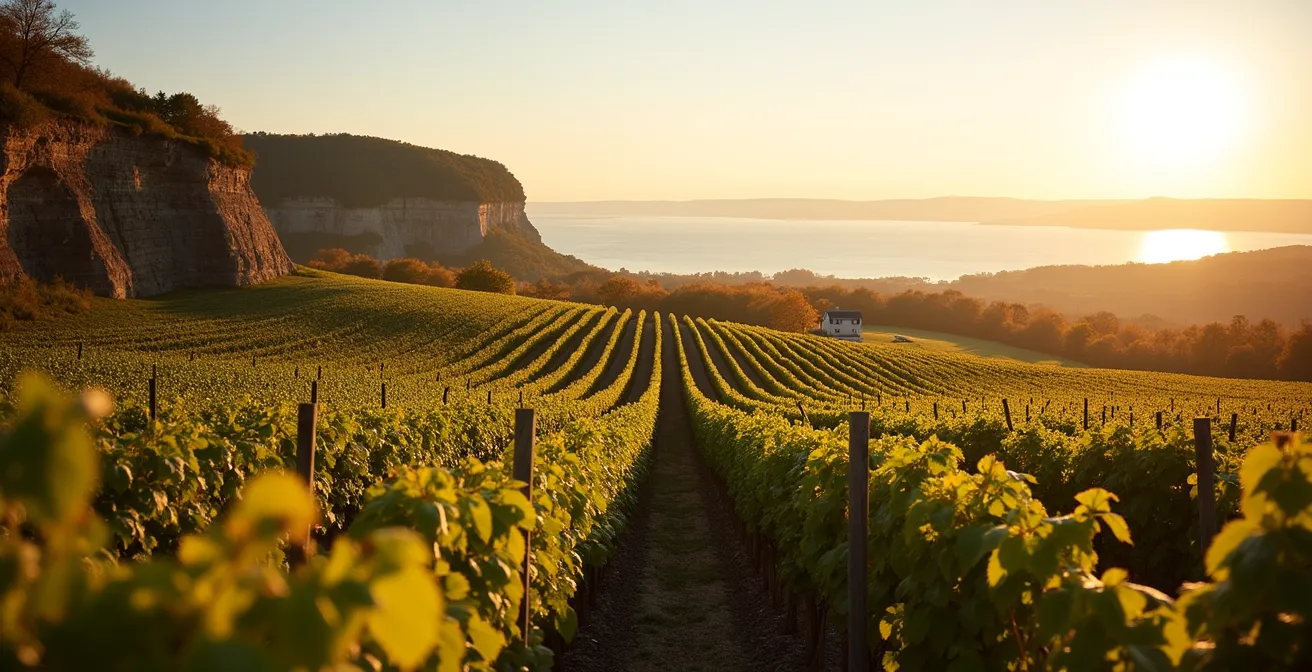
Wineries like Henry of Pelham, with a 35-year history of hand-picking grapes for Icewine, exemplify this authentic model. They offer intimate barrel cellar tastings and local cuisine, providing visitors with a genuine connection to Canadian winemaking traditions. This stands in stark contrast to the quick, transactional nature of a tourist district. The value here is not in fleeting entertainment, but in a lasting appreciation for the craft.
The following comparison starkly illustrates the two divergent philosophies of Niagara tourism, highlighting why the Benchlands provide a more meaningful context for a luxury product like Icewine.
| Aspect | Clifton Hill | Niagara Benchlands |
|---|---|---|
| Tourism style | Transactional, high-volume attractions | Transformational, terroir-focused experiences |
| Typical duration | 2-3 hours quick visits | Full-day wine tours and tastings |
| Economic model | Entertainment district | Agricultural tourism & real estate appreciation |
| Visitor experience | Neon lights, chain restaurants | Family wineries, farm-to-table dining |
| Notable venues | Tourist shops, haunted houses | Hidden Bench, Thirty Bench, Pearl Morissette |
| Connection to land | Minimal | Direct vineyard & winemaker interaction |
When you purchase a bottle of VQA Bench-designated Icewine, you are supporting an entire ecosystem of agricultural integrity and authentic tourism. The high price reflects not just the risk and rarity of the liquid in the bottle, but the preservation of the landscape and culture that created it. To truly appreciate this liquid gold, the next logical step is to explore the accredited VQA wineries of the Niagara Peninsula for an authentic tasting experience.