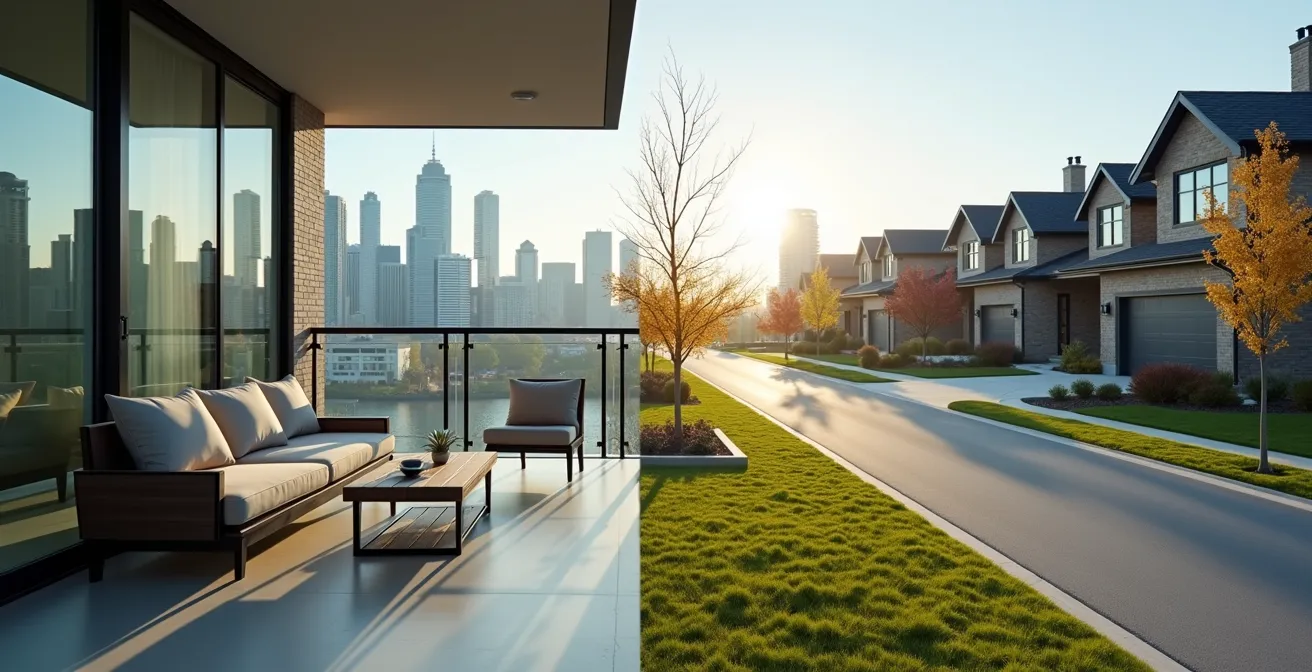
The pursuit of an “affordable” house in the Greater Golden Horseshoe’s outer suburbs is often an illusion that trades a lower mortgage for crippling hidden costs in transportation, time, and community.
- The financial savings on housing are frequently erased by transportation expenses, which can easily exceed $800 per month.
- Peripheral suburbs are more susceptible to faster price drops during economic downturns, posing a greater financial risk.
Recommendation: Before making a move, conduct a total lifestyle cost audit that accounts for all transportation, time, and social factors, not just the property’s sticker price.
The dream is a powerful one for many Canadian families: a detached home with a backyard, friendly neighbours, and a safe street for the kids to play on. For those feeling the squeeze in Toronto’s core, the sprawling suburbs of the Greater Golden Horseshoe (GGH)—from Hamilton to Oshawa to Barrie—seem to offer this affordable escape. The common wisdom suggests you simply trade a bit of commute time for a lot more house. This logic seems sound, and real estate listings with lower prices are a compelling lure.
But this is a dangerously incomplete picture. As a sociologist observing the patterns of urban sprawl, I see a recurring story where the search for affordability becomes a trap. The sticker price of a suburban home is a misleading metric, a single variable in a complex equation of well-being. What is often overlooked is the web of secondary costs—financial, temporal, and social—that fundamentally erode the very quality of life these moves are meant to secure. This isn’t just about balancing a budget; it’s about understanding the lifestyle deficit created when the suburban promise clashes with the reality of infrastructure designed for cars, not people.
So, what if the true key to a better life isn’t finding the cheapest house, but understanding the total cost of the lifestyle attached to it? This article will deconstruct the affordability illusion. We will dissect the hidden financial burdens, evaluate the intangible value of community, and explore the real risks and strategic alternatives in your search for a home in the GGH.
To provide a clear and structured analysis, this guide examines the critical factors that influence the true cost of suburban living. Below is a summary of the key areas we will explore to help you make a more informed decision beyond the initial purchase price.
Summary: Deconstructing the Real Cost of GGH Suburban Life
- 407 ETR bills and GO Train fares: the $800/month hidden cost of affordability
- Which towns offer a real community feel versus just rows of sleeping houses?
- Why you can’t build an addition on your Greenbelt-protected property
- Why peripheral suburbs drop in price faster than the core during downturns?
- How to negotiate a 2-day office week to make the super-commute viable?
- Condo downtown or House in Pickering: what actually costs less monthly including GO Train fares?
- Why properties within 800m of a new LRT station historically gain 20% more value
- Why paying a premium for a “Walker’s Paradise” score saves you money on car ownership?
407 ETR Bills and GO Train Fares: The $800/Month Hidden Cost of Affordability
The most immediate and painful shock for many new suburbanites is the “commuting tax.” The lower mortgage payment that seemed so attractive is quickly eroded by the relentless daily cost of getting to work. This isn’t a minor expense; it is a second, shadow mortgage payment. For a daily commuter using the 407 ETR to bypass congestion, the costs are staggering. Depending on the distance and time of travel, it’s common for these expenses to reach between $800 and $1,000 per month for a single commuter. This figure, often conveniently omitted from affordability calculations, represents a significant drain on household income.
Even public transit, while more sustainable, is not a cheap alternative. A monthly GO Transit pass from an outer-ring city like Barrie or Hamilton to Union Station can run into the hundreds of dollars. When a family requires two cars for daily life—one for the commuter and one for the parent managing errands and school runs locally—the costs of insurance, gas, and maintenance for that second vehicle must also be factored in. A study on this very topic found the perceived savings can be minimal; a CMHC analysis revealed that for some, moving to a suburb like Burlington might only save about $208 a month once commuting costs are included, but at the price of an extra 23 hours spent commuting.
This table illustrates how quickly toll costs can accumulate for a regular commuter on the 407 ETR, based on a typical 60km daily round trip. The variation between peak and off-peak hours highlights the financial penalty for travelling during standard business hours.
| Time Period | Rate per km | Monthly Cost (60km daily) |
|---|---|---|
| Peak Hours | $0.58/km | $1,392 |
| Regular Hours | $0.35/km | $840 |
| Off-Peak | $0.18/km | $432 |
This financial drain is more than just numbers on a spreadsheet; it’s a direct reduction in a family’s disposable income, impacting everything from savings for retirement to the ability to afford extracurricular activities for children. The affordability illusion is shattered when the true monthly outlay is calculated.
Which Towns Offer a Real Community Feel Versus Just Rows of Sleeping Houses?
Beyond the financial costs, there is a profound social cost to living in poorly planned suburban developments. Many new subdivisions are engineered for cars, not people, resulting in what are known as “bedroom communities” or “sleeping houses.” These are places where residents sleep and park their cars, but live their social and economic lives elsewhere. The lack of a central, walkable hub, independent businesses, and public gathering spaces creates a sterile environment that actively discourages spontaneous social interaction.
A true community, in contrast, is built around what sociologists call “third places”—locations outside of home (the first place) and work (the second place) where people can gather, interact, and build social capital. These are the independent coffee shops, the bustling public libraries, the town squares with benches, and the farmers’ markets. They are the lifeblood of a community. Towns like Unionville in Markham or Port Perry have maintained this character through their historic main streets, creating a sense of place and belonging that is absent in a sprawling cul-de-sac landscape.
The visual contrast between these two types of environments is stark. One fosters walking, chance encounters, and local commerce, while the other isolates residents in their homes and cars, creating a landscape of social disconnection.

Before committing to a suburb, it is crucial to audit its potential for a genuine community feel. A higher house price in a town with strong community infrastructure can offer a far greater return in quality of life than a cheaper house in a social desert. The following checklist can help you assess a potential neighbourhood’s community fabric.
Your Action Plan: The “Third Place” Community Audit
- Independent Shops: Check for independent coffee shops, bakeries, and stores within walking distance, not just chain franchises.
- Library Activity: Visit the local library. Is it just a place for books, or does it have a full calendar of community programs, workshops, and events?
- Public Gathering Spaces: Identify public squares, plazas, or parks with ample seating that are actively used by residents.
- Community Centres: Look up the local community centres. Do they offer a wide range of programming for different age groups and interests?
- Historic Main Street: Does the town have a preserved, functional Main Street with local businesses, or is commerce dominated by strip malls and big-box stores?
Why You Can’t Build an Addition on Your Greenbelt-Protected Property
Another critical, and often misunderstood, element of the GGH real estate landscape is the Ontario Greenbelt. For a family dreaming of buying a property with a large lot and plans for future expansion—a new wing, a second-story addition, or a large workshop—discovering their property is on or abuts Greenbelt-protected land can be a deal-breaker. The Greenbelt is not simply a park; it’s a massive, legally protected zone of environmentally sensitive land, farms, and forests that wraps around the Golden Horseshoe.
Its regulations are designed to permanently protect these areas from urban sprawl, which means development is severely restricted. As UBC Wiki contributors note in their analysis of the housing crisis, the policy’s origins are complex and deliberate:
The Greenbelt was created by integrating parts of the Niagara Escarpment Protection and the Oak Ridges Moraine Conservation Plan to created a large band of protected areas surrounding the Golden Horseshoe
– UBC Wiki Contributors, Course:CONS200/2023 – The Golden Horseshoe Housing Crisis vs. Ontario’s Greenbelt
This protection has direct consequences for homeowners. While you might own a two-acre lot, you may be prohibited from building anything outside the home’s original footprint. Adding an extension, a guesthouse, or even a paved driveway could require a complex and often unsuccessful series of applications to the local conservation authority and municipality. These rules are in place to prevent soil degradation, protect water sources, and preserve natural heritage. They are not easily bent for individual home renovation plans. Furthermore, the political landscape surrounding the Greenbelt is volatile, as seen in recent controversies, adding a layer of long-term uncertainty for property owners about what will be permitted in the future.
Therefore, any potential buyer looking at property near rural or forested areas in the GGH must perform due diligence beyond a standard title search. It’s essential to consult municipal zoning maps and the local conservation authority to understand precisely what restrictions apply. Assuming you can expand your “affordable” home later is a risky gamble that could leave your family’s plans permanently on hold.
Why Peripheral Suburbs Drop in Price Faster Than the Core During Downturns?
The “affordability” of homes in the GGH’s peripheral suburbs comes with a hidden financial risk: higher price volatility. During real estate market downturns, these outer-ring communities often experience faster and deeper price drops than the established, transit-rich urban core. This phenomenon is a classic example of demand elasticity. The demand for housing in the core is relatively inelastic; people need to live there for work, education, and access to amenities. It’s a “must-have” market.
In contrast, demand for housing 60 or 90 minutes away from the city centre is much more elastic. It is often driven by discretionary buyers seeking more space, who can pull back from the market when economic uncertainty rises or when commuting costs become prohibitive. When interest rates go up or a recession looms, the first thing families cut is the long, expensive commute. This causes demand in the periphery to evaporate more quickly, putting downward pressure on prices. A home that seemed like a bargain during a market peak can quickly become a liability, with its value falling faster than that of a smaller, more expensive condo in the city.
This visual metaphor helps to illustrate the concept: the stable, dense foundation of the urban core versus the more precarious and sensitive nature of peripheral markets.

This isn’t just a theoretical risk. During economic slowdowns, we often see a “flight to quality,” where buyers and capital retreat to the most stable and desirable locations. For the GGH, this means properties with excellent walkability and transit access hold their value better. A family who stretched their budget to buy in a far-flung suburb may find themselves with negative equity, owing more on their mortgage than the home is currently worth, while a downtown property may only see a minor correction. This risk of higher volatility should be a crucial part of any long-term financial calculation.
How to Negotiate a 2-Day Office Week to Make the Super-Commute Viable?
For many who have already made the move to the outer suburbs, the reality of the “super-commute”—a daily journey exceeding 45 minutes each way—has set in. The financial and temporal costs are real, and the only way to make this lifestyle sustainable long-term is to reduce the frequency of the commute. Negotiating a hybrid work arrangement, such as a 2-day office week, has become less of a perk and more of a strategic necessity.
The prevalence of this issue is well-documented. According to Ontario census data, an astonishing 31.5% of commuters in Oshawa and 30.8% in Toronto already spent 45 minutes or more travelling to work even before the most recent wave of outward migration. With today’s traffic, these numbers are likely even higher. A five-day-a-week commute from Barrie to downtown Toronto is a recipe for burnout; a two-day commute is a manageable compromise.
Successfully negotiating this arrangement requires a strategic, data-driven approach, not an emotional appeal. Your goal is to frame the request as a business benefit, not just a personal convenience. First, build a case for your proven productivity while working remotely. Use metrics if possible: projects completed, deadlines met, sales targets achieved. Demonstrate that your performance is independent of your physical location. Second, propose a clear and predictable schedule (e.g., in-office every Tuesday and Wednesday) so your team and manager know when to expect you for collaborative tasks. Third, create a “Commute Viability Proposal.” This document should outline how the reduced commute will enhance your well-being, reduce stress, and ultimately make you a more focused and sustainable employee, reducing the company’s risk of burnout and turnover.
Finally, focus the negotiation on outcomes, not presence. The core argument is that your value to the company is measured by the quality of your work, not the number of hours you spend on the Gardiner Expressway. By presenting a professional, well-reasoned case, you transform the conversation from “asking for a favour” to “proposing a mutually beneficial work strategy.”
Condo Downtown or House in Pickering: What Actually Costs Less Monthly Including GO Train Fares?
The fundamental trade-off at the heart of the GGH housing debate is often simplified to “space versus location.” But a true comparison requires a rigorous, all-in monthly cost analysis. When we move beyond the mortgage payment and include all associated lifestyle costs, the financial picture can flip entirely. Is a larger house in a suburb like Pickering truly more “affordable” than a smaller condo downtown once the full costs of the suburban lifestyle are tallied?
The answer is often no. The suburban home may require one, or even two, cars, adding costs for insurance, gas, maintenance, and eventual replacement. The daily commute via GO Transit is a significant and non-negotiable monthly expense. Suburban homes often come with higher property taxes and utility bills due to their larger size. In contrast, the downtown condo dweller may have a higher mortgage and condo fees but can often eliminate car ownership entirely, relying on transit, walking, and cycling. Their utility costs are typically lower, and their commute cost is negligible.
The following table provides a realistic comparison of the total monthly outlay for these two hypothetical scenarios. It’s a sobering look at how the affordability illusion works in practice.
| Cost Category | Downtown Toronto Condo | Pickering House |
|---|---|---|
| Average Mortgage | $3,500 | $3,000 |
| Property Tax | $350 | $450 |
| Condo Fees/Maintenance | $650 | $200 |
| GO Transit Monthly | $0 | $400 |
| Second Car Costs | $0 | $600 |
| Utilities | $150 | $300 |
| Total Monthly | $4,650 | $4,950 |
As the numbers show, the “cheaper” house in Pickering could actually cost $300 more per month to live in. This doesn’t even begin to quantify the non-recoverable cost of time lost to commuting—time that could be spent with family, exercising, or pursuing personal interests. This comprehensive view reveals that true affordability is about the total cost of living, not just the cost of housing.
Key Takeaways
- The “affordability” of outer suburbs is often an illusion once the full cost of commuting (fares, tolls, second car) is factored in.
- Peripheral real estate markets are more volatile and tend to lose value faster than the urban core during economic downturns.
- True quality of life depends on “community infrastructure” like walkable main streets and public spaces, which many new subdivisions lack.
Why Properties Within 800m of a New LRT Station Historically Gain 20% More Value
If the overarching lesson is that car-dependent lifestyles are a financial and temporal trap, then the strategic alternative is to invest in proximity to high-quality public transit. History has repeatedly shown a direct and powerful correlation between transit infrastructure and property values. In the GGH, this is most evident around GO stations and, increasingly, the new Light Rail Transit (LRT) lines being developed.
Properties located within a short walking distance (typically considered 800 metres, or a 10-minute walk) of a new transit station consistently outperform the broader market. The “20% more value” figure is a widely observed benchmark in urban planning studies, representing the premium buyers are willing to pay for convenience, reduced reliance on cars, and predictable commute times. This isn’t just about saving money on gas; it’s about buying back time and reducing daily stress. The federal government’s massive investment in the region’s transit underscores this long-term strategy; in 2017, it was announced that the Government of Canada would invest over $1.8 billion in the GO Transit Regional Express Rail project alone.
This “transit premium” acts as a buffer against the market volatility discussed earlier. While peripheral, car-dependent suburbs are the first to feel the chill of a market downturn, properties anchored to major transit hubs tend to be more resilient. Their demand is supported by a permanent base of commuters and residents who prioritize access. For a family making a 25-year mortgage commitment, choosing a location near a future or existing LRT/GO station is one of the most effective long-term wealth-building and risk-mitigation strategies available. It transforms the home from a simple dwelling into a transit-oriented asset.
Therefore, a savvy homebuyer in the GGH should be looking not just at current maps, but at Metrolinx’s future plans. Paying a slight premium today for a property near a planned station can result in significant financial gains and an immeasurable improvement in quality of life tomorrow.
Why Paying a Premium for a “Walker’s Paradise” Score Saves You Money on Car Ownership?
This brings us to the ultimate counter-strategy to the affordability illusion: embracing density and walkability. It may seem counter-intuitive, but paying a premium for a home in a neighbourhood with a high Walk Score (often labelled a “Walker’s Paradise”) can be one of the smartest financial decisions a family can make. This is because it allows for the elimination of the single biggest non-housing expense: the personal vehicle.
The cost of car ownership in a city like Toronto is immense. It goes far beyond the monthly car payment. When you factor in insurance, gas, parking, and regular maintenance, the true annual cost can be staggering. As one analysis highlights, maintaining a personal vehicle in Toronto can cost between $10,000 and $12,000 per year. For a family with two cars, this can amount to nearly $2,000 per month—a sum that could service a significant amount of additional mortgage debt.
By consciously choosing a home where daily errands, school drop-offs, and even commuting can be done on foot, by bike, or via a short transit ride, a family can unlock these savings. The money previously spent on a depreciating asset (a car) can be redirected into a mortgage for an appreciating asset (a well-located home). This strategy involves calculating the break-even point: how much more can you afford to pay for a house if you are saving $12,000 a year on a car? Often, the math works out decisively in favour of the more expensive, walkable property. Occasional car needs can be easily met through car-sharing services like Communauto or Zipcar at a fraction of the cost of ownership.
This is the final reframing of affordability. It is not about the lowest purchase price. It is about designing a lifestyle with the lowest possible recurring costs and the highest possible quality of life. The freedom from traffic, the health benefits of daily activity, and the strong sense of community in a walkable neighbourhood are bonuses that no sprawling suburb can offer.
Frequently Asked Questions About GGH Property and Development
Can I renovate within my existing building envelope in the Greenbelt?
Yes, renovations that occur within the existing structure of your home are generally permitted without needing special approvals from conservation authorities.
What about building accessory structures like sheds on a Greenbelt property?
Minor accessory structures, such as sheds or small garages, may be allowed but will almost certainly require proper permits. The specific rules vary greatly depending on the regulations of your local Conservation Authority.
How do recent political changes affect my Greenbelt property rights?
The 2023 Ontario Greenbelt controversy demonstrated that the rules governing these protected lands can change abruptly with political shifts. This creates a significant level of uncertainty for property owners regarding future development rights and land use policies.