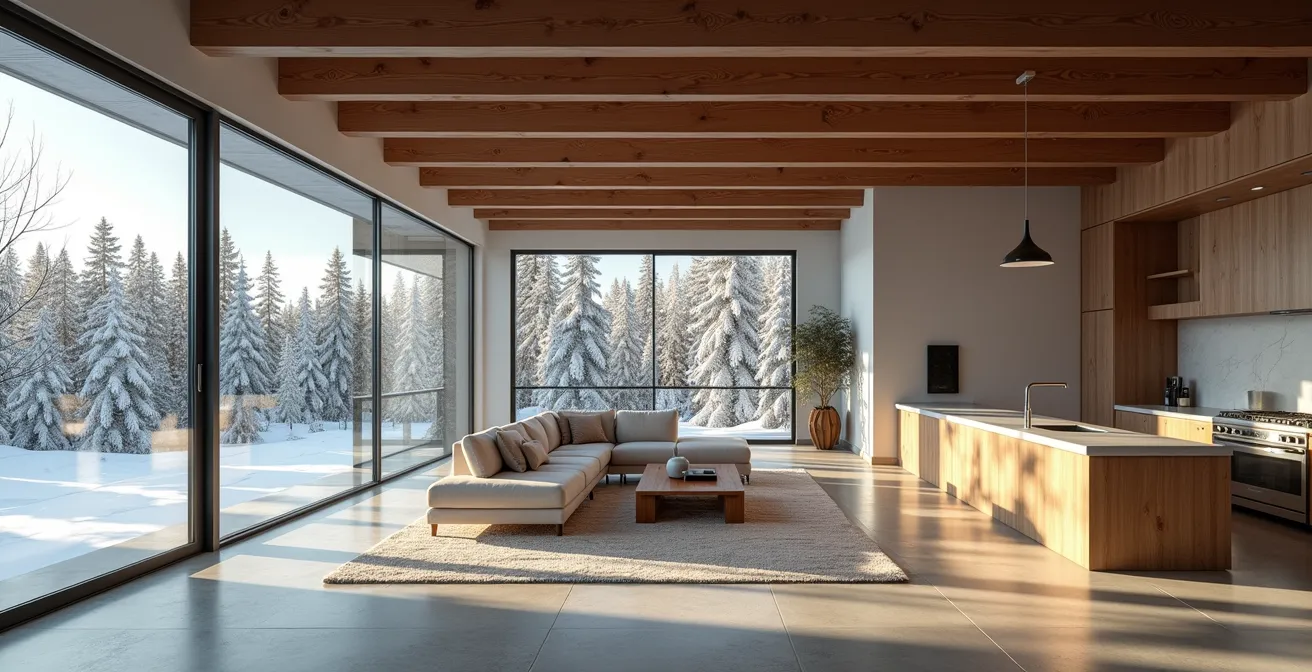
The sleek beauty of a modern home often masks a deep sensory discomfort, from echoing noise to a persistent chill. The solution isn’t to compromise the aesthetic, but to adopt a holistic design philosophy.
- Sound, heat, and visual calm are interconnected; solving one in isolation often fails.
- Material choices and structural details, from roofing to fixtures, have profound long-term impacts on livability in the Canadian climate.
Recommendation: Shift your focus from simply “decorating” a space to practicing “sensory architecture”—strategically engineering comfort into every layer of your home’s design.
You fell in love with the clean lines, the soaring ceilings, and the flood of natural light. Modern, open-concept living promises a life of uncluttered elegance. Yet, the reality is often… loud. Conversations echo, footsteps clatter, and the beautiful, hard surfaces that define the aesthetic turn your home into an echo chamber. The common advice is to throw down rugs and hang heavy curtains, but this often feels like a stylistic compromise, a cluttered bandage on a design wound. This approach betrays the very minimalism you sought in the first place.
As an interior architect specializing in sensory comfort, I see this conflict constantly with my Canadian clients. The struggle goes beyond just poor acoustics. It extends to the challenge of maintaining privacy behind floor-to-ceiling windows, the visual noise of exposed technology, or the shocking energy bills from heating a double-height room through a harsh winter. These are not separate problems; they are symptoms of a design approach that prioritizes the visual over the experiential.
But what if the solution wasn’t about adding clutter, but about smarter, more integrated design? The key isn’t to muffle your modern home, but to tune it. This requires moving beyond simple fixes and embracing a philosophy of sensory architecture. It’s a holistic method where we consider how a space feels, sounds, and functions from the very beginning, ensuring that aesthetics and livability are partners, not opponents.
This guide will walk you through the core principles of sensory architecture. We will deconstruct the common challenges of modern Canadian homes—from acoustics and heating to privacy and material choices—and provide integrated solutions that enhance, rather than detract from, your home’s contemporary beauty. We will explore how to make your home not just look good, but feel profoundly right.
To help you navigate these interconnected challenges, this article breaks down the essential considerations for achieving true sensory comfort in your home. Here is what we will cover.
Summary: A Guide to Sensory Comfort in Modern Canadian Homes
- How to maintain privacy in floor-to-ceiling window homes without ruining the view?
- How to wire a minimalist modern home for automation without seeing a single cable?
- Flat roof vs Pitched roof: realizing the maintenance cost difference in snowy climates
- The matte black finish trap: why some modern fixtures look cheap after 2 years
- How to heat a double-height modern living room without bankrupting yourself?
- How to soundproof a condo bedroom against neighbors without major renovations?
- Why tearing out horsehair plaster destroys the soundproofing of old homes
- How to organize a 500 sq ft condo to feel like 800 sq ft using visual psychology?
How to maintain privacy in floor-to-ceiling window homes without ruining the view?
Floor-to-ceiling windows are a hallmark of modern architecture, designed to dissolve the barrier between inside and out. Yet, this visual connection can come at the cost of privacy. The conventional solution—heavy drapery—often feels bulky and contradicts the minimalist ethos. The sensory architecture approach is to find solutions that are as elegant as they are effective. One of the most powerful tools is upgrading the glass itself. Modern glazing technology offers incredible options, from switchable smart glass that turns opaque at the touch of a button to films that provide daytime privacy without obscuring the view.
These high-performance windows also offer significant thermal benefits, crucial for managing comfort and energy costs in Canada’s varied climate. Features like double or triple-pane glass with Low-E (low-emissivity) coatings are essential. They reflect heat back to its source, keeping your home warmer in the winter and cooler in the summer. Upgrading is often supported by government incentives; for instance, some Ontario homeowners can receive rebates of $175-$325 per window for installing ENERGY STAR certified models.
Beyond the glass, consider layered treatments. A combination of sheer, light-filtering blinds for daytime ambiguity and discreet, motorized blackout roller shades that disappear into the ceiling when not in use provides ultimate flexibility. This layered approach allows you to precisely control light and privacy, maintaining the clean aesthetic while making the space adaptable to your needs throughout the day and night. The goal is to manage the sensory input of light and sight with the same intention as you manage sound or temperature.
How to wire a minimalist modern home for automation without seeing a single cable?
Visual calm is a cornerstone of sensory comfort. In a minimalist interior, every visible cable, wire, and power brick is a form of visual noise that disrupts the intended serenity. As homes become smarter, the challenge of integrating technology without creating clutter grows. The secret to a truly seamless smart home lies in planning for invisibility from the outset, a core tenet of sensory architecture. This means thinking about wiring not as an afterthought, but as an integral part of the home’s circulatory system.
During a new build or a deep renovation, the strategy is to embed the infrastructure within the walls. This involves using dedicated conduits and raceways to route all low-voltage (Ethernet, speaker wire, automation controls) and high-voltage wiring to a central hub. This approach allows for future upgrades without tearing open drywall. By planning for more capacity than you currently need, you future-proof the home for technologies that don’t even exist yet. The goal is for technology to be felt, not seen.
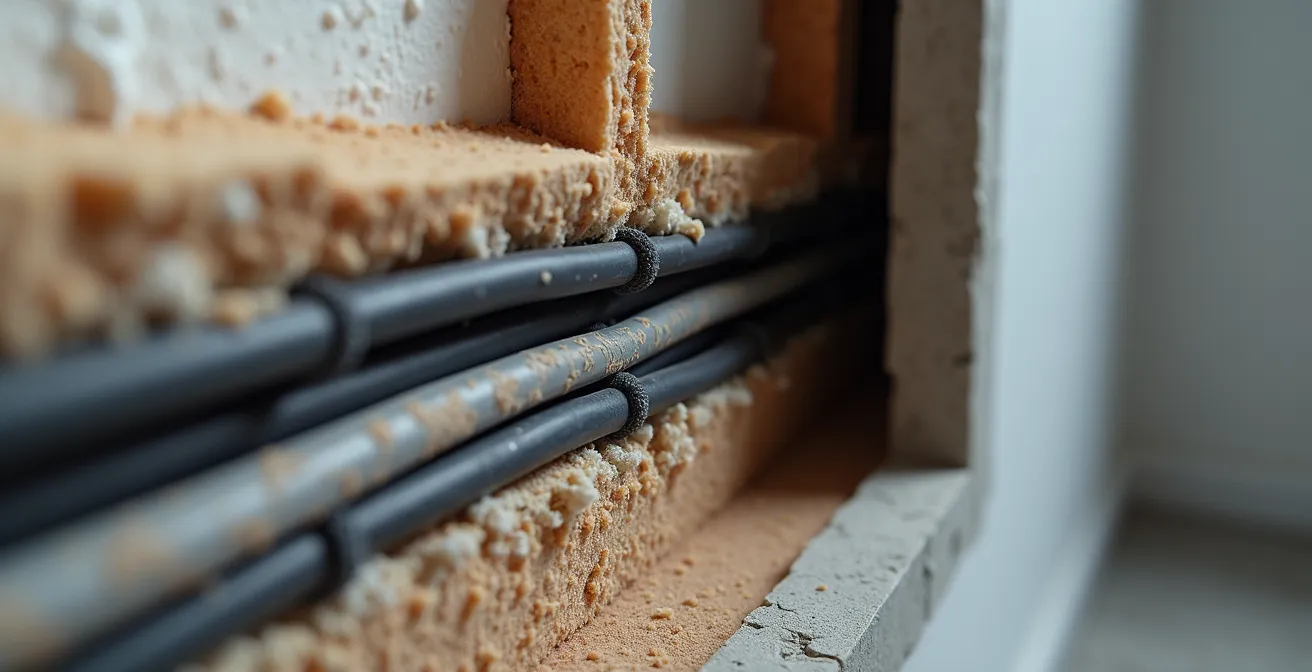
As this detailed view shows, a well-planned wall cavity can house an entire network of smart home infrastructure, completely hidden from view. For existing homes, the approach requires more creativity. Options include using baseboard raceways that blend into the trim, hiding wires behind strategically placed furniture, or using flat speaker wire that can be spackled and painted over. For audio, wireless systems have improved dramatically, but for ultimate reliability and quality, a wired solution remains superior. The key is to treat every cable as a design problem to be solved with elegance, ensuring the home’s technology serves your comfort without compromising its visual tranquility.
Flat roof vs Pitched roof: realizing the maintenance cost difference in snowy climates
An often-overlooked aspect of a home’s sensory impact is the background stress of maintenance. The striking, cubist form of a modern flat-roofed house is visually powerful, but in a snowy Canadian climate, that aesthetic choice has significant practical and financial consequences. Unlike pitched roofs, which are designed to shed snow and water naturally, flat roofs are designed to hold them. This requires a much more robust, and expensive, system of drainage and waterproofing to prevent leaks and structural damage from the weight of accumulated snow and ice.
One of the most common and costly issues in Canada is the formation of ice dams. On a flat roof, melted snow can refreeze around drains, creating a pool of standing water that can work its way into the smallest imperfections in the roofing membrane. Professional ice dam removal in Toronto typically costs between $300 to $1,500 per service, a recurring expense that pitched-roof homeowners rarely face. Regular snow removal is also not a suggestion but a necessity to stay within building code limits for snow load, adding another operational cost.
This table, based on professional roofing data, clearly illustrates the difference in winter maintenance demands. The data is further detailed in an analysis of flat roof snow removal.
| Maintenance Type | Flat Roof | Pitched Roof |
|---|---|---|
| Snow Removal (2,500 sq ft) | $100-$300 per service | Usually self-shedding |
| Ice Dam Prevention | Heat cables required | Proper ventilation often sufficient |
| Maximum Snow Load | 20 lbs/sq ft (building code) | 30-40 lbs/sq ft typical |
| Removal Frequency | After every 6 inches snowfall | Only in extreme conditions |
This doesn’t mean flat roofs are impossible in Canada, but it does mean the decision should be made with full awareness of the long-term commitment. It requires superior materials, flawless installation, and a budget for diligent, professional maintenance. Choosing a flat roof is a commitment to a high-maintenance relationship for the sake of a specific look, a factor that weighs heavily on the home’s overall sense of ease and comfort.
The matte black finish trap: why some modern fixtures look cheap after 2 years
The allure of matte black fixtures is undeniable. They are bold, sophisticated, and the epitome of modern design. However, this popular finish can become a source of profound dissatisfaction, a classic example of an aesthetic choice that fails the test of daily life. The problem isn’t the colour, but the finish. Matte surfaces, by their nature, are microscopically porous compared to their polished chrome or nickel counterparts. This texture is what gives them their soft, non-reflective look, but it’s also what makes them a magnet for fingerprints, soap scum, and, most critically in Canada, mineral deposits.
The longevity of a matte black finish is directly tied to your home’s water quality, a factor that varies dramatically across the country. This isn’t just an anecdotal observation; it’s a matter of chemistry.
Hard water common in cities like Calgary and Winnipeg accelerates mineral buildup on matte black finishes, while Vancouver’s soft water is more forgiving.
– Industry observation, Canadian municipal water quality impact on fixtures
This mineral buildup (limescale) creates a chalky, white film that is incredibly difficult to remove without using harsh chemicals that can further damage the finish. What starts as a chic design statement quickly degrades into a fixture that looks perpetually dirty and worn. The constant cleaning required creates a low-level sensory friction, turning a simple object of utility into a source of frustration. The principle of material honesty in sensory architecture suggests choosing materials that age gracefully. For matte black, this means opting for higher-quality applications like PVD (Physical Vapor Deposition) or powder coating, which are far more durable than simple painted-on finishes, or accepting the high-maintenance reality of the choice.
How to heat a double-height modern living room without bankrupting yourself?
A double-height living room is a breathtaking architectural feature, creating a sense of volume and grandeur. However, it also creates a monumental challenge for thermal comfort, especially during a Canadian winter. The fundamental enemy is physics: heat rises. This process, known as thermal stratification, leads to a frustrating and inefficient scenario where the 20-foot-high ceiling is toasty warm while you’re shivering on the sofa below. Trying to heat this entire volume of air with a conventional forced-air system is like trying to fill a bucket with a hole in it—a costly and ultimately losing battle.
The sensory architecture solution is to work *with* physics, not against it. First, you must stop heat loss at the source by ensuring the building envelope is robust, especially the vast expanses of glass. Second, you must actively recirculate the air. A large, slow-moving ceiling fan (an HVLS fan) or even a standard fan set to run in reverse during the winter can gently push the warm air that has collected at the ceiling back down into the living space. This simple act of thermal destratification can dramatically improve comfort and reduce heating costs.

Finally, the type of heat matters. Radiant floor heating is an excellent solution as it heats objects and people directly, not the air, creating a more uniform and comfortable warmth from the ground up. In provinces with low-cost hydroelectricity like Quebec, it’s a particularly smart investment. For retrofits, modern cold-climate heat pumps are incredibly efficient and eligible for significant rebates. In fact, Canadian homeowners can receive grants of up to $6,500 through programs like the Canada Greener Homes Initiative for installing these systems. By combining a tight envelope, air circulation, and smart heat sources, you can transform a cold, cavernous space into a cozy, efficient haven.
How to soundproof a condo bedroom against neighbors without major renovations?
Nowhere is acoustic comfort more critical than in a condo, where you are separated from your neighbors by a single wall. The sounds of footsteps, muffled televisions, and conversations can be a constant intrusion, destroying the peace of your private sanctuary. While major renovations involving decoupling walls with resilient channels are the gold standard, they are often prohibited by condo bylaws and are always costly. The good news is that you can achieve significant noise reduction by applying the principles of acoustic treatment: adding mass and absorption.
Adding mass helps to block sound waves. This can be done by applying mass-loaded vinyl (MLV) to the shared wall, a heavy, flexible material that can be hidden behind a new layer of drywall or even a large piece of furniture like a bookshelf filled with books. For a less permanent solution, custom-built acoustic window plugs made from MDF and acoustic foam can be inserted at night to block traffic noise effectively. The key is to create a dense barrier that sound struggles to vibrate through.
Absorption, on the other hand, reduces echo and reverberation within your own room, which can make external noises seem less jarring. This is where you can get creative. A great DIY project is building your own acoustic panels. As one Montreal-based builder, Solomon Krause-Imlach, demonstrated, you can create studio-quality panels using widely available Rockwool Safe’n’Sound insulation, a simple lumber frame, and aesthetically pleasing fabric. Even offcuts from construction sites can be used, making it a cost-effective solution. These panels can be hung like artwork, combining function with personal style and turning a sound problem into a design opportunity.
Why tearing out horsehair plaster destroys the soundproofing of old homes
In the rush to modernize older homes, one of the most common and damaging mistakes is tearing out original horsehair plaster walls and replacing them with modern drywall. While the plaster may be cracked and uneven, it possesses a secret superpower: exceptional acoustic performance. This old-world material provides a level of soundproofing that is difficult and expensive to replicate with modern materials. Understanding why is a lesson in the physics of sound.
The effectiveness of horsehair plaster comes from two key properties: mass and damping. As acoustic consultants in Toronto explain, the character of a room is defined by reverberation. Horsehair plaster is significantly denser and thicker than a standard sheet of drywall, giving it superior mass that naturally blocks the transmission of airborne sound. Furthermore, the traditional lath-and-plaster system, with its small air gaps and irregular surface behind the wall, creates an effective damping system. This assembly dissipates sound wave energy as heat, preventing it from passing through the wall. Replacing this with a thin, rigid sheet of drywall is like swapping a brick wall for a drum skin. The result is often a shocking increase in noise transmission between rooms and from the outside, a common complaint highlighted in national surveys. Indeed, according to the 2018 Canadian Housing Survey, only 56% of apartment/condo residents were satisfied with exterior noise levels, compared to 81% in detached homes, a gap often exacerbated by poor material choices in renovations.
Preserving and repairing original plaster is almost always the superior choice for acoustic comfort. Skim-coating over the existing surface can restore a smooth, modern look while retaining the wall’s inherent sound-deadening properties. Tearing it out in the name of “modernization” is a prime example of sacrificing invisible, high-performance features for a perceived aesthetic gain, a trade-off that almost always leads to long-term regret.
Key Takeaways
- True home comfort is a holistic equation; you cannot solve for acoustics without considering heat, light, and visual calm.
- In the Canadian climate, aesthetic choices for the building’s exterior (like roofs and windows) have direct, long-term consequences on maintenance costs and stress.
- The best design solutions work with physics—by managing thermal stratification and sound damping—rather than fighting against it with brute force or cosmetic fixes.
How to organize a 500 sq ft condo to feel like 800 sq ft using visual psychology?
In the compact reality of modern Canadian condo living, the ultimate luxury is a sense of space. While you can’t change the physical square footage, you can dramatically alter the *perceived* space using principles of visual psychology. This is sensory architecture at its most subtle, manipulating light, layout, and lines to make a small space feel open, airy, and uncluttered. It’s about designing for the eye to travel, creating an illusion of depth and breadth.
The first step is to define zones without building walls. This “visual zoning” creates distinct areas for living, dining, and working within an open-plan layout, giving the space a sense of order and purpose. Area rugs are the most common tool for this, but the technique is more powerful when layered. A pendant light can define a dining area, while a comfortable armchair and a floor lamp can create a cozy reading nook. By positioning furniture at slight angles instead of flat against the walls, you create more complex sightlines and break up “sound corridors” where noise can travel unimpeded.
Light is your most powerful ally. Layering light sources—ambient (ceiling), task (lamps), and accent (sconces)—adds depth and dimension to a room. Mirrors are a classic tool for a reason; they bounce light and create an illusion of depth. In a Canadian context, this is especially crucial for combating the darkness of long winters and its effect on mood (SAD). Choosing multi-functional, visually light furniture—pieces with slim legs that show the floor beneath them—enhances the sense of openness. Brands like the Canadian-founded Article or Winnipeg’s EQ3 specialize in this type of design.
Your Action Plan: Optimizing Your Condo’s Perceived Space
- Use rugs to visually define zones without physical barriers.
- Layer lighting with pendant lights, floor lamps, and sconces to create depth.
- Position furniture at slight angles to break sound corridors.
- Install acoustic panels that double as artwork.
- Choose multi-functional furniture from Canadian brands like Gus* Modern, Article, or EQ3.
- Use mirrors strategically to combat winter darkness and SAD.
By applying these strategies, you move beyond merely furnishing a space and begin to intentionally sculpt the experience within it. You are guiding the senses to perceive calm, order, and spaciousness, proving that good design isn’t about how much space you have, but how intelligently you use it.
Ultimately, transforming your modern house into a comfortable home requires a shift in perspective. Instead of treating noise, privacy, and comfort as afterthoughts to be fixed, begin to see them as essential ingredients of the design itself. By adopting a holistic, sensory-first approach, you can create a space that is not only beautiful to look at but is a deep and lasting pleasure to live in. Begin today by auditing your own space through this new lens and identifying one small change you can make to improve its sensory comfort.
Frequently Asked Questions on Condo Soundproofing
Can I install acoustic panels without damaging walls?
Yes, many acoustic panels come with removable mounting brackets or can be hung like artwork without permanent alterations, making them ideal for rental units or condos where wall damage is a concern.
What’s the most effective removable solution for traffic noise?
Custom-built window plugs made from MDF and acoustic foam provide excellent noise reduction and can be removed when needed. They create a tight seal and add significant mass to the window opening, which is often the weakest point for sound entry.
Do I need condo board approval for acoustic treatments?
It is crucial to check your condo corporation’s bylaws. While many aesthetic changes like hanging panels may not require approval, anything that involves altering the wall surface or could be perceived as a modification might. In provinces like Ontario, the Condominium Act governs what constitutes a “major” vs. “minor” change, and it’s always best to get clarification in writing from your board to avoid future disputes.