
True understanding of Canadian maritime culture comes not from observing, but from respectfully participating in its unwritten social contracts.
- Resilience is found in the economic realities of industries like fishing, not in romanticized, “quaint” lifestyles.
- Access to authentic experiences like kitchen parties is earned through humility, genuine interest, and contribution.
Recommendation: Shift your mindset from a tourist taking photos to a guest learning the local rhythm, starting with the simple, respectful act of buying directly from a fisherman.
The salt-sprayed coast of Atlantic Canada whispers stories far older and deeper than any postcard can capture. Many travelers arrive seeking the rugged beauty of its landscapes, ticking off lighthouses and scenic drives. They might eat a lobster roll and declare they’ve “done” the Maritimes. But this approach only scratches the surface, missing the powerful current of resilience that truly defines these communities. This resilience isn’t just about enduring harsh weather; it’s a living, breathing thing woven into the daily interactions, the music, the crafts, and the quiet dignity of hard work.
The common advice is to visit historic sites or eat at famous restaurants. While enjoyable, these are often passive experiences. The real soul of the coast isn’t a spectacle to be consumed; it’s a conversation to be joined. So, what if the key to unlocking this deeper understanding wasn’t about where you go, but *how* you engage? What if true connection lies in learning the unwritten rules of the wharf, figuring out how to earn a seat at a kitchen party, and appreciating the immense skill behind a “simple” life? This guide is about moving beyond observation and into participation. It’s a roadmap to understanding that maritime resilience is a verb, an action you can be a part of.
In the sections that follow, we’ll explore the practical steps and mindset shifts needed to connect with this living heritage. From the economic pulse of the fishing docks to the cultural heartbeat of a cèilidh, you’ll discover how to engage with Canada’s coastal communities in a way that is both meaningful and memorable.
Contents: Your guide to the heart of coastal life
- Buying off the wharf: the unwritten rules of engaging with fishermen
- How to get invited to a Ceilidh or kitchen party if you don’t know anyone?
- Rug hooking and storytelling: why these slow arts survive in a fast world?
- The mistake of telling locals “how simple and quaint” their hard lives are
- Which small-town festivals offer the best seafood chowder in Atlantic Canada?
- Mapping the famous shipwrecks visible from the shore at low tide
- English speakers in rural Quebec: how to integrate beyond the “Bonjour”?
- How to follow the Lighthouse Trail to understand the maritime history of the coast?
Buying off the wharf: the unwritten rules of engaging with fishermen
The first step toward understanding maritime resilience is often the most direct: a transaction. But buying seafood directly from a fisherman’s boat is more than just a purchase; it’s your entry into a social contract built on respect for time, tide, and tradition. This isn’t a supermarket. There are no convenient hours or credit card machines. This is the frontline of a vital industry, and showing you understand that is paramount. The significance of these direct purchases becomes clear when you consider the economic backbone of the region; in Atlantic Canada, lobster alone contributed over $1.3 billion in 2016, representing a massive part of the commercial fisheries’ value.
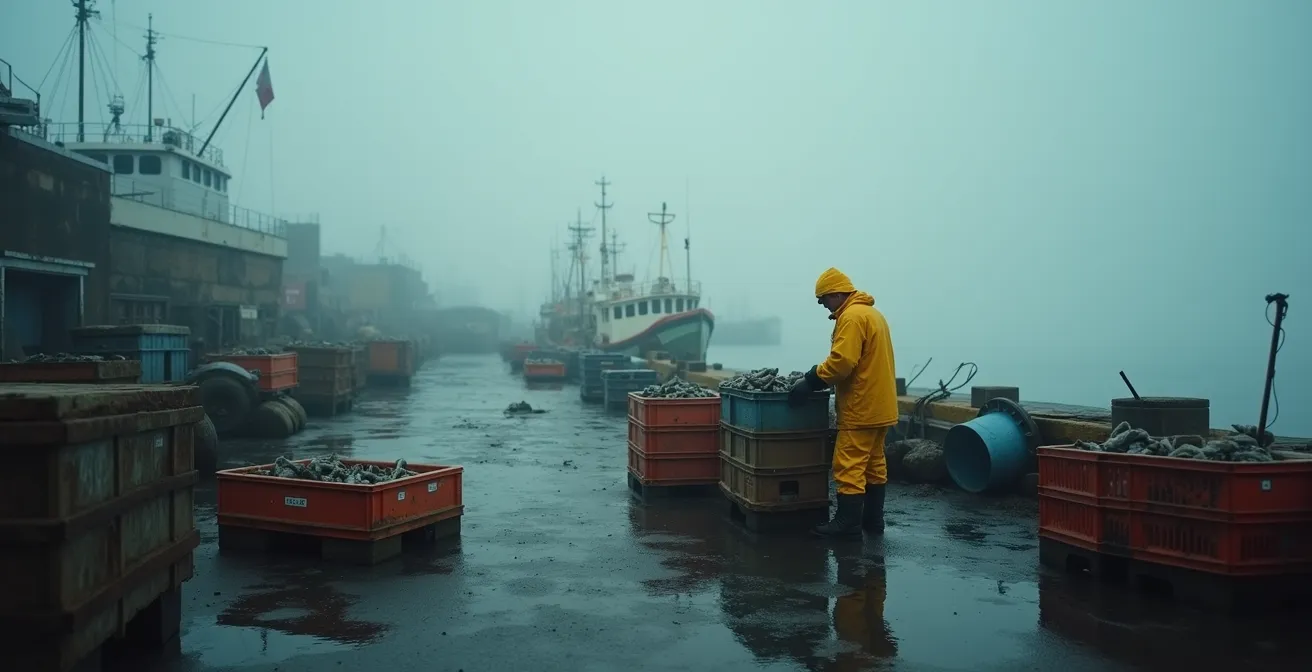
When you approach a boat, you’re stepping into someone’s workplace. The key is to be prepared and respectful, demonstrating that you value their time and expertise. This simple act of commerce, when done right, is an act of reciprocity. You receive the freshest possible catch, and the fisherman receives fair compensation without a middleman. It’s a small but powerful way to participate in the local economy and acknowledge the hard work that underpins coastal life. To navigate this interaction successfully, you need to know the unwritten rules.
Your Action Plan: Buying Fish Like a Local
- Bring cash in small bills ($10s and $20s) and your own cooler with ice. Fishermen operate cash-only businesses and appreciate buyers who come prepared.
- Ask about the catch timing and be flexible. Understand that tide schedules and weather conditions dictate availability, not consumer convenience.
- Inquire respectfully about seasonal closures and DFO (Department of Fisheries and Oceans) regulations to show you understand the challenges they face.
- Learn the difference between buying from large co-ops versus individual fishermen. Co-ops offer more variety, but individual purchases provide direct economic support.
- Understand that ‘Frozen at Sea’ (FAS) products from Canadian factory freezer trawlers are high-quality options that represent modern fishing adaptation.
How to get invited to a Ceilidh or kitchen party if you don’t know anyone?
If buying from the wharf is the first handshake, the kitchen party is the welcome into the living room. A cèilidh (pronounced kay-lee) or kitchen party is the cultural heartbeat of many Maritime communities—an informal gathering of music, storytelling, and dance. Unlike a formal concert, there’s no firm line between performer and audience. As the Baddeck Gathering Ceilidhs organizers note, it’s a party “where everyone is welcome to perform if they wish.” The challenge for a visitor is clear: how do you get access to such an intimate event without an invitation? The answer lies not in a secret password, but in a posture of humility and genuine interest.
You don’t just “find” a kitchen party; you earn your way to one. Start by frequenting the public-facing versions. Many communities, like those on Cape Breton, have evolved the tradition to include public concerts and pub nights that maintain an authentic atmosphere. Go to these events. Listen more than you talk. Buy a local musician’s CD. If you play an instrument, have it with you, but wait to be asked. The key is to show you’re there to appreciate, not just to consume an “experience.” Your chances of finding an authentic gathering are high, especially in places like Prince Edward Island, where these parties are a frequent part of summer life across the island. The goal is to become a familiar, friendly face—someone who is genuinely engaged with the culture.
The transition from a public cèilidh to a private kitchen party happens organically. It comes from conversations at the local pub, from being recognized at a community hall, or from simply showing up with a respectful and open heart. It’s not about being the life of the party; it’s about being a welcome part of its rhythm.
Rug hooking and storytelling: why these slow arts survive in a fast world?
In an age of instant gratification, the survival of “slow arts” like rug hooking and oral storytelling speaks volumes about maritime resilience. These are not mere hobbies; they are acts of cultural memory, weaving and speaking the history of the coast into existence. Each hooked mat tells a story—of a family home, a prize-winning dory, or a local legend. These crafts survive because they are fundamentally about connection and community, not just production. They are a deliberate choice to slow down and create something meaningful with one’s hands, a quiet rebellion against a world that moves too fast.
The resilience of these arts lies in their adaptability. Artisans have created sustainable business models that invite outsiders in, not just as customers, but as students. For example, Molly Made Fibre Art Studio in Woody Point, Newfoundland, offers five-day workshops with the explicit goal of keeping the craft alive. Participating in such a workshop is one of the most profound ways to connect. You’re not just buying a souvenir; you are learning the skill, hearing the stories from the artisans themselves, and contributing to the economic viability of the tradition. You become part of the story of its survival.
This preservation effort has deep roots. It follows a long tradition of individuals recognizing the value of this heritage. In the mid-1900s, folklorist Helen Creighton painstakingly recorded the Celtic traditions and ghost stories of rural Nova Scotia, ensuring they wouldn’t be lost to time. Today’s artisans and storytellers are her direct descendants, continuing the vital work of carrying the culture forward. Engaging with them, listening to their tales, and learning their craft is to participate in this legacy.
The mistake of telling locals “how simple and quaint” their hard lives are
Perhaps the single greatest mistake a visitor can make is to look upon a life of hard physical labor and call it “simple” or “quaint.” This well-intentioned but deeply misguided compliment ignores the complex reality and economic realism that defines maritime Canada. It romanticizes a struggle and dismisses the immense skill, intelligence, and resilience required to make a living from the sea or land. The perception of ‘quaint simplicity’ masks serious economic truths; historically, Atlantic provinces remain the poorest regions of Canada, a fact shaped by the decline of traditional industries like fishing, forestry, and shipbuilding.
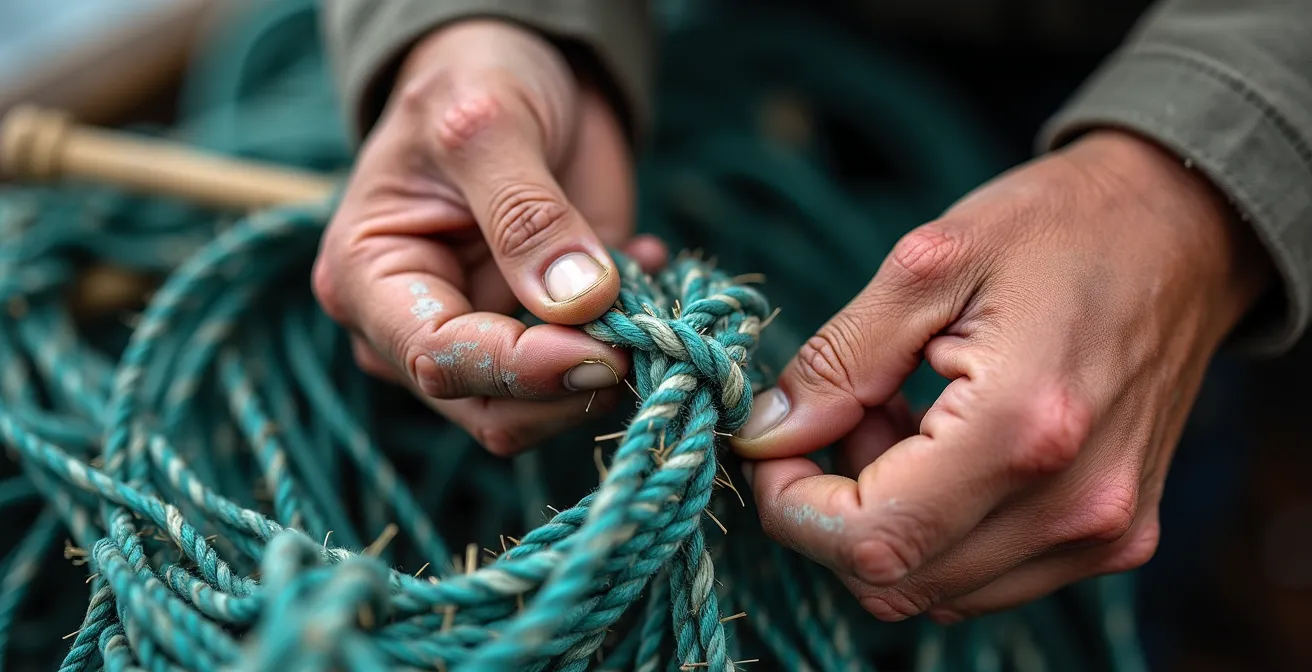
The weathered hands mending a net are not a charming photo opportunity; they are the hands of a highly skilled professional performing a critical task that determines their livelihood. The colourful fishing village isn’t a movie set; it’s a community grappling with fluctuating fish stocks, global market prices, and the constant threat of a changing climate. Calling this life “simple” is to erase the complexity and the worry, effectively patting someone on the head for their own survival. It creates a barrier, positioning the speaker as a privileged observer rather than a respectful guest.
True appreciation comes from acknowledging the difficulty and admiring the skill. Instead of “it’s so simple,” try “I can’t imagine how much skill that takes.” Ask questions about the process, the challenges, and the history. This shift in language demonstrates empathy and respect. It opens the door to genuine conversation and allows you to see the person, not a caricature. It is the fundamental mindset shift required to move from tourist to welcome visitor, recognizing the profound strength and sophistication behind a life that is anything but simple.
Which small-town festivals offer the best seafood chowder in Atlantic Canada?
After embracing the economic realities and social etiquette of the coast, you can begin to explore its culinary traditions with a more informed palate. And there is no dish more emblematic of the region than seafood chowder. But chowder in Atlantic Canada is not a monolithic entity; it is a fierce point of regional pride and a delicious expression of local identity. A festival chowder cook-off can be as intense as any sporting event. Exploring these variations is a way to taste the terroir of the sea, where every town and province has its own philosophy on the perfect blend of seafood, cream, and potatoes.
From the lobster-forward bowls in New Brunswick to the thick, potato-heavy styles of Nova Scotia, each chowder tells a story about the local catch and dairy. As Destination Cape Breton proudly claims, “The culinary scene on Cape Breton Island is truly unlike anything you have experienced,” and this sentiment applies to the entire region’s approach to its most iconic dish. Attending a small-town festival and sampling the chowder is a perfect way to support a community directly while engaging in a beloved local ritual. It’s a delicious form of research into regional identity.
The following table provides a starting point for your culinary exploration, highlighting the distinct styles you’ll encounter across the provinces. Use it not as a definitive ranking, but as a map to guide your own delicious journey.
| Province | Chowder Style | Key Characteristics | Notable Festival |
|---|---|---|---|
| Nova Scotia | Creamy Maritime | Potato-heavy, thick cream base | Halifax Waterfront |
| Newfoundland | Seafood-packed | Often includes turnip or carrot | St. John’s Harbor |
| PEI | Dairy-rich Island | Features island dairy and potatoes | Summerside Lobster Carnival |
| New Brunswick | Lobster-forward | Emphasis on lobster meat | Shediac Lobster Festival |
Mapping the famous shipwrecks visible from the shore at low tide
The coastline of Atlantic Canada is a museum of maritime history, its floor littered with the bones of thousands of shipwrecks. While many are lost to the depths, some offer a ghostly reminder of the ocean’s power, their skeletal remains visible from shore at low tide. These wrecks are more than just tragic relics; they are markers of change and catalysts for resilience. The 1873 loss of the SS Atlantic near Halifax, for instance, was a horrific disaster that spurred significant improvements in marine safety and led to the construction of more lighthouses along the treacherous coast. Each wreck tells a story not just of loss, but of the lessons learned and the adaptations made in its wake.
However, to focus only on the wrecks of the colonial era is to see a fraction of the story. The maritime history of this land is immensely deeper and older. It’s crucial to acknowledge that Indigenous maritime heritage is the foundation of coastal life in Canada. Archeological evidence shows that Maritime Archaic traditions date back as far as 7500 years. These peoples were master navigators and harvesters of the sea, developing sophisticated technologies and a deep, reciprocal relationship with the ocean long before the first European ships arrived and subsequently wrecked upon these shores.
When you look at a visible shipwreck, you are seeing a powerful, tangible piece of history. But the true act of understanding is to see it in context. Imagine the layers of history beneath it: the centuries of Indigenous stewardship, the tragedies that prompted innovation, and the continuous, evolving relationship between people and the sea. The visible wreck is just the most recent chapter in a very, very old story.
English speakers in rural Quebec: how to integrate beyond the “Bonjour”?
While often grouped with Atlantic Canada, Quebec’s coastal regions, like the Gaspé Peninsula, possess a unique cultural and linguistic landscape. For an English speaker, integrating here requires a different, yet related, set of skills centered on linguistic respect and community participation. Moving beyond a simple “Bonjour-Hi” is not just polite; it’s the essential price of admission to the richness of Québecois culture. It signals a desire to be part of the community, not just a resident within it. This contrasts with officially bilingual provinces like New Brunswick, where over 30% of the population speaks French as a first language within a different legal framework.
In rural Quebec, French is the language of daily life, community, and heart. Making an effort, no matter how clumsy, is a profound gesture of respect. The goal isn’t immediate fluency, but visible effort. This means embracing your accent, being willing to make mistakes, and patiently asking for help. It means understanding the local context, such as the practical impacts of language laws like Bill 96 on daily life. True integration happens in small, consistent actions that demonstrate commitment to the local culture.
The path to integration is paved with daily interactions. It’s about becoming a familiar face at the local *dépanneur* (corner store), volunteering at a community event, or joining a local sports league. It’s about showing up and participating in the life of the town, in its own language.
Your Roadmap: Integrating into Rural Québecois Life
- Become a regular at your local dépanneur. Make small talk in broken French and ask the owner’s advice on local matters.
- Volunteer at a *cabane à sucre* (sugar shack) during maple syrup season to show commitment to Québecois traditions.
- Join a *pétanque* league or help with the fall apple harvest in regions like the Eastern Townships.
- Learn regional French variations. The French spoken in the Gaspésie differs from that in the Estrie region.
- Understand the practical impacts of Bill 96 on accessing municipal services and school enrollment to navigate local realities.
The Essentials
- True maritime resilience is an active, living culture, not a historical artifact to be observed.
- Respectful engagement begins with understanding the economic realities and unwritten social rules of coastal communities.
- Participation—whether through learning a craft, speaking the language, or buying direct—is the most authentic way to connect.
How to follow the Lighthouse Trail to understand the maritime history of the coast?
Lighthouses are the quintessential icons of the maritime coast, stoic sentinels standing against the sea. To follow a “Lighthouse Trail,” especially along a coast like Nova Scotia’s with its approximately 150 lighthouses, can be more than a scenic drive. It can be a journey through the history of navigation, settlement, and survival. But to truly understand their story, you must see them not as static monuments, but as dynamic symbols of resilience. Their story isn’t just in their past function, but in their present life. Many of these structures have been saved from demolition by passionate community groups who have given them new purpose.
The most powerful lesson from the lighthouses is one of adaptation. A perfect example is the West Point Lighthouse in Prince Edward Island. It has been transformed from a crucial navigation aid into a successful inn and restaurant. It still serves as a beacon, but now it guides travelers instead of ships. This is resilience in action: preserving heritage not by freezing it in time, but by giving it a new, sustainable economic life that continues to serve the community. When you visit a lighthouse, ask about its current use. Is it a museum, a B&B, a community center? Supporting these new functions is supporting the preservation of history.
As you travel from one lighthouse to the next, you’re tracing a map of human ingenuity and perseverance against an unforgiving environment. You see how they are strategically placed at treacherous capes and hidden shoals. You are, in essence, seeing the coastline through the eyes of a 19th-century ship captain. These structures are the physical manifestation of the lessons learned from countless shipwrecks and lost lives. They are monuments to a hard-won wisdom, and their continued existence is a testament to the communities that refuse to let their stories fade.
Your journey into the heart of maritime Canada begins with a single step: choosing participation over observation. The next time you feel the pull of the coast, start by planning how you’ll engage, not just what you’ll see. Seek out a fisherman’s co-op, find a local cèilidh schedule, or book a craft workshop. Begin your exploration with a gesture of respect and a genuine desire to understand.