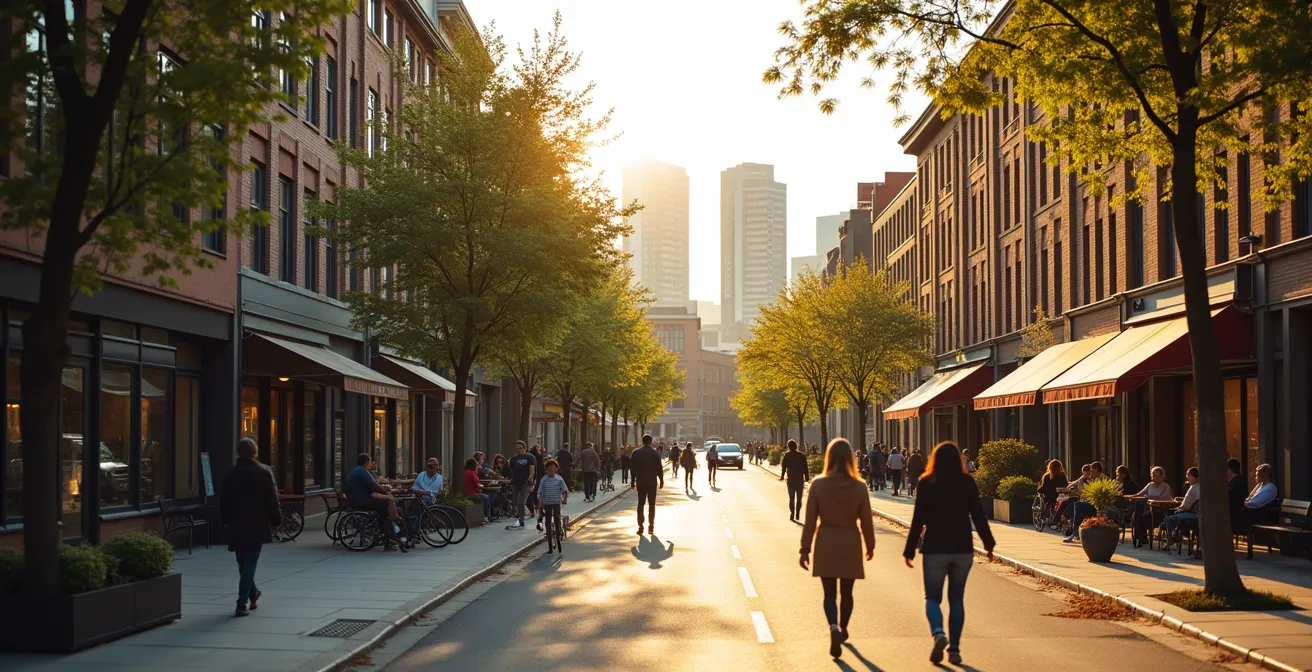
Paying a premium for a highly walkable home in Canada isn’t a luxury expense; it’s a strategic financial decision that liquidates the hidden liability of a second car.
- Shedding a second vehicle can unlock a “Car-Free Dividend” of over $10,000 annually in avoided costs like insurance, maintenance, and depreciation.
- True walkability in Canada requires a “Four-Season Audit” that goes beyond a simple score to account for winter maintenance, safety, and transit access.
Recommendation: Shift your analysis from comparing property prices alone to evaluating the total cost of housing plus transportation for a more accurate financial picture.
For many Canadian buyers, the choice seems stark: a spacious suburban house with a yard, inevitably tethered to car-dependent life, or a smaller, more expensive urban home that offers the dream of walkability. The debate is often framed as a trade-off between space and convenience, with the higher price tag of a “Walker’s Paradise” seen as a luxury. Conventional wisdom suggests you save on gas but lose on square footage, and that walkable living is a lifestyle choice for those who can afford it.
This perspective, however, misses the fundamental economic equation at play. The premium paid for a walkable property is not merely a cost; it’s an investment in a powerful financial tool. By choosing a location where daily life—groceries, school, coffee, transit—is accessible on foot, you are not just buying a home. You are buying the option to eliminate your biggest depreciating asset: the second car, and in some cases, the first one too. This decision unlocks what can be called a “Car-Free Dividend”—a substantial annual saving that can dramatically alter your household’s financial health.
But what if the key to affordability isn’t a lower sticker price in the suburbs, but a strategic investment in a location that systematically reduces your largest non-housing expense? This article dismantles the traditional view by analyzing walkability as a financial strategy. We will explore how to truly assess a neighbourhood’s walkability in a Canadian context, quantify the financial benefits of ditching a car, navigate the common trade-offs like noise, and identify communities that offer both vibrant life and investment potential.
This guide provides a framework for analyzing the true cost and benefit of walkability, moving beyond simple scores to a sophisticated understanding of lifestyle and finance. Explore the key factors that determine whether paying that premium is the smartest financial decision you can make.
Table of Contents: A Financial Analyst’s Guide to Walkability and Real Estate
- The “15-minute city” test: can you buy milk without starting a car?
- How to test the safety of a neighborhood walk at night before buying?
- Zipcar and Communauto: do you really need a second car in a walkable zone?
- The trade-off: does walkability always mean living with street noise?
- Are the sidewalks wide enough and are there curb cuts for families?
- Which towns offer a real community feel versus just rows of sleeping houses?
- Why properties within 800m of a new LRT station historically gain 20% more value
- How to identify the “sweet spot” of gentrification where value meets livability?
The “15-minute city” test: can you buy milk without starting a car?
The “15-minute city” is a powerful concept where all essential needs—work, shopping, education, healthcare, and leisure—can be met within a quarter-hour walk or bike ride. For a homebuyer, this isn’t just about convenience; it’s the foundational test for a car-light lifestyle. However, achieving this ideal in sprawling Canadian cities is a significant challenge. It requires a level of urban density and mixed-use zoning that is still more the exception than the rule. A recent McGill University analysis highlights this gap, finding that only 6% of Montrealers could conduct all their travel within a 30-minute round trip when car ownership was factored in.
This reality means a high Walk Score is only a starting point. The real test is a practical, four-season audit. A neighbourhood that is a walker’s paradise in July can become an impassable landscape of icy sidewalks and snow-blocked curb cuts in February. True walkability in Canada must be winter-proof. Before buying, you must investigate factors that online scores simply cannot capture.
Consider the following practical checks for four-season walkability:
- Municipal Performance: Research the municipality’s official snow-clearing performance records and stated response times for sidewalks, not just roads.
- Winter-Accessible Routes: Map the grocery stores, clinics, and transit stops within your 15-minute radius that remain accessible during the peak winter months. Are there heated underground networks like Montreal’s RÉSO or Calgary’s +15 Skywalk?
- Real-World Testing: If possible, test the walk yourself during a January or February cold snap. Assess sidewalk conditions and calculate door-to-door transit times, including waiting for a bus in freezing temperatures.
A neighbourhood only passes the 15-minute city test if it functions for you and your family 12 months a year. This deeper due diligence separates true convenience from a fair-weather amenity.
How to test the safety of a neighborhood walk at night before buying?
A walkable neighbourhood is only truly functional if you feel safe using it at all hours. Safety is a critical component of lifestyle convenience, influencing whether you’ll actually take that evening stroll to a restaurant or feel comfortable with your teenager walking home from a friend’s house. This feeling of security is a combination of objective data and subjective perception, both of which must be investigated before you commit to a property.
The visual and ambient quality of a neighbourhood at night is paramount. Well-lit streets, the presence of other pedestrians (“eyes on the street”), and a general sense of activity contribute more to perceived safety than any statistic. A street lined with homes whose lights are on feels vastly different from one dominated by dark, inactive storefronts. Your due diligence must therefore extend beyond daytime visits.

Beyond personal observation, digital tools offer powerful insights into a neighbourhood’s objective safety profile. Before buying, a thorough digital safety audit is essential. This involves triangulating data from official sources, community forums, and local news to build a complete picture. Here’s how to conduct your research:
- Official Crime Data: Access public safety data portals, such as the one offered by the Toronto Police Service, to review real-time, geographically-specific crime statistics. Look for trends, not just isolated incidents.
- Community Intelligence: Search neighbourhood-specific Facebook groups and local subreddits (e.g., r/askTO, r/vancouver) using keywords like “safety,” “theft,” or “late night.” Resident experiences provide invaluable context.
- Bylaw Compliance: Review municipal bylaws for things like snow and ice clearing requirements. Poorly maintained sidewalks in winter are a significant safety hazard, and high rates of non-compliance can be a red flag.
Ultimately, a combination of evening site visits during different seasons and diligent online research will tell you if the neighbourhood’s safety matches your family’s needs.
Zipcar and Communauto: do you really need a second car in a walkable zone?
For many suburban families, a second car isn’t a luxury; it’s a logistical necessity. In a truly walkable urban neighbourhood, however, this assumption crumbles. The combination of high accessibility and the rise of robust car-sharing services like Communauto, Zipcar, and Evo fundamentally changes the financial equation. Giving up a second car unlocks the “Car-Free Dividend”—a massive annual saving that often outweighs the premium paid for the walkable location.
The true cost of car ownership goes far beyond a monthly payment. It includes insurance, gas, maintenance, parking, and depreciation—a relentless financial drain. As a prospective homebuyer, comparing these ongoing costs to the occasional use of a car-share service reveals a powerful opportunity for savings. This is where the financial argument for walkability becomes undeniable.
The following table, based on Canadian market data, illustrates the stark difference in annual costs. The analysis from a recent Zoocasa report on car costs and housing provides a clear financial breakdown.
| Cost Category | Second Car Ownership | Car-Share Power User | Annual Savings |
|---|---|---|---|
| Annual Operating Costs | $9,500-$16,000 (CAA estimate) | $2,400-$3,600 (200 hours/year) | $7,100-$12,400 |
| Insurance | $1,725/year average | Included | $1,725 |
| Maintenance | $500-$700/year | Included | $500-$700 |
| Parking | $2,400/year urban | Street parking included | $2,400 |
| Depreciation | 30% first year | None | Variable |
Case Study: The Financial Impact in Calgary
The financial leverage is significant even in cities known for harsh winters. A 2024 analysis by Zoocasa found that completely eliminating car costs in Calgary could slash a typical monthly mortgage payment of $2,655 by a staggering 54%, bringing it down to just $1,228. This demonstrates that even when walking is less practical for a few months, the year-round financial structure of a car-free or car-light lifestyle creates immense savings that can be redirected to housing equity.
By liquidating the depreciating asset of a second car and redirecting those thousands of dollars into your mortgage, the “expensive” walkable home suddenly becomes far more affordable on a total-cost-of-living basis.
The trade-off: does walkability always mean living with street noise?
One of the most common concerns for buyers moving from quiet suburbs to vibrant urban cores is the perceived trade-off between convenience and tranquility. The fear is that walkability inevitably comes with a soundtrack of traffic, sirens, and late-night revelers. While it’s true that dense, active neighbourhoods generate more ambient sound, it is a myth that you must sacrifice peace and quiet. The solution lies not in avoiding the neighbourhood, but in choosing the right building envelope.
Modern construction standards and materials can create a remarkably quiet oasis in the heart of a bustling city. The difference between a poorly insulated older building and a contemporary one with a focus on sound attenuation is night and day. As a buyer, your focus should be on the specific construction details that mitigate sound transmission from the outside world.

Assessing a building’s sound insulation capabilities is a key part of your due diligence. Rather than being a deal-breaker, noise is a solvable problem if you know what to look for. Your investigation should include:
- Window Specifications: This is the weakest point for sound entry. Look for triple-pane or laminated glass installations, which are specifically designed for acoustic insulation. Double-pane is standard; triple-pane is a significant upgrade.
- Wall Construction: Concrete buildings, particularly those built after 2000, generally offer superior sound insulation compared to wood-frame constructions. The mass of concrete is highly effective at blocking low-frequency sounds like traffic rumble.
- Unit Position and Orientation: A unit on a higher floor (generally above the 4th or 5th) will experience significantly less street-level noise. Furthermore, a unit that faces an inner courtyard will be dramatically quieter than one facing a main arterial road.
- Peak Hour Testing: The most important test is to visit the property during its noisiest times—typically rush hour on a weekday and a weekend evening—to gauge the real-world sound levels inside the unit.
By focusing on the quality of the building’s shell, you can enjoy all the benefits of a prime walkable location without compromising on a peaceful living environment.
Are the sidewalks wide enough and are there curb cuts for families?
True walkability is about more than just proximity; it’s about accessibility for everyone. A neighbourhood is only genuinely walkable if a parent pushing a double stroller, a person using a wheelchair, or a senior with a walker can navigate it safely and with dignity. This dimension of “wheelability” is often overlooked but is a critical indicator of a community’s infrastructure quality and inclusivity. For families and individuals with mobility challenges, it’s non-negotiable.
The importance of this cannot be overstated. According to Statistics Canada data, 2.7 million Canadians (9.6%) have mobility-related disabilities, and countless more, like parents with young children, rely on accessible pathways. Wide, well-maintained sidewalks, frequent and properly graded curb cuts, and pedestrian-first intersection signals are the bedrock of a truly functional walkable environment. Their absence can effectively exclude a significant portion of the population from participating in community life.
Forward-thinking municipalities are increasingly recognizing this. For example, a 2024 user-led audit in Quebec City, involving 25 individuals who use mobility assistive technologies, systematically identified critical accessibility barriers across different urban environments. This direct user feedback is now informing municipal infrastructure improvements, demonstrating a commitment to building a city for all residents. When you see this level of investment in accessibility, it’s a strong positive signal about the long-term livability of a neighbourhood.
Your 5-Step Physical Walkability Audit
- Identify Contact Points: List all the key destinations you need to access on foot (e.g., grocery store, daycare, transit stop, park) and map the primary walking routes to each.
- Collect Sidewalk Data: Walk these routes and inventory the physical conditions. Note sidewalk width (can two strollers pass?), surface condition (cracks, heaves), and the presence/absence of curb cuts at every intersection.
- Check for Coherence: Compare your findings to your family’s needs. Is there a consistent, unbroken accessible path to your most critical destination, or is the route “broken” by a missing curb cut or a narrow, crumbling section of pavement?
- Assess Safety & Comfort: Evaluate the emotional experience of the walk. Are there sufficient buffers from traffic? Is there shade from trees in the summer? Does the route feel safe and welcoming, or stressful and exposed?
- Create an Integration Plan: Based on your audit, identify any “deal-breaker” barriers. Can they be mitigated (e.g., an alternative, slightly longer route exists), or do they render the neighbourhood unworkable for your specific needs?
This hands-on audit provides a much richer understanding of a neighbourhood’s daily reality than any online score can offer, ensuring it fits your family’s practical requirements.
Which towns offer a real community feel versus just rows of sleeping houses?
Many suburban developments promise “community” but deliver little more than rows of “sleeping houses”—private homes where residents drive into their garages and disappear, with few opportunities for spontaneous social interaction. A real community feel is an active, living thing, fostered by a physical environment that encourages people to get out, interact, and linger. This vibrancy is built on a foundation of what urbanists call “third places.”
Third places are the anchors of community life, distinct from the first place (home) and the second place (work). They are the non-chain coffee shops, local brewpubs, libraries, bustling parks, and community centres where unplanned encounters happen and social bonds are formed. A neighbourhood rich in these destinations is one where community isn’t just a marketing buzzword; it’s a daily reality. The density and quality of these third places are a direct measure of a neighbourhood’s social vitality.
Case Study: Fostering Community in Winnipeg’s Winters
The power of third places is evident even in Canada’s harshest climates. Despite Winnipeg’s traditionally car-centric design, neighbourhoods like Osborne Village and the Exchange District have cultivated a vibrant community life that persists through deep winter. They achieve this through a high concentration of unique local businesses and public spaces, active Business Improvement Areas (BIAs) that program year-round events like winter markets, and a culture that embraces four-season activity. This proves that community vibrancy is a result of intentional design, not just good weather.
As a buyer, you can assess a neighbourhood’s potential for true community by looking for tangible indicators. Go beyond the manicured lawns and look for the infrastructure of social life:
- Third Place Density: Count the number of independent, locally-owned gathering spots within a comfortable walking distance. A high ratio of local businesses to national chains is a strong positive sign.
- Active Programming: Look for evidence of an active BIA or community league. Do they organize farmers’ markets, street festivals, outdoor skating rinks, and other year-round community events?
- Four-Season Public Spaces: Are the parks and public squares designed for year-round use? Look for features like fire pits, covered seating, and programming that continues through the colder months (November-March).
A neighbourhood with these elements is not just a place to live; it’s a place to belong. This social infrastructure is a valuable, if intangible, asset that significantly enhances quality of life.
Why properties within 800m of a new LRT station historically gain 20% more value
It’s a well-observed phenomenon in urban real estate: properties located within a short walk (typically 800 metres, or a 10-minute walk) of a new light rail transit (LRT) station tend to see significantly higher value appreciation than those further away. The oft-cited figure of a 20% value premium isn’t arbitrary; it reflects a powerful convergence of economic forces that savvy buyers can leverage. Understanding the “why” behind this number reveals the true value of transit-oriented development.
The primary driver is a dramatic increase in accessibility. An LRT station fundamentally alters the time-space geography of a city for residents in its catchment area. It provides a reliable, traffic-proof, and low-cost connection to major employment hubs, entertainment districts, and other key destinations. This newfound ease of movement is a highly desirable amenity, and its value gets capitalized directly into the prices of nearby homes. Buyers are willing to pay a premium for a property that saves them time, money, and stress on their daily commute.
Furthermore, the announcement and construction of major public infrastructure like an LRT line acts as a powerful signal of investor confidence. It tells the market that the government is committed to the long-term growth and densification of that corridor. This often triggers a wave of complementary private investment, from new condo developments to retail and service businesses eager to cater to the growing population. This creates a virtuous cycle of amenity growth and value appreciation. A home near an LRT station isn’t just a place to live; it’s an asset tied to a major public and private growth engine, future-proofing its value against rising transportation costs and shifting urban preferences.
For a homebuyer, purchasing near a new or planned LRT station is a strategic move. You are not only buying a home but also a stake in the future accessibility and vibrancy of a neighbourhood, effectively locking in future value gains before they are fully realized by the wider market.
Key takeaways
- The Car-Free Dividend: Viewing the premium for a walkable home as an investment to eliminate a car’s >$10k annual cost fundamentally changes the affordability calculation.
- Four-Season Walkability Audit: A high Walk Score is meaningless in Canada without verifying winter sidewalk maintenance, safety, and all-weather access to essentials.
- The Gentrification Sweet Spot: The ideal investment point is when a neighbourhood gains modern amenities (like artisan bakeries) but retains its established local businesses and community fabric.
How to identify the “sweet spot” of gentrification where value meets livability?
Gentrification is often seen as a double-edged sword, bringing improved amenities but also rising costs that can displace longtime residents. For a homebuyer, however, there exists a “sweet spot”—a specific phase in a neighbourhood’s evolution where you can capture future value appreciation while still enjoying a high degree of livability and a diverse community character. Identifying this transitional moment is the key to a successful and satisfying urban real estate investment.
This sweet spot occurs when a neighbourhood begins to attract new investment and residents, but before it becomes homogenized and prohibitively expensive. It’s the point where the first independent craft breweries and artisan bakeries appear alongside the established, family-run corner stores and repair shops. This blend of old and new creates a dynamic, interesting, and multi-layered community. The goal is to buy in just as the positive momentum is building, not after it has already peaked.
Spotting this phase requires being an astute observer of subtle ground-level changes. Look for these key indicators:
- The “Artisan” Index: Track the arrival of businesses like independent coffee roasters, craft breweries, and artisan bakeries. These are often the pioneers of a neighbourhood’s next phase.
- Corner Store Evolution: Pay attention to what the local corner stores are stocking. When they start adding organic produce or specialty food items next to the lottery tickets and milk, it’s a sign that the local demographic is changing.
- Business Diversity: The sweet spot is characterized by the survival and thriving of established local businesses alongside the new, trendier boutiques. If the old businesses are all being replaced, you may have missed the ideal entry point.
- Development Pipeline: Research planned developments. The approval of new mixed-income housing projects or significant public space upgrades (like a new park or library) are strong signals of future growth.
Investing in a neighbourhood at this stage offers the dual benefit of financial upside and a richer quality of life. As the community matures, you not only build equity but also benefit from the improved amenities and vibrancy. As a final bonus, research shows that this lifestyle change has tangible health benefits. A Canadian study demonstrates that moving to a walkable city adds 1,100 steps per day on average, reinforcing overall well-being.
To truly capitalize on this opportunity, the crucial first step is to shift your financial perspective. Stop thinking about a home’s price in isolation and start calculating your total, blended cost of housing and transportation. Evaluate your current annual spending on car payments, insurance, gas, and maintenance. This is the “Car-Free Dividend” you stand to gain. By applying this figure to your mortgage calculations, you will see that the “expensive” walkable home is often the most financially sustainable choice in the long run.