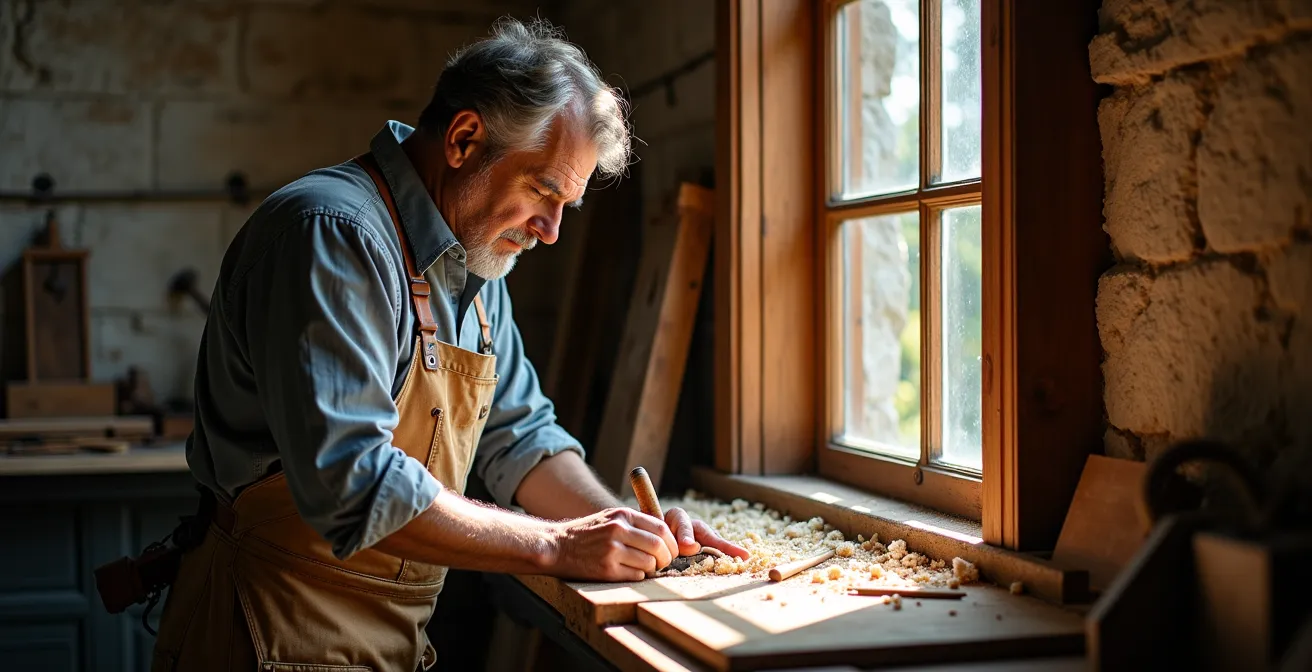
Renovating a Quebec heritage home is less about fighting bureaucracy and more about becoming a steward of history, a journey that significantly enhances both the property’s value and your connection to the community.
- The regulations are not arbitrary barriers but a structured guide to achieving authentic, high-quality craftsmanship.
- Success lies in finding the synergy between traditional skills, like lime mortar masonry, and modern solutions, such as CNC replication.
Recommendation: Shift your mindset from ‘owner’ to ‘curator’ and approach the renovation as a collaborative partnership with the system to achieve a result that is historically respectful and deeply personal.
The dream is intoxicating: a stone house in a historic Quebec borough, its walls whispering stories from centuries past. For lovers of history, owning such a property is the ultimate connection to a tangible past. Yet, for many, this dream is quickly overshadowed by a daunting reality: a labyrinth of regulations, the spectre of unforeseen costs, and the infamous “bureaucratic marathon.” It’s a process that can feel intimidating, opaque, and designed to thwart the very passion that drew you in.
The common advice often circles around the same warnings: be prepared for a long permit process, find a good contractor, and respect the original materials. While true, this advice misses the fundamental point. It frames the renovation as a battle to be won against a rigid system. But what if this perspective is flawed? What if the rules aren’t an enemy to be outsmarted, but a roadmap to authenticity? What if the bureaucracy, in its own way, is the guardian of a shared craftsmanship philosophy that makes these homes so special in the first place?
This is the core of a successful heritage renovation. It requires a mental shift from seeing yourself as a mere owner to embracing the role of a custodian. The regulations become a shared language for preserving the very soul of the building. By understanding the ‘why’ behind the rules—the principles of material integrity, structural honesty, and community fabric—the marathon transforms from a frustrating slog into a meaningful and ultimately rewarding journey.
This guide will walk you through the most common challenges and fears associated with renovating in a heritage district. We will explore everything from material choices and structural issues to community integration and modern upgrades, reframing each obstacle as an opportunity to create something of lasting value and beauty, preserving history while living comfortably within it.
Summary: A guide to navigating the heritage renovation marathon in Quebec
- Why you can’t just change your windows to vinyl in a heritage zone
- Where to find masons who still know how to work with lime mortar?
- English speakers in rural Quebec: how to integrate beyond the “Bonjour”?
- The 200-year-old foundation issues that home inspectors might miss
- How to legally run a Bed & Breakfast in a heritage zone?
- How to replicate 100-year-old baseboards using modern CNC technology?
- Guédille or Club Sandwich: where to find the best lobster rolls on the road?
- How to upgrade the systems of a Victorian home without destroying its soul?
Why you can’t just change your windows to vinyl in a heritage zone
The prohibition against vinyl windows is often the first “rule” prospective renovators encounter, and it perfectly encapsulates the core philosophy of heritage preservation. It’s not an arbitrary aesthetic preference; it’s about material integrity and performance. Historic buildings were designed as a system. Wood windows, for example, allow the walls to “breathe,” managing moisture in a way that modern, impermeable materials like vinyl cannot. Installing a sealed vinyl unit can trap moisture within old stone or brick walls, leading to long-term decay.
The regulatory bodies, like a borough’s urban planning department or the Commission d’urbanisme et de conservation du Québec (CUCQ), view these choices through the lens of historical accuracy and structural longevity. The permit process, while detailed, is a dialogue to ensure your renovation contributes to the building’s life rather than shortening it. It forces a pause and encourages solutions that respect the original craftsmanship. Fortunately, this approach is often supported financially. For instance, Montreal’s heritage support program provides subsidies that can cover a significant portion of the cost for proper restoration using appropriate materials.
Instead of viewing this as a restriction, see it as the first step in your education as a property custodian. Learning why wood is preferred over vinyl is learning the language of your home. It’s about understanding that every component, from the window sash to the mortar, is part of a cohesive, living system.
Action plan: Navigating the heritage permit process
- Verify Status: First, confirm the official heritage status of your property using the online Répertoire du patrimoine culturel du Québec.
- Initial Submission: Submit your initial permit request at the designated permit office for your borough or suburban city to start the formal process.
- Seek Subsidies: Concurrently, send your subsidy request documents via email to the appropriate body, such as the Division du patrimoine.
- Obtain Quotes: Get a minimum of two detailed quotes from contractors who hold a valid Régie du bâtiment du Québec (RBQ) licence and have experience in heritage work.
- Provide Proof: Submit your final package, including detailed project plans drawn by an architect or technologist and proof of your financing capacity for the project.
Where to find masons who still know how to work with lime mortar?
Once you accept the importance of using traditional materials, the next challenge emerges: finding the artisans who still possess the skills to work with them. A prime example is lime mortar. Unlike modern cement-based mortar, which is hard and brittle, lime mortar is softer and more porous. It acts as a sacrificial layer, absorbing and releasing moisture and protecting the surrounding stones from freeze-thaw cycles. Using the wrong mortar can literally destroy a historic stone wall from the inside out.
Finding a mason who is a true expert in traditional lime mortar isn’t as simple as a Google search. These skills are often passed down through apprenticeships and within close-knit networks of passionate craftspeople. This is where the journey of renovation becomes one of community building. You will find that seeking one expert often leads you to another, creating a web of knowledge and shared passion for preservation.
As Marina Rhéaume Gonzalez, who undertook a major heritage restoration in Quebec, notes, this network is the lifeblood of the craft. She explains how the process connects you with people dedicated to preserving these vital skills:
Networks take shape with people who are passionate about this and who share techniques and information. It’s great to see other people interested in keeping ancient techniques alive.
– Marina Rhéaume Gonzalez, Renovating a Century-Old Home in Québec
The Master and the Apprentice: A Fireplace Restoration
During the restoration of a century-old home in Quebec, the owners needed a fireplace built with traditional techniques. The mason they hired, committed to authenticity, felt the project required an even higher level of expertise for the mortar. He called upon his own former teacher, a master craftsman from another region of Québec, who came to the site specifically to prepare and apply an old-fashioned, cement-free lime mortar. This collaboration between generations ensured the fireplace was not just a functional element, but a testament to the preservation of a rare and valuable skill.
English speakers in rural Quebec: how to integrate beyond the “Bonjour”?
Renovating a heritage home is not just a construction project; it’s an act of planting roots. For Anglophones moving to predominantly French-speaking rural or historic areas of Quebec, this process can feel doubly challenging. The “bureaucratic marathon” is often conducted in French, and breaking into established local social circles can seem just as difficult. However, the renovation project itself can become a powerful bridge to community integration.
A renovation is a visible, long-term commitment to a place. It signals to your neighbours that you are not a transient visitor but someone invested in the local fabric. This shared context creates natural opportunities for connection that go far beyond a simple “Bonjour” at the corner store. It might start with a question about a local supplier, a recommendation for a tradesperson, or an offer to borrow a tool. These small interactions are the seeds of genuine relationships.
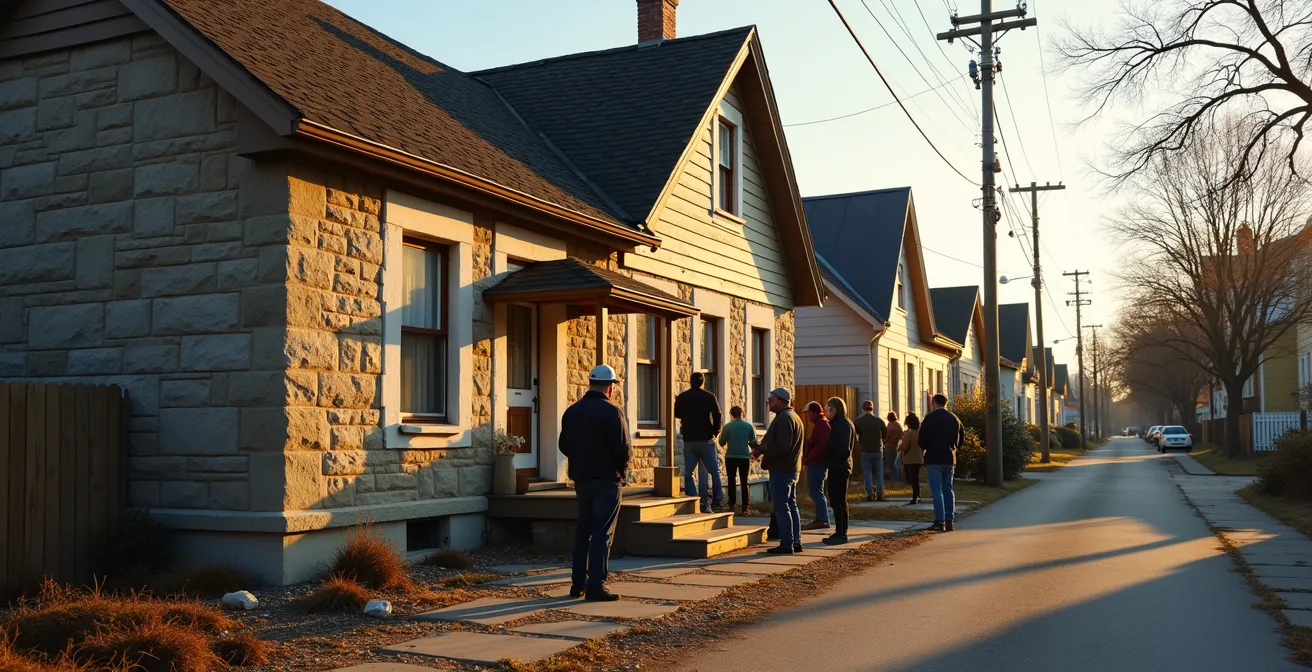
As the project unfolds, neighbours become invested observers and, often, collaborators. They share stories about the house’s previous owners, offer advice based on their own experiences, and celebrate milestones with you. The act of restoring a piece of their shared history makes you part of that history. It’s a powerful form of non-verbal communication that says, “I value what you value.”
From Acquaintance to Friend: The Power of a Shared Project
In the Cap-Rouge area, a man described how his relationship with a neighbour transformed through the simple act of shared work. For nearly 20 years, they were just acquaintances. Then, a series of exchanges began: one needed to borrow a trailer, and the other helped renovate it in return for the loan. This practical collaboration broke the ice, turning a polite but distant relationship into a real friendship. Now, they regularly share a Scotch in the evening, their bond forged through mutual assistance centred around their properties.
The 200-year-old foundation issues that home inspectors might miss
One of the greatest fears for any buyer of a historic home is the unknown lurking within its bones, particularly in the foundation. A standard home inspection, while essential, may not catch the subtle signs of distress specific to 200-year-old construction techniques. Inspectors are generalists; diagnosing a centuries-old fieldstone foundation requires a specialist’s eye and an understanding of how these structures behave over time.
The key is learning to read the language of an old foundation. Problems often manifest in subtle ways that are invisible to the untrained eye. For example, a fine white powder on the interior stone (efflorescence) isn’t just a cosmetic issue; it’s a clear sign of moisture infiltration through the limestone. Similarly, fine diagonal cracks in the lime mortar joints can indicate settlement, while a slight bulge in a stone wall could signal immense pressure from frost heave or improper backfilling.
As a prospective owner, you must become a preliminary detective. By learning to spot these red flags yourself, you can direct your home inspector or a structural engineer to look closer at specific areas of concern. This proactive approach empowers you, transforming fear of the unknown into a manageable risk assessment. It’s not about becoming an engineer, but about being an informed client who can ask the right questions.
Here are some key visual red flags to look for when assessing a heritage foundation:
- Efflorescence Patterns: Look for white, chalky deposits on limestone or brick foundations, indicating water is passing through the masonry.
- Diagonal Mortar Cracks: Fine, step-like cracks running through the mortar joints often suggest differential settlement of the foundation.
- Bulging or Bowing Walls: Any section of a stone wall that appears to be pushing outward can be a sign of serious lateral pressure.
- Basement Floor Heaving: Unevenness or cracking in the basement floor can be caused by frost action from below, a common issue in Quebec’s climate.
- Poor Exterior Grade: The ground around the house should visibly slope away from the foundation to ensure water drains away, not towards it.
How to legally run a Bed & Breakfast in a heritage zone?
For some, a heritage home is not just a place to live, but also a potential source of income that can help offset the significant costs of restoration. The idea of running a charming Bed & Breakfast (or “Gîte touristique”) is a popular one. However, in a protected heritage zone, this adds another layer of regulation to navigate. It is crucial to understand the distinction between a legal B&B and a standard short-term rental, as the rules, especially in heritage areas, are vastly different.
Operating a legal B&B is typically considered an “accessory use” to a residential dwelling, which is often permitted under specific zoning, provided you meet stringent criteria. This usually involves obtaining a certificate from the Corporation de l’industrie touristique du Québec (CITQ), securing commercial insurance, and getting approval from the local heritage committee for any modifications. Short-term rentals (e.g., Airbnb), on the other hand, are increasingly prohibited in the principal residential zones of many heritage districts to preserve community character. Attempting to operate one can lead to heavy fines.
The good news is that municipalities often see well-run, legal B&Bs as a positive contribution to the local tourism economy. They bring visitors who appreciate the historic character you are working so hard to preserve. To support this, various financial incentives may be available. For example, some Quebec municipalities offer grants covering a portion of renovation costs, which can be invaluable when preparing a property for commercial use.
This table highlights the key differences you must consider before embarking on a hospitality project in your heritage home.
| Aspect | Legal B&B (Gîte touristique) | Short-term rental |
|---|---|---|
| CITQ Classification | Required certificate | Registration only |
| Zoning compliance | Accessory use (“Usage complémentaire”) may be needed | Often prohibited in heritage residential zones |
| Heritage approval | CUCQ approval required for all modifications | Limited or no modifications allowed |
| Insurance requirements | Commercial coverage mandatory | Residential policies may be insufficient |
| Tax implications | Business income declaration required | Personal income declaration can have complications |
How to replicate 100-year-old baseboards using modern CNC technology?
One of the great joys of a heritage home is its intricate woodwork: the deep baseboards, ornate crown mouldings, and detailed window casings. When sections are damaged beyond repair, the challenge is creating replacements that are not just similar, but identical. This is where modern technology can become an essential partner in historical preservation. Rather than settling for a “close enough” profile from a big-box store, you can achieve a perfect match using CNC (Computer Numerical Control) technology.
The process combines meticulous historical analysis with digital precision. It starts by carefully removing an intact sample of the original moulding. This sample is then used to create a highly detailed digital file, either through a 3D scan or a precise cross-section drawing. This digital blueprint is fed to a CNC router, which can then carve a perfect replica of the historic profile from a new piece of wood. It’s a beautiful marriage of old and new: a computer-guided machine flawlessly recreating the work of a 19th-century craftsman.
This approach offers two key advantages. First is authenticity; the profile will be an exact match, which is impossible with off-the-shelf options. Second is the choice of material. You can select a wood species that is historically accurate for your home, such as Eastern White Pine, which was common in many Quebec homes. The final step is to apply traditional finishing techniques—such as milk paint or shellac—to match the patina of the remaining original woodwork. This ensures the new pieces blend seamlessly with the old.
Here is a step-by-step guide to the replication process:
- Extract a Sample: Carefully remove a section of the original moulding, taking care to preserve the profile’s sharp edges for accurate measurement.
- Digitize the Profile: Create a detailed cross-section drawing or, ideally, a 3D scan of the sample to generate a precise digital file.
- Find a Workshop: Locate a CNC workshop or a community “Fab Lab” in Quebec that has experience working on heritage projects.
- Select Wood: Choose a historically accurate wood species that matches the original material used in your home.
- Test and Refine: Always produce a small test sample to check for fit and finish before committing to a full production run.
- Finish Authentically: Use traditional finishing methods and materials to ensure the new mouldings blend perfectly with the aged originals.
Key takeaways
- The bureaucratic process for heritage homes is not a roadblock but a structured roadmap to ensure authentic, high-quality restoration.
- Authentic restoration depends on a network of passionate craftspeople whose skills are essential for working with traditional materials like lime mortar.
- Modern technology, such as CNC milling, can be a powerful and precise ally in recreating irreplaceable historical details.
Guédille or Club Sandwich: where to find the best lobster rolls on the road?
After navigating permit applications, sourcing rare materials, and coordinating specialized artisans, it’s easy to lose sight of the “why.” Why embark on this marathon in the first place? The answer is not just in the beautifully restored baseboards or the perfectly pointed stone walls. It’s in the life that the home enables you to live. It’s about embracing the rich culture of Quebec, and sometimes, that means taking a break from the sawdust and enjoying a simple, perfect lobster roll on a sunny afternoon.
This is the reward. The “worth running” part of the H1. Your heritage home is your anchor in a new community and a new landscape, a base from which to explore. The journey to find the best “guédille” (the classic Quebec lobster roll) along the coast of the St. Lawrence is as much a part of the experience as choosing the right paint colour. It’s about discovering the local casse-croûte, debating the merits of a toasted bun versus a soft one, and connecting with the place on a sensory level.

As a heritage consultant, I always advise my clients to build these moments of joy and discovery into their renovation timeline. Don’t let the project consume you. Remember to step away, explore your new surroundings, and indulge in the local flavours. Whether your allegiance lies with the creamy guédille or a towering club sandwich, these small adventures are what transform a house into a home and a renovation project into a life well-lived. They are the punctuation marks in the long, rewarding story you are writing with your historic property.
How to upgrade the systems of a Victorian home without destroying its soul?
Perhaps the most complex challenge in any heritage renovation is achieving systemic symbiosis: integrating modern mechanical, electrical, and plumbing systems into a structure that was never designed for them, all without compromising its historic character. How do you enjoy modern comfort and efficiency without gutting the “soul” of the house—the plaster walls, the original floors, and the intricate woodwork?
The brute-force approach of tearing down walls to run bulky ductwork is the enemy of preservation. The goal is surgical precision and creative thinking. For heating and cooling, high-velocity small-duct systems are a game-changer. Their flexible, narrow tubes can be snaked through existing wall cavities and closets, delivering conditioned air through small, discreet vents that can be subtly integrated into baseboards or ceilings. Radiant floor heating, installed beneath restored original wood floors, provides silent, invisible warmth.
A Breath of Fresh Air: The Sustainable Staircase
Faced with “astronomical” heating and cooling costs in a century-old Quebec retreat, the renovators had to devise passive strategies for thermal performance. One of their most innovative solutions was a new, sinuous staircase. Far from being just a path between floors, its central, open design was engineered to act as a thermal chimney. In the summer, it naturally collects and ventilates warm air. In the winter, it helps distribute heat throughout the house, aided by a mechanical heat recovery system, drastically improving energy efficiency without oversized ductwork.
For electrical upgrades, the focus is on minimizing new channels. Wireless smart home controls can eliminate the need for new switch wiring, while a new 200-amp panel can often be installed in a discreet location, using original junction box locations where possible. The key is to treat the house as a patient in surgery: the interventions should be minimally invasive and maximally effective. Below are some of the most effective solutions for discreetly modernizing your home’s systems.
- High-Velocity, Small-Duct HVAC: These systems use flexible 2-inch ducts that can be routed through existing structures with minimal disruption.
- Radiant Floor Heating: Can be installed under existing floors to provide even, invisible heat.
- Wireless Smart Controls: Smart switches, thermostats, and lighting systems reduce the need to cut into original plaster walls for new wiring.
- Concealed Mini-Split Heat Pumps: The exterior units can be placed discreetly, and the interior lines can be hidden in slim conduits painted to match the exterior.
- Heat Recovery Ventilators (HRVs): Often installed in an attic or basement, these systems ensure fresh air quality without requiring extensive new ductwork.
By shifting your perspective and embracing the role of a steward, the bureaucratic marathon of renovating a heritage home in Quebec transforms into a deeply rewarding process. It’s an opportunity to learn, to connect with a community of artisans, and to create a living space that is both historically authentic and perfectly suited to modern life. To begin your own journey, the next logical step is to seek a personalized consultation to assess the unique needs and potential of your property.