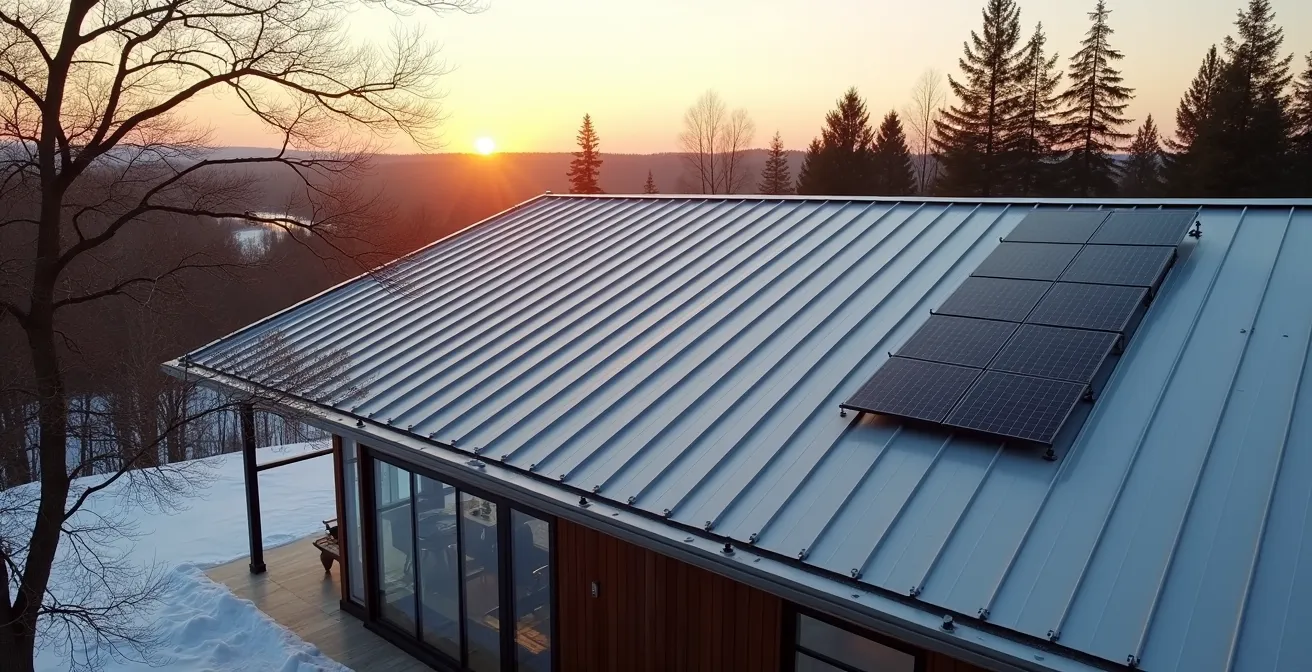
The high price of a standing-seam metal roof isn’t for the metal itself; it’s for an engineered system that guarantees a 50-year lifespan in Canada’s harsh climate.
- Hidden fasteners and proper underlayment prevent leaks caused by ice damming and thermal expansion.
- Superior steel gauge and installation techniques prevent cosmetic “oil canning” and support heavy snow loads.
Recommendation: When getting a quote, focus not on the total price, but on the specific components and installation standards your roofer guarantees for our climate.
As a homeowner in Canada, you’ve likely faced the roofing dilemma: do you choose the familiar, budget-friendly asphalt shingle, knowing you’ll be doing this again in 15 or 20 years? Or do you make the significant upfront investment in a standing-seam metal roof, a “forever roof”? The sticker shock is real. It’s easy to see the initial cost and assume it’s an extravagance. Many articles will give you a generic list of pros and cons, mentioning durability and energy efficiency, and while they’re not wrong, they miss the entire point.
They don’t tell you the most important truth, the one we artisans of the trade stake our reputations on. The question isn’t just about what material lasts longer. The real question is *why* it lasts longer, especially here in Canada where roofs are assaulted by heavy snow, brutal freeze-thaw cycles, and relentless ice damming. People often ask if metal roofs are noisy in the rain (with modern installation and insulation, they aren’t any louder than shingles) or if they attract lightning (they don’t). But these are distractions from the core of the matter.
The secret isn’t just in the metal; it’s in the meticulously engineered system that works together. The higher cost isn’t a markup; it’s the price of specific, intelligent design choices that actively prevent the exact failures that plague lesser roofs over time. This isn’t about buying a product; it’s about investing in peace of mind, structural integrity, and true, worry-free longevity. In this guide, we’ll pull back the curtain and show you, detail by detail, where that extra money goes and why it’s the smartest investment you can make for your home.
This article will guide you through the critical details that define a true lifetime roofing system in Canada. From the hidden components that prevent leaks to the calculations that keep your home safe during the worst winter storms, you will understand what makes a metal roof a superior long-term investment.
Summary: Understanding the True Value of a Standing Seam Metal Roof in Canada
- Exposed vs Hidden fasteners: why spending extra prevents leaks 15 years later?
- How to install metal panels to avoid the wavy “oil canning” look?
- Do you really need snow guards to protect your gutters and pedestrians?
- The myth of cell signal blocking: does a metal roof actually kill your WiFi?
- How to clamp solar panels to standing seams without penetrating the roof deck?
- Why pressure washing your roof is a mistake and how to kill moss gently?
- Why ice and water shield membrane is mandatory in roof valleys
- How to calculate if your roof can handle the “1-in-50-year” snowstorm weight?
Exposed vs Hidden fasteners: why spending extra prevents leaks 15 years later?
Here is the first and most critical difference between a cheap metal roof and a true lifetime system. An exposed fastener roof uses screws drilled directly through the face of the metal panel into the roof deck. It’s fast, it’s easy, and it’s a ticking time bomb. Each screw is a potential leak point, relying on a small rubber washer for protection. Over 10 to 15 years of Canadian weather, those washers dry out, crack, and fail. This is the “downside” of cutting corners.
A standing seam system, by contrast, is a masterclass in engineering. The panels are locked together, and the entire system is secured to the roof with hidden clips. There are no penetrations in the flat part of the panel. The clips are designed to allow for thermal movement—the natural expansion and contraction of the metal through our hot summers and frigid winters. An exposed-fastener roof resists this movement, causing stress around the screws that enlarges the holes over time. A standing seam roof “breathes,” which is the secret to its 50-year integrity.
The cost difference is significant. According to 2024 Ontario metal roofing prices, a concealed fastener system can cost between $14.00 and $16.00 per square foot, almost double the $7.00 to $8.00 for exposed fastener systems. You’re not just paying for a cleaner look; you’re paying to eliminate thousands of future failure points. It’s the difference between a temporary covering and a permanent water-shedding system.
Your Installer Quality-Check Plan: The Fastener System
- Vulnerability Points: Ask the installer to show you exactly how the panels are fastened and how thermal expansion is managed. Confirm there are no face screws.
- Evidence Collection: Request the specific warranty documentation. Does it explicitly cover leaks from fastener failure? Ask to see local examples of their 15+ year old installations.
- Standards Consistency: Verify the panels are a minimum of 24-gauge steel and meet Canadian G90 galvanization standards for corrosion resistance.
- Long-Term Performance: Inquire about the clip system. It should be stainless steel to resist corrosion and rated for our freeze-thaw cycles, allowing for 2-3 inches of panel movement.
- Action Plan: Make the use of a hidden-fastener, floating-clip system a non-negotiable clause in your installation contract.
This initial investment in a superior fastening system is the single most important decision you can make to guarantee a leak-free roof for decades to come.
How to install metal panels to avoid the wavy “oil canning” look?
You’ve seen it before: a large, flat metal roof that looks wavy or distorted under certain light. This visual imperfection is called “oil canning,” and while it doesn’t typically affect the roof’s performance, it speaks volumes about the quality of the material and the craftsmanship of the installation. For a homeowner investing in a premium “forever roof,” it’s simply unacceptable. It’s a sign that shortcuts were taken.
Oil canning is caused by stress in the metal. This can happen for several reasons: using steel that is too thin (higher gauge numbers mean thinner metal), over-tightening fasteners, mishandling the panels during installation, or failing to ensure the roof deck below is perfectly flat. It’s a classic case of where an artisan’s attention to detail separates a good roof from a great one. We take pride in a finished roof that is as flat and crisp as the day the steel was formed.
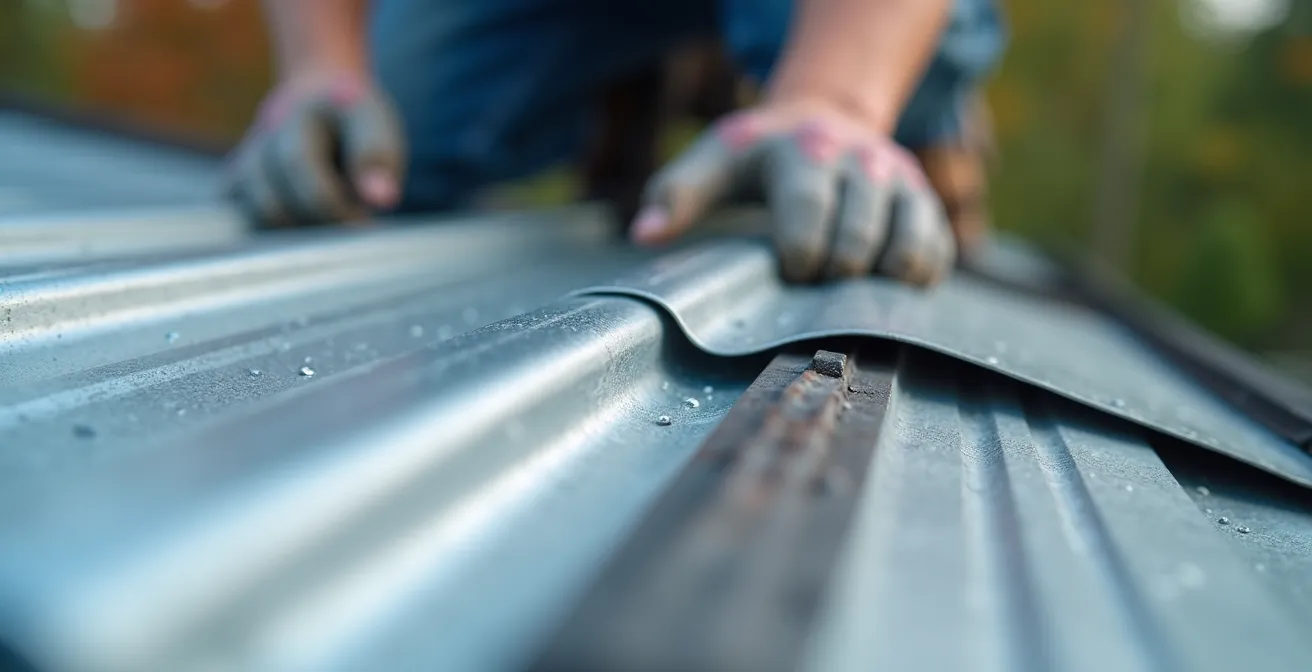
Preventing this requires a systematic approach. As the image above illustrates, precision is everything. The solution begins with the material itself. The Alberta Roofing Contractors Association (ARCA) standards, for instance, are clear on this: they mandate a minimum 24-gauge steel with a minimum yield strength of 33,000 PSI for standing seam systems. This ensures the panel has enough inherent rigidity to resist buckling. Furthermore, some high-end panels have subtle stiffening ribs or striations in the flat part of the panel, specifically engineered to minimize this effect.
When discussing your project with an installer, ask them directly what specific steps they take to prevent oil canning. Their answer will tell you everything you need to know about their commitment to quality.
Do you really need snow guards to protect your gutters and pedestrians?
On an asphalt shingle roof, snow tends to melt slowly or fall off in small amounts. A metal roof is a different beast entirely. Its smooth, low-friction surface is designed to shed water and debris efficiently. This also means it sheds snow—often in large, sudden, and dangerous avalanches. This can rip gutters clean off the house, damage landscaping, and pose a serious risk to anyone walking below.
This is where snow guards come in. They are not just a decorative accessory; in many parts of Canada, they are a critical safety component of the roofing system. Snow guards are small but strong brackets installed in rows across the roof. Their job is not to hold all the snow back indefinitely, but to break up the snowpack and allow it to melt or slide off in a controlled, manageable way. They act like a series of small dams, preventing the catastrophic release of the entire snow load at once.
The need for snow guards depends on your roof’s slope, your local climate, and what’s underneath your eaves. In some jurisdictions, it’s not just a recommendation—it’s the law. For example, as specified in the Ontario Building Code, snow guards are mandatory for roofs with slopes of 10:12 or higher that are situated over public walkways. This is a non-negotiable safety requirement to protect pedestrians. For any home in a region with significant snowfall, they are a wise investment to protect both your property and your family.
Think of them as insurance. You hope you never need them to prevent a disaster, but you’ll be profoundly glad they’re there when a heavy, wet snowfall hits.
The myth of cell signal blocking: does a metal roof actually kill your WiFi?
It’s one of the most persistent myths about metal roofing: the idea that you’ll be living in a “Faraday cage,” cut off from the outside world with no cell service or WiFi. This concern is understandable, as metal does block radio waves. However, in the real world, the impact is far less dramatic than most people fear and is easily managed.
First, let’s address WiFi. Your WiFi router is inside your house, broadcasting its signal within your walls. The metal roof is outside and above this system. It has absolutely no effect on your WiFi signal inside the home. Your ability to stream movies or work from home will be completely unchanged. The myth confuses internal and external signals.
Cell phone reception is a more nuanced issue. A metal roof can, to some extent, weaken cellular signals coming from outside towers. In urban and suburban areas of Canada where cell signals from providers like Bell, Rogers, or Telus are strong and plentiful, most homeowners notice little to no difference in their reception. The signal is powerful enough to penetrate windows and walls, making any reduction from the roof negligible. The problem can arise in rural areas where the signal is already weak. In these cases, a metal roof can be the straw that breaks the camel’s back, leading to more dropped calls.
Fortunately, there is a simple, 100% effective solution: a cell signal booster. These devices, which cost a few hundred dollars, use a small external antenna to capture the outside signal, amplify it, and rebroadcast it inside your home. They completely solve any reception issues, including for 5G home internet hubs, ensuring your “forever roof” doesn’t compromise your modern connectivity.
How to clamp solar panels to standing seams without penetrating the roof deck?
One of the greatest advantages of a standing seam metal roof is its future-readiness, particularly for solar energy. Homeowners across Canada are looking to install solar panels to reduce electricity costs and take advantage of provincial incentives. With a traditional asphalt roof, this involves drilling dozens of holes through the shingles and roof deck to mount the solar racking, creating numerous potential leak points on a roof that may only have 10-15 years of life left anyway.
This is where the standing seam system truly shines. The raised “seams” of the roof are essentially built-in rails. Specialized, non-penetrating clamps are designed to grip these seams tightly, providing an incredibly strong mounting point for solar panels without a single new hole being made in the roof. This is a revolutionary advantage. You are preserving the 50-year watertight warranty of your roof while adding a 25-year power generation system on top of it. As experts at Professional Metal Roofing Canada note, this synergy is key:
Non-penetrating clamps are the key to combining a 50-year roof with a 25-year solar panel system, allowing homeowners to access provincial incentives without voiding their roof warranty.
– Professional Metal Roofing Canada, The Role of Snow Guards on Metal Roofing in Canada
However, the roof must be “solar-ready” from the start. This means using a minimum 24-gauge steel that can handle the extra weight (the “load”) of the panels and snow. The seams should be installed at a consistent spacing (often 16 inches) to match standard solar racking. It’s crucial to ensure your installer confirms that using their recommended clamp system will not void the roof’s warranty. It’s a conversation that must happen before the first metal panel is laid.
By choosing a roof system that’s designed for this integration, you’re not just buying a roof; you’re investing in a platform for your home’s future energy independence.
Why pressure washing your roof is a mistake and how to kill moss gently?
A metal roof is famously low-maintenance, but “low-maintenance” doesn’t mean “no-maintenance.” Over time, especially in damp Canadian climates like coastal British Columbia, you might see moss or algae begin to form. The temptation for many homeowners is to pull out a pressure washer and blast it clean. This is a profound mistake that can permanently damage your investment.
Modern metal roofs are protected by high-performance finishes, not just simple paint. In Canada, quality installers use premium finishes like Sherwin Williams Fluropan, which contain a PVDF resin (often known by the trade name Kynar 500). This sophisticated coating is what provides the exceptional resistance to fading and chalking, keeping your roof looking new for decades. However, the immense force of a pressure washer can strip away the microscopic protective layers of this finish, dulling the surface and, most critically, voiding the manufacturer’s warranty. You could be trading a minor cosmetic issue for a catastrophic failure of the roof’s primary defence against the elements.
The proper way to clean a metal roof is with gentle rinsing from a garden hose and, for stubborn biological growth, a soft-bristle brush with a mild, diluted cleaning solution (like a quarter cup of car wash soap in a gallon of water). For long-term moss prevention, there is an even better, passive solution. A Vancouver homeowner shared their success with this method:
After installing zinc strips at the ridge line three years ago, we’ve seen dramatic reduction in moss growth on our metal roof. The natural biocide effect works perfectly in BC’s damp climate without any harsh chemicals entering our watersheds.
– West Coast Metal Roof Moss Prevention Success, Construction Canada
As rain washes over the zinc strips, it carries metallic ions down the roof surface, creating an environment where moss and algae cannot grow. It’s a simple, elegant, and environmentally friendly solution that protects your roof’s finish and your warranty.
Remember, the goal is to work with the roof’s engineered systems, not against them. Gentle cleaning and proactive prevention are the cornerstones of true 50-year longevity.
Why ice and water shield membrane is mandatory in roof valleys
What you see on a finished roof is only half the story. The components hidden underneath are just as critical to its long-term performance, especially in a Canadian winter. Chief among these is the ice and water shield. This is a self-adhering, rubberized asphalt membrane that is applied directly to the roof deck in the most vulnerable areas before the metal panels are installed.
Its primary job is to provide a final, waterproof line of defence against ice damming. Ice dams form when heat escaping from the attic melts snow on the upper part of the roof. This water runs down to the colder eaves, where it refreezes, creating a “dam” of ice. Water gets trapped behind this dam, and with nowhere to go, it can be forced up and under the roofing material, leading to serious leaks, rot, and mould inside your attic and walls. A standard felt underlayment is water-resistant, but it is not waterproof against this kind of standing water.
In Canada, applying this membrane isn’t just a good idea; it’s a building code requirement. According to Section 9.26 of the National Building Code of Canada, this type of self-adhering eave protection is mandatory in all areas where the January design temperature is -18°C or colder—which covers the vast majority of the country. The membrane must be applied at the eaves, in all valleys, and around any roof penetrations like chimneys or skylights. The Alberta Roofing Contractors Association (ARCA) even mandates this continuous membrane under all architectural metal roofing, with specific requirements for high-temperature rated versions that can withstand the heat absorbed by metal panels in the summer.
When an installer gives you a quote, it must include a high-temperature ice and water shield. Skipping this step is not just cutting a corner; it’s a direct violation of building standards and a recipe for disastrous water damage.
Key Takeaways
- A standing-seam roof’s value lies in its engineered system, not just the metal.
- Hidden fasteners that allow for thermal expansion are non-negotiable for preventing long-term leaks.
- Proper material selection (min. 24-gauge steel) and installation technique are crucial to avoid cosmetic flaws and ensure structural integrity.
- Components like snow guards and ice & water shield are mandatory safety and performance features for the Canadian climate.
How to calculate if your roof can handle the “1-in-50-year” snowstorm weight?
We’ve talked about shedding snow and preventing ice dams, but the most fundamental question is this: can your roof’s structure handle the immense weight of the snow before it even has a chance to slide? In Canada, this isn’t a trivial question. The National Building Code of Canada (NBCC) provides detailed climatic data, specifying the “ground snow load” for every municipality. This is the weight of snow that your roof, from the trusses to the panels, must be engineered to support. This isn’t just an average snowfall; it’s based on a “1-in-50-year” maximum snow event.
This is where the term “engineered system” comes full circle. A responsible roofer doesn’t just install panels; they ensure the entire roofing assembly is appropriate for your specific location’s structural load requirements. The weight of snow can be staggering. As the table below shows, the design requirements vary dramatically across the country, from a relatively light 25 lbs/sqft in Vancouver to a crushing 86 lbs/sqft in St. John’s.
This data, based on analysis from sources like Construction Canada, dictates everything from the spacing of your roof trusses to the gauge of the steel panels and the type of clips used to secure them. A roof designed for Calgary’s snow load would be dangerously under-engineered for Montreal’s.
| City | Ground Snow Load (kPa) | Equivalent Weight (lbs/sqft) | Design Consideration |
|---|---|---|---|
| Vancouver | 1.2 | 25 | Light snow, rain more common |
| Calgary | 1.5 | 31 | Chinook effects considered |
| Toronto | 1.8 | 38 | Wet snow events critical |
| Montreal | 2.4 | 50 | Heavy accumulation zones |
| St. John’s | 4.1 | 86 | Extreme coastal loads |
This is the final proof that you are not just buying a roof covering, but a complete structural system designed for safety and longevity in your corner of Canada. When you speak to an installer, your final question should be: “Can you show me, in the contract, that the entire roofing system meets the specified ground snow load for our municipality according to the NBCC?” That is the question that guarantees a true “forever roof.”
Frequently Asked Questions about Standing Seam Metal Roofs
Does a metal roof block WiFi signals inside the house?
No, WiFi signals originate from inside your home and are unaffected by the metal roof above. The router broadcasts signals within the house normally.
Will I lose cell phone reception with a metal roof?
In urban areas with strong signals, the impact is minimal. Rural areas with weak signals may experience degradation, but cell signal boosters effectively solve this issue.
What about 5G home internet hubs from Bell or Rogers?
These cellular-based internet services may require a signal booster installation, which costs $300-800 and completely resolves any interference.