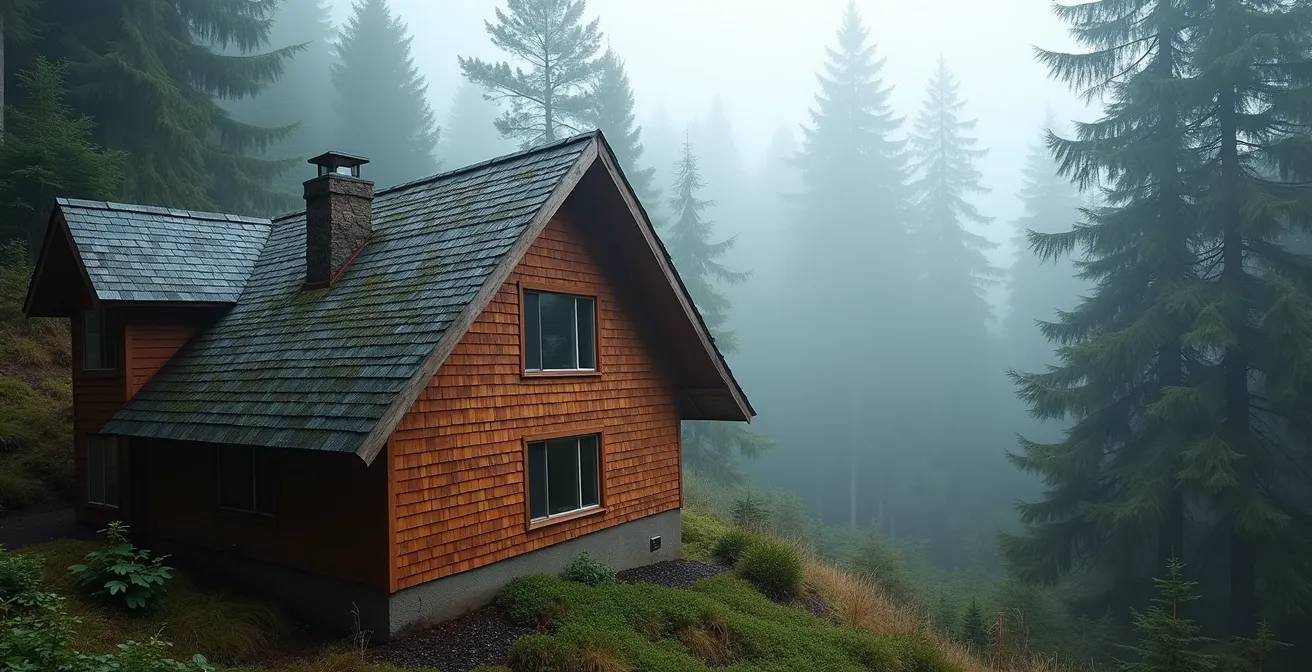
Your maintenance instincts from a drier climate are likely causing long-term damage to your new BC home.
- Aggressive cleaning like pressure washing strips protective layers, inviting moisture and rot.
- The constant dampness creates unique challenges—from roof-destroying moss to hidden structural decay—that require gentle, preventative strategies.
Recommendation: Stop fighting the water with brute force. Learn to manage its flow with a preventative mindset to protect your investment for decades.
Welcome to the Pacific Northwest. If you’ve recently moved from a drier province like Alberta or Saskatchewan, you’ve probably already noticed the rain is different here. It’s not just a seasonal event; it’s a constant presence that defines the environment and, crucially, dictates how you must care for your home. Many newcomers arrive armed with a lifetime of home maintenance habits: pressure wash the deck, scrub the roof, and seal every crack you can find. These are the standard plays, the things that worked perfectly back where the sun was more friend than foe.
But here on the “Wet Coast,” these brute-force tactics can be disastrous. The relentless moisture isn’t an enemy to be blasted away, but a force of nature to be understood and managed. Applying the wrong methods doesn’t just fail to solve the problem; it actively accelerates decay, voids warranties, and sets you up for five-figure repair bills down the line. The truth is, a temperate rainforest has its own set of rules, and your home’s survival depends on learning them.
This guide is about a fundamental mindset shift. It’s not a simple checklist; it’s a new strategy for coexisting with moisture. We’ll deconstruct common mistakes, reveal the subtle warning signs of major problems, and introduce the core principles of a maintenance philosophy designed specifically for the challenges and opportunities of the British Columbia coast. From your roof to your garden, you’ll learn to work with the climate, not against it.
This article provides a comprehensive overview of the essential maintenance adjustments required for BC’s unique climate. Explore the sections below to understand each critical aspect of protecting your coastal home.
Summary: A New Maintenance Mindset for the Wet Coast
- Why pressure washing your roof is a mistake and how to kill moss gently?
- How to earthquake-proof your home’s contents for the “Big One”?
- Living on the Gulf Islands: reality vs fantasy of ferry-dependent commuting
- The “soft spot” on the deck that signals a $10k structural rot problem
- How to grow vegetables year-round in Zone 8b without a heated greenhouse?
- Exposed vs Hidden fasteners: why spending extra prevents leaks 15 years later?
- Why walking on wet rocks can be fatal on the Pacific coast
- Why standing-seam metal roofing costs 3x more than asphalt but saves money over 50 years?
Why pressure washing your roof is a mistake and how to kill moss gently?
For newcomers from drier climates, seeing a vibrant green layer of moss on a roof can trigger an immediate impulse: blast it off. This is, without a doubt, the most common and costly mistake a BC homeowner can make. Your asphalt shingles are covered in tiny ceramic granules that protect the underlying material from UV radiation and weather. A high-pressure washer acts like a sandblaster, stripping these essential granules away and drastically shortening your roof’s lifespan. In fact, professional cleaners report that homeowners who neglect moss or treat it improperly can see a 40% reduction in their roof’s life.
The correct approach is a form of gentle de-fouling. Moss acts like a sponge, holding moisture against your shingles and promoting rot and granule loss. The goal is not to violently tear it off, but to kill it at the root and let the rain wash it away over time. This preserves the integrity of your shingles. While DIY is an option, professional services are often a wise investment, especially for steep or high roofs. For a typical home, professional removal costs range from $500 to $2,500, a fraction of the cost of premature roof replacement.
The frequency of this maintenance depends heavily on your home’s specific environment, particularly its proximity to trees which shed debris and provide shade.
| Environmental Factor | Maintenance Frequency | Key Indicators |
|---|---|---|
| Heavy tree coverage | Every 1-2 years | Visible moss growth, debris accumulation |
| Moderate exposure | Every 2-3 years | Some algae streaking, minor moss patches |
| Open exposure | Every 4-6 years | Minimal organic growth, sun exposure |
Action Plan: Gentle Moss Removal
- Safety First: Only inspect and work on the roof when it’s completely dry. Always use appropriate safety gear, including a harness and non-slip footwear.
- Choose Your Treatment: Apply a commercially available, eco-friendly moss treatment or a simple solution of water and borax according to package directions.
- Let It Work: Allow the solution to sit for the recommended time (typically 15-30 minutes) to effectively kill the moss and break down its root structure.
- Gentle Agitation: Use a soft-bristle brush to gently scrub any thick, dead patches. Avoid stiff brushes or aggressive scraping that can damage shingles.
- Low-Pressure Rinse: Thoroughly rinse the roof with a garden hose or a very low-pressure washer, always aiming the water in a downward motion to avoid forcing it up under the shingles.
How to earthquake-proof your home’s contents for the “Big One”?
Life on the West Coast means living with the low-grade, ever-present awareness of seismic risk. While building codes address the structural integrity of your home, what happens to everything *inside* it during a significant earthquake is your responsibility. The “Big One” is a matter of when, not if, and securing your home’s contents can prevent serious injury and thousands of dollars in damage. The first priorities are the “three Ts”: the tall, the top-heavy, and the tanked.
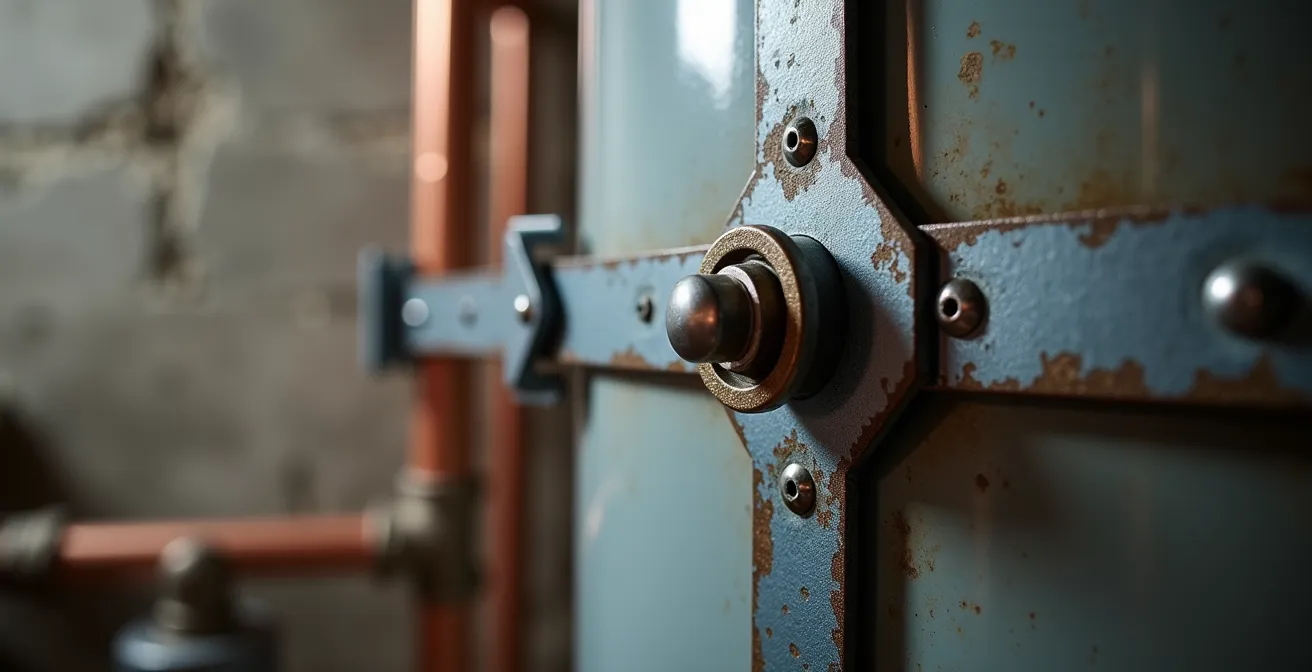
Tall furniture like bookcases, display cabinets, and wardrobes should be securely anchored to wall studs. Use flexible nylon straps or metal brackets to allow for some movement without toppling. Top-heavy items are particularly dangerous. Think of flat-screen TVs, which should be tethered to their stands or the wall. Place heavy objects on lower shelves to reduce the risk of them becoming projectiles. Finally, the tanked item in every home is the hot water tank. A full tank can weigh over 400 pounds and, if it falls, can sever gas and water lines, creating a fire and flooding hazard. It is essential that your tank is properly secured with seismic straps.
This simple, visual step is one of the most critical actions you can take to prepare your utility room for a seismic event.
Beyond these basics, consider adding latches to kitchen cabinets, especially those holding glassware. Use museum wax or putty to secure valuable ornaments and pictures on shelves. It’s not about turning your home into a fortress, but about taking methodical, common-sense steps to mitigate the most obvious risks. Having a well-stocked earthquake kit with water, food, and first-aid supplies is the other half of this critical preparation.
Living on the Gulf Islands: reality vs fantasy of ferry-dependent commuting
The dream of island life is a powerful one for many moving to BC: serene forests, ocean views, and a tight-knit community feel. The Southern Gulf Islands—like Galiano, Mayne, and Pender—offer this in spades. However, the fantasy of a peaceful escape often collides with the logistical reality of a life dictated by the BC Ferries schedule. Before you buy that charming cabin with a water view, you must internalize what it means to be a ferry-dependent commuter.
Your life will revolve around sailing times. A missed ferry isn’t an inconvenience; it can mean waiting several hours for the next one, potentially disrupting work, appointments, or childcare arrangements. “Sailing waits” during peak summer months or holidays can add hours to your travel day. Furthermore, ferry services can be cancelled due to severe weather, mechanical issues, or crew shortages, effectively isolating you from the mainland. This can mean an unexpected night in a hotel or missing an important event.
Beyond the schedule, consider the other dependencies. Power outages are more frequent and can last longer than in urban centres. Access to specialized medical care, a wide variety of shops, or even a specific grocery item requires a ferry trip. While the islands have wonderful local services, you trade convenience for tranquility. The lifestyle is immensely rewarding for those who embrace this reality, but it can be a source of constant frustration for those who expect mainland-level accessibility. It requires a mindset of planning, patience, and self-sufficiency.
The “soft spot” on the deck that signals a $10k structural rot problem
On the Wet Coast, your deck is not just an outdoor living space; it’s a complex structure constantly under siege from moisture. One of the most insidious and dangerous warning signs of a failing deck is the “soft spot.” It often feels like a slight sponginess or give underfoot, a subtle change you might dismiss as a quirk of the wood. This is a critical error. That soft spot is rarely a problem with a single deck board; it is the final, visible symptom of a deep and advanced structural rot problem in the hidden framework below.
This happens when water finds a way past the deck boards and saturates the underlying joists and beams. Because this area has poor air circulation, it stays wet, creating a perfect environment for wood-destroying fungi. The rot silently eats away at the structural members until they lose their integrity. The “soft spot” is you literally feeling the flex of a rotted joist that can no longer support its load. By the time you feel it, the damage is already extensive. Ignoring it can lead to catastrophic deck collapse.
Discovering this requires preventative forensics. When you are cleaning your deck, pay attention with your feet. Test areas where water tends to pool, near posts, or against the house. If you find a spot that feels different, probe the underside of the deck in that area with a screwdriver. If the wood is soft and fibrous, you have a serious problem. Repairing a single joist is manageable, but if the rot has spread to the ledger board (where the deck attaches to the house) or multiple joists, you are often looking at a complete rebuild—a project that can easily exceed $10,000 or more. That small, soft spot is your home’s final warning.
How to grow vegetables year-round in Zone 8b without a heated greenhouse?
For those arriving from provinces with harsh winters, the idea of gardening in December seems impossible. Yet, much of BC’s coast is in Plant Hardiness Zone 8b, a temperate climate where the ground rarely freezes solid. This opens up the incredible possibility of a four-season harvest without the expense of a heated greenhouse. The secret isn’t fighting the cold, but rather embracing the cool, wet winters and protecting plants from excessive rain and the occasional frost.
The cornerstone of winter gardening here is the raised bed combined with a cold frame. Raised beds, made from cedar or rock, provide excellent drainage—essential in our rainy climate to prevent roots from rotting. A cold frame is simply a transparent lid (often polycarbonate or old windows) that fits over the raised bed. It acts as a miniature, unheated greenhouse, protecting plants from being battered by rain, shielding them from light frosts, and raising the soil temperature by a few crucial degrees on sunny winter days. This simple setup is all you need to create a thriving winter vegetable patch.
The right tools and techniques allow for a productive garden even during the misty coastal winter months.

Success also depends on crop selection. You can’t grow tomatoes in January, but a huge range of vegetables thrive in cool weather. Start planting your winter crops in late summer (August and September). Focus on hardy greens like kale, Swiss chard, and collards, which actually taste sweeter after a light frost. Root vegetables like carrots, leeks, and parsnips can be left in the ground and harvested as needed. With the addition of cloches (small, bell-shaped covers for individual plants) and a thick layer of mulch like straw or leaves, you can enjoy fresh, homegrown food all year long.
Exposed vs Hidden fasteners: why spending extra prevents leaks 15 years later?
In a region that receives approximately 1,500mm of annual rain like BC’s Lower Mainland, every single penetration point on your home’s exterior is a potential point of failure. This is nowhere more true than with fasteners used on roofing and siding. A common cost-saving measure is to use an exposed fastener system, where screws or nails are driven directly through the exterior material, with a small rubber gasket on the screw head providing the seal. While effective in the short term, this is a ticking time bomb in a wet climate.
Think of the math: a typical roof or wall could have thousands of these exposed fasteners. Each one is a tiny point of failure waiting to happen. The rubber gaskets are under constant assault from UV radiation, which makes them brittle, and the expansion and contraction of the materials from temperature changes. Over 10-15 years, these gaskets inevitably fail. Water begins to seep past the screw, into the sheathing, and eventually into your home’s structure. The leak is often invisible for years, slowly causing rot until it manifests as a major interior problem.
This is where the principle of moisture jiu-jitsu comes into play. A hidden fastener system (or clip system) is designed to work *with* the elements. Panels are attached to the structure using clips, and the panels themselves are designed to interlock over top of the clips and fasteners. The result is a continuous, unbroken exterior skin with no exposed penetration points. While the upfront material cost is higher, you are eliminating thousands of potential failure points. You are investing in a system that acknowledges the reality of constant moisture and is designed to manage it flawlessly for decades, rather than relying on a tiny piece of rubber to hold back the rainforest.
Why walking on wet rocks can be fatal on the Pacific coast
The rugged, rocky shorelines of the Pacific coast are breathtakingly beautiful, but they hold a hidden danger that newcomers often underestimate. The risk isn’t just that the rocks are wet; it’s what grows on them. The intertidal zone—the area between the high and low tide marks—is covered in a thin, black, biofilm of algae that, when wet, becomes as slippery as black ice. A simple misstep while exploring tide pools or rock hopping can result in a serious fall, leading to broken bones or head injuries far from easy help.
This is a fundamental rule of coastal safety: never trust your footing on a dark, wet rock. Assume every surface below the high-tide line is treacherous. Always wear footwear with excellent grip, like hiking boots or dedicated water shoes, not smooth-soled sneakers or sandals. Move slowly, test your footing before committing your full weight, and try to stay on barnacle-covered rocks, which offer more texture and grip than the smooth, algae-covered ones.
The other major, and often fatal, hazard is an ignorance of the ocean’s power. The Pacific is not a lake. “Sneaker waves” are a real phenomenon where a wave much larger than the preceding ones can surge up the shore without warning, sweeping unsuspecting people off the rocks. Compounding this, people often venture out onto rock shelves at low tide, lose track of time, and find their exit path cut off by the incoming tide. Before you ever set foot on a rocky beach, check the tide charts for your specific location and always be aware of the ocean’s state. Keep an eye on the water, never turn your back on the waves, and ensure you have a clear and safe exit path as the tide comes in.
Key Takeaways
- Gentle Management Over Brute Force: The most effective maintenance on the Wet Coast uses gentle, preventative methods that work with the climate, not against it.
- Your Home is a System: Think of your house’s exterior as a complete “building envelope” designed to manage moisture. A failure in one part (like a fastener) will affect the whole system.
- Long-Term Investment Pays Off: Choosing more durable, weather-appropriate materials and systems (like metal roofing or hidden fasteners) costs more upfront but prevents catastrophic, expensive failures later.
Why standing-seam metal roofing costs 3x more than asphalt but saves money over 50 years?
For homeowners planning to stay in their BC home for the long haul, one of the most significant strategic decisions is roofing. While asphalt shingles are the default choice due to their low upfront cost, a standing-seam metal roof represents a profoundly different philosophy of homeownership—one that aligns perfectly with the demands of the Wet Coast. While the initial investment can be three times that of a standard asphalt roof, the long-term economics are overwhelmingly in its favour.
An asphalt roof in our climate might last 15-20 years before it requires replacement. A properly installed standing-seam metal roof has a lifespan of 50 years or more. Over a 50-year period, you would likely replace an asphalt roof two or even three times, with each replacement incurring costs for materials, labour, and disposal. The single installation of a metal roof avoids all that future expense and disruption. Furthermore, metal roofs are impervious to the moss and algae that plague and destroy asphalt shingles. This drastically reduces maintenance burdens and costs.
This ties directly into the financial security of your investment. As a leading roofing expert points out, neglecting maintenance on a standard roof has direct warranty implications:
Long-term moss infiltration on your roof can destroy the integrity of your shingles and take years off your roof’s life. It will also invalidate your shingle warranty as moss removal is a maintenance item.
– Absolute Roof Solutions, How to Effectively Handle Moss on Your Roof
Choosing a metal roof is an upfront commitment to a low-maintenance, worry-free building envelope. It sheds rain and debris flawlessly, it won’t rot or be eaten by insects, and it often increases a home’s resale value. It is the ultimate expression of working with the environment, choosing a material that is unfazed by the constant moisture and will protect your home for a lifetime.
By adopting this preventative, strategic, and climate-aware mindset, you can move beyond the cycle of reactive repairs and truly protect the value and integrity of your new British Columbia home. The next logical step is to conduct a thorough audit of your own property, looking for these specific issues and opportunities for improvement.